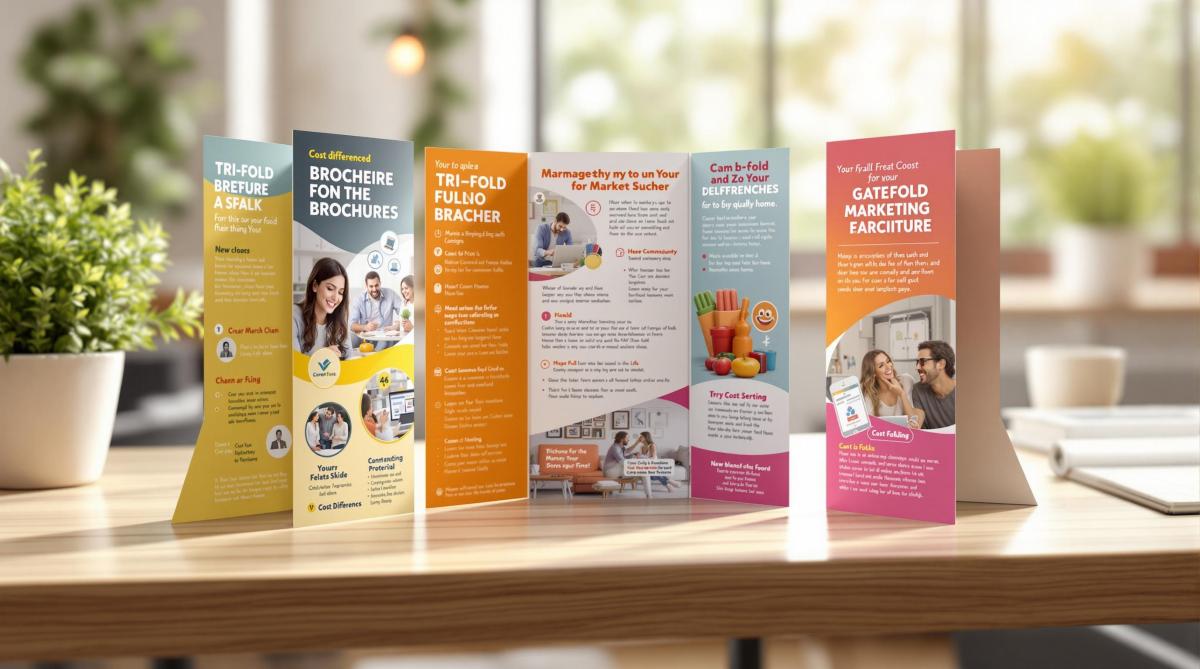
Choosing the right folded print format depends on your budget and marketing needs. Here’s a quick cost comparison for the three most common formats:
- Tri-Fold: Budget-friendly, costs start at $115 per 1,000 units. Ideal for general marketing.
- Z-Fold: Slightly pricier, starting at $125 per 1,000 units. Great for step-by-step guides.
- Gatefold: Premium option, starting at $140 per 1,000 units. Perfect for bold visuals.
Quick Comparison Table
| Format | Base Cost (per 1,000) | Complexity | Best Use |
|---|---|---|---|
| Tri-Fold | $115 | Low | General marketing |
| Z-Fold | $125 | Medium | Sequential storytelling |
| Gatefold | $140 | High | High-impact visuals |
Bulk orders and premium finishes like UV coating or foil stamping can increase costs. Tri-folds are the most cost-effective, while gatefolds offer the best visual impact. Choose based on your goals and budget.
Brochure Printing Examples: Trifold, Bifold, and Z-Fold Formats
1. Tri-Fold Costs
Tri-fold brochures are one of the more budget-friendly options for folded print materials. Pricing depends on factors like order quantity, paper type, and production methods. The standard format uses an 8.5" x 11" sheet folded into three equal sections, making it a popular choice for general marketing.
As highlighted earlier, tri-fold brochures are the most economical starting point for folded marketing materials.
Ordering in bulk helps lower the cost per unit:
| Quantity | Cost Range |
|---|---|
| 500 | $50–$200 |
| 1,000 | $80–$300 |
| 5,000 | $300–$1,000 |
Your choice of paper stock also plays a big role in pricing. A 70 lb. uncoated paper keeps costs low, while specialty stocks can add 10-30% to the price.
If you’re looking for premium touches, additional finishing options can increase costs:
- Spot UV coating
- Foil stamping
- Die-cutting
- Full-bleed printing
Turnaround time is another factor to consider. Standard production takes 5-7 business days, but expedited options come with added charges:
- Express (3-4 days): 15-25% extra
- Rush (1-2 days): 30-50% extra
- Same-day: 75-100% extra (if available) [1][3]
2. Z-Fold Costs
Z-fold brochures generally cost 8-15% more than tri-folds. This is because the folding process is more intricate and requires specialized equipment, with labor contributing an additional 20-30% to the overall expense [7]. Despite the higher price, Z-folds are ideal for presenting content in a clear, sequential layout.
Here’s how pricing typically breaks down based on volume:
| Quantity | Total Cost | Cost/Piece |
|---|---|---|
| 100 | $150 – $250 | $1.50 – $2.50 |
| 500 | $400 – $600 | $0.80 – $1.20 |
| 1,000 | $500 – $800 | $0.50 – $0.80 |
| 5,000 | $1,500 – $2,500 | $0.30 – $0.50 |
| 10,000 | $2,000 – $3,500 | $0.20 – $0.35 |
The cost per piece drops significantly as quantities increase, a trend similar to other folded brochure formats.
Material costs can also vary, typically accounting for 10-30% of the total, depending on the type of paper used [1][2]. Additionally, the printing method impacts the final price:
- Digital printing is better suited for smaller orders under 500 units, costing around $1.00-$2.00 per piece.
- Offset printing becomes more affordable for larger quantities (over 1,000 units), with costs ranging between $0.30-$0.60 per piece [2].
If you’re looking to add premium finishes, here are some options and their approximate costs:
- Full-color printing [7]
- UV coating: $0.10-$0.20 per piece [3]
- Spot UV: $0.15-$0.30 per piece [3]
- Foil stamping: $0.50-$1.00 per piece [6]
These finishing touches can elevate the look and feel of your Z-fold brochures, making them stand out even more.
3. Gatefold Costs
Gatefold brochures, known for their dual-panel folding that demands precise alignment, are among the most expensive folded print options. These typically cost 20-30% more than standard tri-fold brochures [2]. While the price is higher, gatefolds are a go-to choice for creating a striking visual impression, making them ideal for high-impact marketing campaigns.
Here’s a pricing breakdown for standard 11" x 17" gatefold brochures [5]:
| Quantity | Price Range | Cost/Piece |
|---|---|---|
| 500 | $414 – $513 | $0.83 – $1.03 |
| 1,000 | $553 – $685 | $0.55 – $0.69 |
| 2,500 | $829 – $1,027 | $0.33 – $0.41 |
| 5,000 | $1,200 – $1,600 | $0.24 – $0.32 |
| 10,000 | $2,000 – $2,500 | $0.20 – $0.25 |
The higher costs reflect the additional material requirements and the precise handling needed for this style of fold.
Choices like paper weight and coating also play a role in determining the price, similar to other formats (refer to the Tri-Fold section for more details). Adding premium finishes can further increase costs by 10-50% [1][4], with options including:
- Gloss or matte coating
- Spot UV treatment
- Foil stamping
- Embossing or debossing
For projects with tight deadlines, opting for 24-hour turnaround services can double the base cost, with surcharges ranging from 50-100% [1][3].
To keep costs manageable, using standard sizes like 8.5" x 11" or 11" x 17" is a practical approach.
sbb-itb-ce53437
Format Comparison
Let’s break down how these three folded formats compare in terms of cost and practical use.
| Feature | Tri-Fold | Z-Fold | Gatefold |
|---|---|---|---|
| Base Cost (500 pieces) | $50–$200 | $400–$600 | $414 |
| Panel Layout | 6 panels total | 6 panels total | 8 panels total |
Beyond the initial cost, structural differences play a role in long-term expenses. For instance, at 1,000 units (printed on 100lb gloss paper, full-color): Tri-folds range from $300–$500, Z-folds from $350–$550, and Gatefolds from $400–$650 [6][8].
Production Complexity
Tri-folds are straightforward to produce, thanks to their standardized design. Gatefolds, on the other hand, demand extra setup time and skilled labor to ensure proper alignment. This added complexity increases labor costs and can lead to longer production times [7][3].
Space Utilization
Gatefolds stand out by providing the largest single-panel space, making them perfect for bold visuals. Z-folds, however, excel at sequential storytelling, offering a flow that tri-folds can’t match. These space advantages can lead to more efficient messaging in campaigns that aim to make a strong impact [9].
For projects that need a polished look without overspending, Z-folds often strike a balance between cost and creative flexibility. Meanwhile, Tri-folds remain the go-to option for economical and straightforward informational materials [1][3].
Additional Cost Factors
When calculating the total cost of folded print materials, it’s important to consider more than just the base printing expenses. Several elements can significantly influence the final price.
Paper Stock Selection
The type of paper you choose has a big impact. For instance, using heavier paper like 100 lb. gloss can cost 10-20% more per piece compared to the standard 80 lb. option [7][10].
Setup Costs
Different fold types come with varying setup costs due to their complexity:
- Tri-fold: $50-$200 for a standard setup
- Z-fold: $75-$250, as it requires precise alignment
- Gatefold: $100-$300 due to the intricate setup and design adjustments [1][2]
Finishing Options and Costs
Adding finishing touches can enhance the look and feel of your materials, but they come with additional costs:
| Finishing Type | Cost Addition (per piece) |
|---|---|
| Aqueous Coating | $0.02-$0.05 |
| UV Coating | $0.05-$0.10 |
| Matte Lamination | $0.10-$0.20 |
| Embossing | $0.15-$0.30 |
Bulk Discounts
Ordering in larger quantities can save you money. The per-unit cost typically drops by:
These savings apply across all folded formats, making bulk orders a cost-effective choice regardless of the design complexity.
Shipping and Handling Costs
Shipping costs can add 5-15% to your total project expenses. For example:
- Shipping 1,000 tri-folds locally costs $30-$50
- Shipping the same quantity nationally costs $75-$150 [5]
Larger orders often benefit from better shipping rates per unit, making them more economical in the long run.
Rush Production Fees
Need your materials quickly? Expedited production comes with extra charges:
- 3-5 day rush service: Adds 20-30%
- 1-2 day rush service: Increases costs by 50-100%
Design Complexity
Intricate designs, such as those requiring precise fold alignment or exact brand color matching, can raise prepress costs by 20-40%.
Conclusion
After analyzing the costs of tri-fold, z-fold, and gatefold formats, it’s clear that selecting the right brochure style depends on balancing budget and communication goals. The data highlights that tri-fold brochures are the most budget-friendly, costing about 20-30% less than other formats for print runs under 5,000 units [1].
While tri-folds hold their cost advantage for smaller print runs, gatefolds become a more practical option for large campaigns, as the price difference narrows to just 10-15% for orders over 10,000 units [1][6]. Here’s a quick comparison:
| Format Type | Ideal Use | Cost Efficiency | Typical Cost per 1,000 (100lb gloss) |
|---|---|---|---|
| Tri-fold | Marketing materials, Direct mail | Most economical | $250-$350 |
| Z-fold | Step-by-step guides, Timelines | Moderate | $300-$400 |
| Gatefold | High-end visuals, Premium projects | Higher cost | $350-$450 |
For larger print volumes, the cost gap between these formats becomes less significant. Digital printing also makes intricate folds more affordable for smaller batches, giving businesses more flexibility to choose based on their messaging needs rather than just cost.
Keep in mind that production timelines can also influence costs. Expedited printing often leads to higher expenses, so plan accordingly. Ultimately, your choice of format should align with both your budget and campaign goals. Tri-folds are perfect for cost-conscious projects, gatefolds deliver a more polished look, and z-folds work well for structured, sequential messaging.
FAQs
What is the difference between Z fold and tri fold?
The main difference between Z-fold and tri-fold brochures lies in their folding style and panel sizes. A Z-fold uses equal-sized panels that fold in an accordion style, while a tri-fold features uneven panels, with the right panel typically narrower to allow for proper overlapping during the fold[1]. This design difference influences both production costs and layout options.
| Feature | Z-Fold | Tri-Fold |
|---|---|---|
| Panels | Equal | Uneven |
| Fold Pattern | Zigzag | Standard |
| Cost Premium | +8-15% | Base |
The Z-fold design often requires a different press setup, which can slightly increase production costs. However, it’s a great choice when you need larger panels to showcase detailed content or visuals[6]. For a detailed breakdown of costs by quantity, check the Format Comparison section above.
Related Blog Posts
- Ultimate Guide to Paper Types for Business Printing
- Offset vs. Digital: Paper Size Considerations
- How to Choose Cost-Effective Printing Materials
- Cost Analysis: Traditional vs. Alternative Materials
https://app.seobotai.com/banner/banner.js?id=67b288d50d4a761ccc990085
 BergenCountyPrintersBlogs