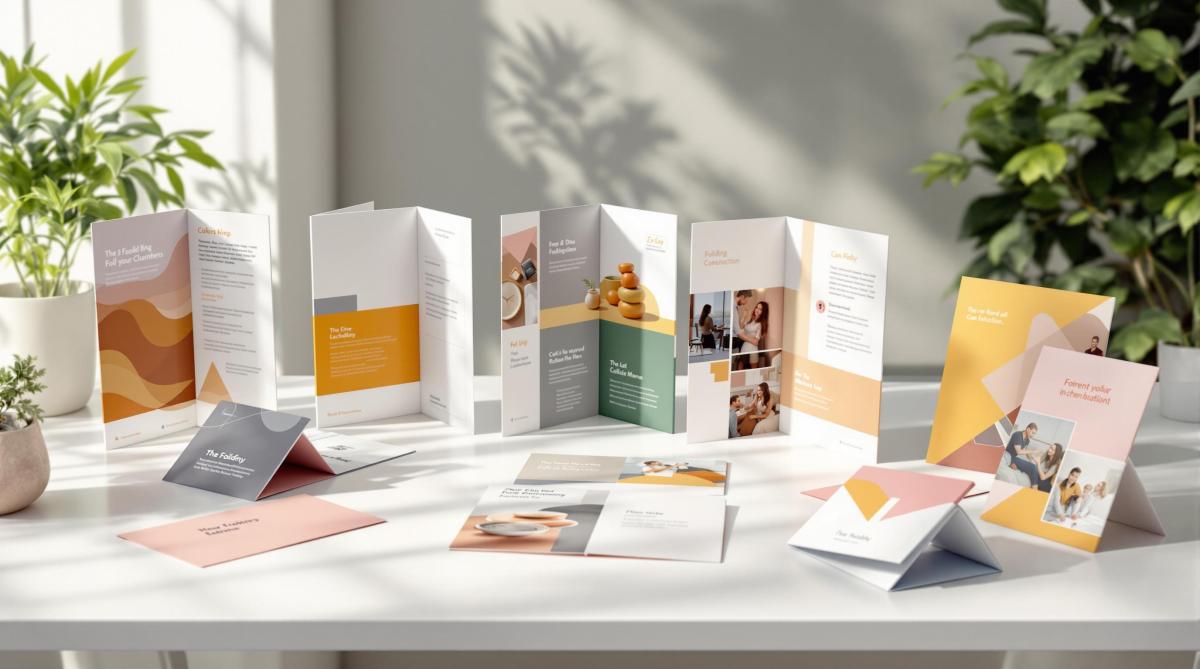
Want your print materials to stand out? Choosing the right folding style can make all the difference. Whether you’re designing brochures, menus, or newsletters, the fold determines how your content is presented and experienced. Here’s a quick overview of the 8 most common folding styles and their uses:
- Half Fold: Simple, 2-panel layout for menus or greeting cards.
- Tri-Fold: Compact, 3-panel design ideal for brochures and mailers.
- Z-Fold: Logical, zigzag format for maps and technical guides.
- Gate Fold: Dramatic reveal with inward-folding panels, great for invitations.
- Accordion Fold: Expands like an accordion for catalogs or timelines.
- Double Parallel Fold: Neat, 4-panel structure for newsletters or price lists.
- Roll Fold: Sequential, step-by-step unfolding for instructions or product inserts.
- French Fold: Elegant 4-panel fold, perfect for art prints or premium materials.
Each fold offers unique benefits, from organizing content to creating an engaging reader experience. Consider your content, audience, and budget to choose the best option for your project. Ready to dive deeper? Let’s explore each folding style and its applications.
The Brochure Fold: How to stand out with professional folding
Types of Print Folding Methods
Print folding methods help organize content and grab attention, ranging from straightforward half folds to intricate accordion patterns.
Here’s a breakdown of common folding techniques used in professional printing:
| Fold Type | Panel Count | Best Used For | Key Features |
|---|---|---|---|
| Half Fold | 2 panels | Menus, greeting cards, programs | Simple and timeless layout |
| Tri-Fold | 3 panels | Brochures, mailers, pamphlets | Compact and easy to carry |
| Z-Fold | 3+ panels | Maps, technical guides, charts | Logical and sequential flow |
| Gate Fold | 3-4 panels | Announcements, invitations | Creates a dramatic reveal |
| Accordion Fold | 4+ panels | Product catalogs, timelines | Great for displaying more content |
| Double Parallel Fold | 4 panels | Newsletters, price lists | Organized and compact structure |
| Roll Fold | 4+ panels | Product inserts, instructions | Unfolds information step by step |
| French Fold | 4 panels | Art prints, premium materials | Sophisticated and polished look |
When choosing a folding style, keep these factors in mind:
- Content Volume: Pick a fold that fits your amount of information.
- Distribution Method: For mailed pieces, go for sturdy designs; for handouts, opt for visually appealing styles.
- Reader Interaction: Think about how the fold will guide readers through your content.
- Production Costs: Complex folds may require additional setup and increase printing expenses.
Each folding method offers unique ways to present your message effectively. Up next, we’ll dive deeper into the design and applications of these styles.
1. Half Fold
Description and Folding Method
The half fold, also known as the book fold, splits a single sheet into two equal panels that open like a book. This simple design makes it easy for readers to navigate and follow the content.
Common Applications
The half fold works well for print materials that need a clear and straightforward layout. It’s often used for:
- Greeting cards
- Event programs
- Menus
- Presentation folders
- Announcements
Advantages and Disadvantages
Here’s a quick look at what the half fold offers and where it might fall short:
| Advantages | Disadvantages |
|---|---|
| Affordable to produce | Limited space for detailed content |
| Professional and sturdy look | May feel too simple for complex designs |
| Easy-to-read, book-like format |
The half fold remains a go-to option for projects that require a clean, professional layout. Up next, let’s take a closer look at the tri-fold and its compact, three-panel structure.
2. Tri-Fold
Description and Folding Method
A tri-fold brochure splits a sheet into three equal sections, creating two parallel folds. To fold it, the right panel is tucked inward first, followed by the left panel folding over it. This creates a neat, six-panel layout that unfolds from left to right.
Common Applications
Tri-folds are a popular choice for various materials, such as:
- Marketing brochures
- Product catalogs
- Service menus
- Direct mail pieces
- Conference handouts
- Real estate listings
- Educational materials
Advantages and Disadvantages
| Advantages | Disadvantages |
|---|---|
| Compact size fits in standard #10 envelopes | Limited content space per panel |
| Six panels allow for organized, structured messaging | Text must be carefully sized for readability |
| Sleek, professional design | Middle panel width is slightly smaller than the outer panels |
| Affordable for bulk printing | Fold lines can complicate design placement |
| Easy to distribute and display | Images spanning panels need careful alignment |
To make the most of a tri-fold, plan each panel’s content with purpose. Use the front panel to grab attention, the interior panels for detailed information, and the back panel for contact details or a call to action. This layout ensures your message is clear and professionally presented.
3. Z-Fold
Description and Folding Method
The Z-fold, or zigzag fold, gets its name because the folded sheet resembles the letter "Z" when viewed from the side. It’s created by dividing a sheet into three equal panels. The first panel folds backward, the second forward, allowing the panels to open in sequence.
Common Applications
The Z-fold is a practical choice for various uses, including:
- Maps and Floor Plans: Great for displaying large-format geographic or spatial information.
- Technical Documentation: Perfect for step-by-step instructions or guides.
- Event Programs: Ideal for presenting schedules or timelines.
- Product Specifications: Useful for organizing technical details.
- Direct Mail Campaigns: Provides an engaging unfolding experience.
Advantages and Disadvantages
| Advantages | Disadvantages |
|---|---|
| All panels are visible when fully opened | Requires precise folding for a clean look |
| Great for presenting step-by-step content | May not fit standard envelope sizes |
| Creates a smooth, natural flow across panels | Alignment across folds needs careful planning |
| Suitable for larger formats | More complex to produce in bulk |
| Offers creative reveal opportunities | Thicker paper can complicate folding |
The Z-fold works well for presenting information in a logical, easy-to-follow format. To make the most of this style, design your content to flow naturally from left to right, using each panel to expand on the previous one. Up next, we’ll dive into the gate fold, which brings a dramatic flair to your print designs.
4. Gate Fold
Description and Folding Method
A gate fold features two outer panels that fold inward to meet in the center, resembling a gate closing. These outer panels are slightly narrower than the center panel, creating a neat, seamless edge when closed. Once opened, it reveals a wide, striking layout perfect for grabbing attention.
Common Applications
Gate folds are often used for printed materials that aim to deliver a memorable reveal. Examples include:
- Wedding invitations: Adds a touch of elegance to the presentation.
- Real estate brochures: Perfect for showcasing large property images in the center spread.
- Product catalogs: Ideal for highlighting luxury items or detailed product features.
- Annual reports: Engages readers with a visually appealing way to display achievements and financial data.
- Art programs and gallery brochures: Enhances storytelling through creative layouts.
Up next: the accordion fold, another dynamic option for printed designs.
sbb-itb-ce53437
5. Accordion Fold
Description and Folding Method
The accordion fold, often called a pleated fold, creates panels that alternate in direction, expanding and contracting like an accordion. This design allows for a neat, compact layout that can unfold to display multiple sections of content.
Common Applications
Accordion folds are ideal for content that needs to be sequential or easily expandable. They are often used for:
- Transit schedules with route maps and timetables
- Exhibition guides for navigating museums or galleries
- Product manuals with step-by-step instructions
- Marketing materials that highlight company stories or product features
- Tourist maps that provide detailed, pocket-sized area information
This folding style is a practical choice for a wide range of printed materials. At Miro Printing & Graphics Inc., we specialize in applying this method to create customized print solutions tailored to your specific needs.
6. Double Parallel Fold
Description and Folding Method
A double parallel fold involves folding a sheet twice in the same direction, resulting in four equal, nested panels. This creates a compact and polished layout.
Common Applications
This fold is ideal for materials requiring a clear, organized presentation. At Miro Printing & Graphics Inc., it’s commonly used for:
- Corporate annual reports with structured financial data
- Real estate brochures highlighting multiple properties
- Educational materials and course catalogs
- Technical specification sheets
- Multi-page event programs
Advantages and Disadvantages
Here’s a breakdown of the strengths and challenges of using a double parallel fold:
| Aspect | Details |
|---|---|
| Advantages | – Offers a clean, organized layout – Naturally separates content into sections – Fits standard envelopes – Ideal for step-by-step information – Compact when folded |
| Disadvantages | – Limited design flexibility – Requires precise folding for alignment – Not ideal for thick paper stocks – All panels must be the same width – Center panels can be harder to view |
This folding style is perfect for presenting information in a logical sequence. The nested panels guide readers smoothly through the content while maintaining a professional look. Up next, learn how the roll fold offers another way to present sequential information effectively.
7. Roll Fold
Description and Folding Method
A roll fold consists of multiple panels that fold one over the other in sequence. Each panel is slightly narrower than the one before it, allowing them to fit neatly together. At Miro Printing & Graphics Inc., we typically create roll folds with three to six panels, though four panels are the most commonly used.
Common Applications
The sequential nature of roll folds makes them a great choice for:
- Product catalogs displaying a range of items
- Step-by-step guides or instructions
- Multi-page restaurant menus
- Travel brochures featuring different locations
- Healthcare packets with detailed information
These uses take advantage of the fold’s ability to present content in a logical, step-by-step manner.
Advantages and Disadvantages
Roll folds come with both benefits and challenges, which are important to weigh when deciding if this style fits your needs:
| Aspect | Details |
|---|---|
| Advantages | – Perfect for presenting information in order – Each panel flows naturally to the next – Compact when folded – Works well with thin to medium-weight paper – Fits standard envelope sizes |
| Disadvantages | – Requires careful panel width calculations – Inner panels must be progressively smaller – Limited space for content on inner panels – Design is more complex due to varying panel sizes – Folding precision can increase production costs |
The progressively narrowing panels demand accurate design to avoid issues like buckling. This folding style is especially effective for storytelling or content that needs to be read in a specific sequence.
8. French Fold
Description and Folding Method
The French fold involves folding a sheet first horizontally and then vertically, creating four equal panels that open like a book. This method is sometimes called a quarter fold because it divides the sheet into four uniform sections. Miro Printing & Graphics Inc. often uses this technique to achieve a polished, professional finish.
Common Applications
This folding style is commonly used for:
- Wedding invitations
- Formal announcements
- High-end marketing materials
- Art gallery programs
- Concert programs
- Photography portfolios
- Holiday greeting cards
- Annual reports
Advantages and Disadvantages
| Aspect | Details |
|---|---|
| Advantages | – Creates a polished, high-end look – Offers four panels for organizing content – Opens in both directions for a dynamic design – Great for showcasing large images across panels |
| Disadvantages | – Requires precise folding, which can raise production costs – May need heavier paper for durability – Designing across panels can be tricky – Limited space for text-heavy designs – Aligning panels perfectly can be challenging |
The French fold is a great option for projects that call for an elegant and interactive design. It works especially well for premium print materials where presentation matters.
How to Choose the Right Fold Style
Selecting the right fold style depends on factors like how it presents your content, its usability, and the overall purpose of your project.
Content Volume and Layout
- If your material is text-heavy, go for folds with multiple panels, such as tri-fold or z-fold.
- For image-focused designs, choose folds that emphasize visuals, like gate folds or French folds.
Purpose and Audience
The fold style should align with the purpose of your project and the preferences of your audience:
- Formal presentations: Use French or gate folds for a polished, professional look.
- Marketing materials: Tri-folds work well for brochures, while accordion folds are great for catalogs.
- Direct mail campaigns: Half folds or roll folds are cost-effective and practical for mailing.
Technical Considerations
Key technical factors can influence your choice of fold:
| Factor | How It Affects Your Choice |
|---|---|
| Paper Weight | Heavier paper may not work with complex folds. |
| Print Budget | Intricate folds can increase production costs. |
| Distribution Method | Mailing requirements might limit fold options. |
| Production Timeline | Complex folds could require more time to produce. |
These considerations ensure your project stays within budget and meets deadlines.
Practical Factors
- Make sure the piece is durable enough for handling and fits where it will be stored or displayed.
- Check if the fold makes the content easy to navigate and understand.
- Factor in production volume – larger quantities may favor simpler folds for efficiency.
"Let us know what type of project you are working on, and allow us to offer our expertise… The end result is a finished piece that exceeds your highest expectations but never your budget!" – Miro Printing & Graphics Inc.
Size and Format
The dimensions of your print play a big role in fold selection. Standard sizes are ideal for common fold types, while custom dimensions may require more specialized techniques. Matching the fold to your print size ensures your message is presented effectively.
Conclusion
Choosing the right print folding style can elevate your marketing materials into polished, engaging pieces. A well-thought-out fold not only organizes your content but also creates an interactive experience that draws readers in and leaves a strong impression.
"Presentation is the first step to a successful, lasting relationship." – Miro Printing & Graphics Inc.
When deciding on a folding style, think about your content, the type of paper, how the materials will be distributed, and your production timeline. The goal is to find a fold that blends creative design with practical needs for maximum effect. With decades of experience, our team ensures your finished product strikes the perfect balance between creativity and precision.
Successful print materials bring together visual appeal and functionality. By considering your content layout, audience preferences, and technical factors, you can choose a folding style that complements your message and meets practical requirements. Every fold, when thoughtfully selected and executed, enhances the flow and impact of your printed piece.
Related Blog Posts
- Folded Print Formats: Cost Breakdown
- Ultimate Guide to Grid Systems in Printing
- 5 Tips to Prevent Cracking on Folded Prints
- French Fold Brochures: Design Tips
https://app.seobotai.com/banner/banner.js?id=67e1f4227856e801f1f25995
 BergenCountyPrintersBlogs