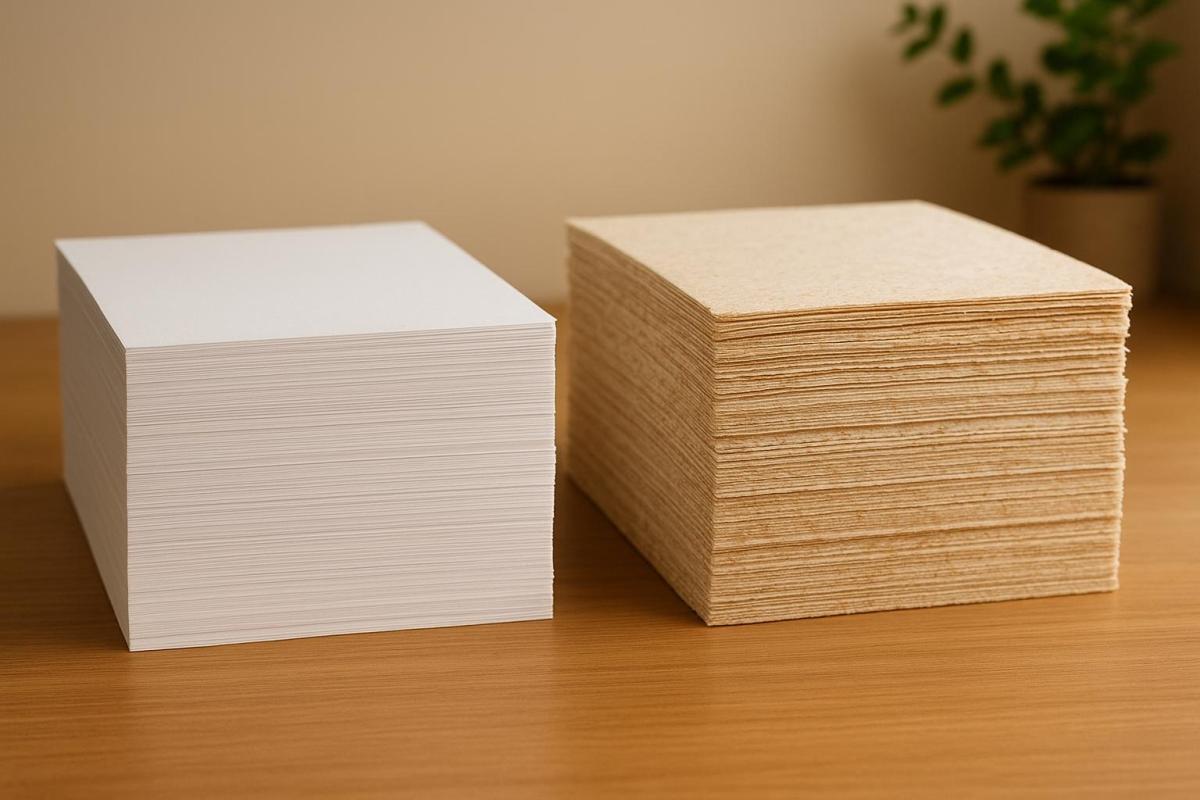
Looking for eco-friendly printing options? Here’s a quick breakdown of natural fiber substrates (like bamboo and cotton) compared to wood-based paper:
- Growth Cycle: Bamboo matures in 3–5 years; trees take 20–50 years.
- Environmental Impact: Bamboo uses less water, absorbs more CO₂, and requires minimal chemicals. Wood-based paper production is resource-heavy but widely recycled.
- Print Quality: Bamboo offers smooth surfaces for fine art, while wood paper ensures consistent results for high-volume printing.
- Cost: Bamboo and cotton papers are pricier but cater to premium projects. Wood paper is more affordable for everyday use.
Quick Comparison
| Criteria | Bamboo | Wood Paper | Cotton |
|---|---|---|---|
| Growth Cycle | 3–5 years | 20–50 years | Annual harvest |
| Water Usage | Low | Moderate | Very high |
| Carbon Absorption | 35% more CO₂ than trees | Lower | Variable |
| Print Quality | Smooth, high-end finishes | Consistent, versatile | Durable, soft texture |
| Cost | High (premium applications) | Low (mass-market use) | High (luxury printing) |
Bottom Line: Choose bamboo or cotton for premium, eco-conscious projects. Stick to wood-based paper for cost-effective, large-scale printing.
Bamboo Paper: A Sustainable Alternative to Wood-Based Paper?
Raw Material Sources and Impact
The environmental footprint of paper production depends heavily on the raw materials used. Choosing the right materials can make a big difference for both sustainability and cost. Let’s break down the impact of some key raw materials and their role in paper production.
Bamboo and Cotton Production
Bamboo is an incredibly efficient material for paper production. It matures for harvest in just 3–5 years, making it a faster and more sustainable option compared to traditional wood.
Here’s why bamboo stands out:
- Low water usage: It requires just 1/6 the water that trees need.
- Carbon absorption: Bamboo absorbs 35% more CO₂ than trees.
- No chemicals needed: It grows without pesticides or fertilizers.
- Self-regenerating: It regrows naturally after harvesting.
On the other hand, cotton presents some challenges despite being a renewable resource. It’s the most pesticide-intensive crop in the world, and its water demands are staggering – producing just one kilogram of cotton requires over 10,000 liters of water.
These factors highlight the environmental trade-offs of using bamboo and cotton, setting the stage for a closer look at traditional wood pulp.
Wood Pulp and Forest Management
Traditional wood pulp, while widely used, comes with its own set of environmental concerns. This industry consumes 33–40% of all industrial wood traded globally, contributing significantly to deforestation. To put it into perspective, producing one ton of white paper requires around 17 trees, underscoring the resource-heavy nature of this process.
Here’s a quick comparison of bamboo, wood pulp, and cotton:
| Feature | Bamboo | Wood Pulp | Cotton |
|---|---|---|---|
| Water Usage | Low | Moderate | Very high |
| Chemical Needs | Minimal | Moderate | High (pesticides) |
| Carbon Impact | 12 tons CO₂/ha/year absorbed | 1 ton CO₂/40 years | Variable |
| Growth Cycle | 3–5 years | 20–50 years (hardwood) | Annual harvest |
Beyond raw material sourcing, the production process itself has a significant impact. For every kilogram of paper made, about 3.3 kg of CO₂ is released into the atmosphere. However, sustainable practices are helping to reduce these effects. In the United States, for example, over 1 billion trees are planted annually, and only about 2% of managed forests are harvested each year.
Brazil offers an example of alternative approaches. In 2013, bamboo made up 77% of the country’s cellulose pulp derived from non-wood plant fibers. Even so, the supply fell short of the annual demand of 1 million tons, showing the challenges of scaling up alternative materials.
Manufacturing Methods and Material Features
The way natural fiber and wood-based paper substrates are made plays a big role in shaping their qualities and how they perform in different uses.
Natural Fiber Manufacturing Steps
Bamboo processing can be done using mechanical, chemical, or enzymatic methods, each with its own pros and cons. For example, mechanical processing keeps the natural properties of bamboo intact but comes with higher labor costs. This method involves crushing and separating the fibers, resulting in the following composition:
| Component | Percentage |
|---|---|
| Cellulose | 73.83% |
| Hemicellulose | 12.49% |
| Lignin | 10.15% |
| Moisture | 3.16% |
| Pectin | 0.37% |
Chemical processing, on the other hand, can enhance certain properties. For instance, one study highlights the benefits of treating bamboo strips with LMwPF resin:
"The strips were treated with LMwPF resin for 1 hour, dried at 60°C for 6–9 hours, and hot-pressed (14 kg/m², 140°C, 5–17 minutes), resulting in enhanced stability and mechanical performance."
These methods differ sharply from the standardized chemical processes used to produce wood pulp.
Wood Pulp Production Methods
Wood pulp production is largely dominated by chemical methods, with the kraft process leading the way. This process, which accounts for about 80% of global pulp production, involves breaking down lignin in wood using sulfide ions in a highly alkaline solution. The key component here is white liquor, a mix of sodium hydroxide (NaOH) and sodium sulfide (Na₂S). This method produces fibers that are stronger compared to those from other pulping techniques.
Another method, sulfite pulping, is less common today, making up less than 10% of total chemical pulp production. Despite this, it offers unique benefits. As H.L. Hintz explains:
"Sulfite pulping can be controlled to produce pulps over a wide range of lignin contents and pulp yields."
The major difference between these two methods lies in their chemical environment. Kraft pulping uses strongly alkaline conditions, while sulfite pulping employs acidic or neutral conditions with sulfur dioxide and bisulfite ions. This difference impacts the final product’s qualities: kraft pulp is known for its strength, although it starts with a darker color, which can be corrected through bleaching to achieve a high level of whiteness.
Print Quality Results
The quality of print plays a crucial role in determining the final appearance of any printed material. Papers made from natural fibers and traditional wood-based sources bring distinct characteristics to the table, influencing factors like image clarity, color intensity, and overall durability. These qualities are the result of specific manufacturing processes that shape the paper’s properties, ultimately impacting both its longevity and visual appeal.
Material Strength Tests
The strength of paper is heavily influenced by the structure of its fibers, which stems from the manufacturing techniques used. Natural fiber and wood-based papers exhibit different mechanical properties that directly affect their performance during printing. For instance, bamboo paper demonstrates directional strength, meaning it can bear more load along the alignment of its fibers. However, studies show that over time, the cellulose and hemicellulose content in bamboo fibers may decrease, potentially affecting their durability. For reference, individual bamboo fibers boast a tensile strength of approximately 1.6 GPa and an elastic modulus near 33 GPa. On the other hand, traditional wood-based and cotton papers display varying levels of durability and dimensional stability, largely dictated by their fiber compositions.
Print Surface Quality
The surface of the paper is another critical factor in print quality, as it determines how ink interacts with the material. This directly affects aspects like print resolution, color accuracy, and overall visual appeal.
"Our customers seek the highest quality printing surface that will make their signs standout while trying to keep costs down."
The texture and coating of paper significantly influence the sharpness of details and the vibrancy of colors. Smooth papers are known for producing sharper images and brighter colors, while textured papers create a tactile, artistic feel with softer tones. Natural fiber papers, in particular, have unique ink absorption traits that affect color saturation and drying times. Coated papers, meanwhile, enhance both durability and color brilliance, whereas uncoated natural fiber papers offer a more organic and understated look.
"The result of using these sustainable raw materials is an overall very different aesthetic quality to a typical glossy cotton paper. The first thing to take into consideration is that they are all matte papers. This results in less contrast and more of the textural quality of the paper showing through in the final print."
Testing has shown that certain papers, like Ilford Smooth Cotton Rag, deliver exceptionally smooth finishes ideal for high-quality printing. Meanwhile, specialty bamboo papers are particularly well-suited for artistic applications, such as calligraphy and fine art printing, thanks to their distinctive properties.
sbb-itb-ce53437
Price Analysis
The cost comparison between natural fiber substrates and traditional wood-based paper reveals notable differences in both production expenses and market pricing. Understanding these dynamics is crucial for businesses aiming to choose the best material for their printing needs.
Manufacturing Cost Factors
The production costs for natural fiber and wood-based papers are shaped by several important factors. Wood pulp facilities benefit from large-scale production, making them more cost-efficient, while natural fiber processing often occurs in smaller facilities, leading to higher per-unit costs. Additionally, machines used for wood pulp processing are up to three times faster than those designed for non-wood fibers.
Here’s a breakdown of how specific cost components differ:
| Cost Component | Natural Fiber Impact | Wood-Based Impact |
|---|---|---|
| Raw Materials | Lower initial cost due to agricultural waste availability | Costs depend on regional supply and demand |
| Processing | Requires more energy and chemicals | Streamlined and efficient processes |
| Equipment | Higher costs per unit due to smaller-scale operations | Benefits from economies of scale |
| Labor | More labor-intensive | Automation reduces labor expenses |
These factors collectively explain the cost disparities between natural fiber and wood-based paper, which ultimately affect market pricing.
Market Prices
The differences in production costs are directly reflected in the prices consumers pay. In the U.S., natural fiber papers – often marketed as premium or artistic products – tend to be more expensive than their wood-based counterparts.
For everyday office use, wood-based paper is the more economical choice. For instance, Amazon Basics Multipurpose Copy Paper (8.5 × 11 inches) costs $26.09 for 2,500 sheets, which breaks down to about $5.22 per ream. On the other hand, specialty bamboo papers are priced significantly higher:
| Product Type | Price | Quantity |
|---|---|---|
| Bamboo Mixed Media Paper (6" × 9.8") | $13.95 | 15 sheets |
| Bamboo Mixed Media Block (9.4" × 12.6") | $13.95 | 25 sheets |
| Hahnemühle Bamboo Fine Art Paper | $76.40 | Unit Price |
For specialized printing needs like business cards and marketing materials, bamboo-based options are even pricier:
- Business Cards: Starting at $48.76
- Postcards: Starting at $152.07
- Greeting Cards: Starting at $214.05
- Bookmarks: Starting at $100.83
While natural fiber products come with higher upfront costs, their durability and eco-friendly appeal provide added value over time. In fact, industries such as automotive manufacturing have reported that using natural fiber composites can lower part costs by up to 20% and reduce weight by approximately 30%.
Environmental Impact Measurements
The environmental footprint of natural fiber substrates and traditional paper differs significantly throughout their lifecycle – from production to recycling and eventual disposal.
Decomposition and Reuse
Natural fibers break down within weeks or months under optimal conditions, while traditional paper takes several months. Recycling trends also differ: paper recycling is widely practiced. In 2021, paper and cardboard made up 40.3% of the European Union’s 84 million tonnes of packaging waste.
| Material Type | Decomposition Characteristics | Recycling/Reuse Trends | Environmental Impact Overview |
|---|---|---|---|
| Natural Fibers | Weeks to months under ideal conditions | Limited fiber-to-fiber recycling | Naturally biodegrades into non-toxic byproducts |
| Traditional Paper | Several months under ideal conditions | Widely recycled; 40.3% of EU packaging waste in 2021 | Energy-intensive production with notable CO₂ emissions |
These differences in decomposition and recycling provide a foundation for understanding the broader carbon footprint of these materials.
Carbon Impact
Carbon emissions further highlight the differences between these substrates. Traditional paper manufacturing is resource-heavy and emits significant amounts of CO₂. For instance, producing one tonne of paper requires approximately 17 trees. However, recycling paper can reduce energy consumption by up to 70%, offering a more resource-efficient alternative.
Bamboo, on the other hand, presents a more eco-friendly option. Bamboo Grove highlights its environmental benefits:
"By choosing bamboo over slower-growing timber, we can reduce the strain on forests and encourage a more sustainable approach to resource management".
Bamboo’s rapid growth and efficient carbon sequestration make it a standout material. It absorbs carbon more effectively than traditional timber, contributing to lower atmospheric greenhouse gas levels. As Bamboo Grove explains:
"Bamboo’s ability to sequester carbon contributes to lowering atmospheric greenhouse gas levels. As consumers and businesses choose bamboo over carbon-intensive materials, they help decrease overall carbon emissions".
Meanwhile, innovative approaches in fiber recycling are helping reduce the environmental toll of paper. For example, the Spanish company Hilaturas Ferre has developed a mechanical recycling process that preserves fiber quality at a 15 mm staple length. This technology enables the production of yarns with up to 50% recycled content, offering a more sustainable alternative for fiber processing.
U.S. Print Market Uses
In the U.S., natural fiber and wood-based substrates cater to different needs, depending on the project requirements and client preferences.
Natural Fiber Print Projects
Natural fiber substrates are the go-to choice for premium and environmentally conscious printing. This segment is experiencing notable growth, with bamboo paper alone projected to hit $77.48 billion by 2030, expanding at a 5.9% annual growth rate in the U.S..
These materials are often used in high-end applications, such as:
| Application | Material Choice | Key Benefits |
|---|---|---|
| Fine Art Prints | 100% Cotton | Excellent water absorption, archival quality |
| Legal Documents | Cotton Paper | Durability and fade resistance |
| Luxury Business Cards | Recycled Cotton | Premium texture with a sustainability story |
| Premium Packaging | Bamboo | Unique texture and eco-friendly appeal |
For example, Mohawk and MOO collaborated to create 100% recycled cotton business cards using fabric waste from t-shirts.
While natural fibers shine in premium applications, wood-based papers remain indispensable for large-scale, cost-effective production.
Wood Paper Applications
Traditional wood-based papers dominate high-volume printing, offering affordability and versatility. In 2016, global paper demand surpassed 472 million tons, with wood-based substrates playing a key role across various industries.
Common uses include:
| Project Type | Paper Choice | Market Trends |
|---|---|---|
| Commercial Print | Uncoated Wood-based | Increasing preference for natural textures |
| Labels | Bio-based Substrates | Rising demand for sustainable options |
| Marketing Materials | Mixed Fiber | Balances cost with quality |
| Catalogs | Traditional Wood | Efficient for high-volume production |
Joshua Levine, CEO of Legion Paper, highlights the innovation in this field:
"Over the last 25 years we’ve dedicated our company to sourcing and creating the very best fine art papers the world has to offer. In creating our bamboo paper we used our resources and experience to develop something in keeping with the rest of our products–something not just unique but something that performs up to our customers’ high standards."
Both natural fiber and wood-based papers remain essential. While traditional papers dominate in mass-market printing, natural fibers are carving out a growing niche in premium and eco-conscious segments.
Miro Printing & Graphics Inc. (https://bergencountyprinters.com) expertly combines both substrate types to provide tailored, sustainable printing solutions across the U.S.
Conclusion: Substrate Selection Guide
Choosing the right substrate means aligning your project’s needs, budget, and environmental goals. Here’s a quick comparison to help guide your decision:
| Project Requirements | Natural Fiber Substrates | Traditional Wood-Based Paper |
|---|---|---|
| Premium Print Jobs | Great for fine art and luxury cards | Better for high-volume commercial printing |
| Cost Considerations | Best for high-end projects | More affordable for large production runs |
| Environmental Impact | Lower carbon footprint and biodegradable | Supported by an established recycling system |
| Durability Factors | Can vary in strength and moisture resistance | Reliable with consistent durability |
| Print Quality | Offers unique textures and aesthetics | Ensures consistent, dependable results |
This table highlights how different substrates cater to specific project needs. It builds on earlier discussions about raw materials, manufacturing processes, print quality, cost, and environmental considerations.
Natural fiber substrates shine in premium and eco-conscious projects, offering a blend of sustainability and aesthetic appeal. Meanwhile, traditional wood-based paper remains a trusted choice for high-volume printing, balancing cost and performance. In North America, paper-based substrates still dominate 48% of the label market, underscoring their importance in the industry.
At Miro Printing & Graphics Inc., substrate selection is guided by these key steps:
- Assessing project requirements: Matching substrate features to specific needs.
- Considering budgets and production volumes: Balancing costs with scale.
- Evaluating sustainability goals: Factoring in certifications and environmental impact.
- Testing print quality: Ensuring the material meets design standards.
- Reviewing durability needs: Tailoring to the application’s demands.
Whether you’re creating premium marketing materials or managing large-scale commercial printing, the right substrate can make all the difference. Natural fibers are perfect for luxury and sustainable projects, while traditional papers deliver dependable results for high-volume needs.
"It’s been talked about for a long time, but now we’re starting to see more action and traction with companies embracing sustainable solutions."
FAQs
What makes bamboo a more eco-friendly alternative to traditional wood-based paper?
Bamboo stands out as an eco-friendly alternative to traditional wood-based paper, largely because of its incredibly fast growth. While trees can take anywhere from 20 to 50 years to mature, bamboo reaches maturity in just 3 to 5 years. This quick regrowth not only helps combat deforestation but also ensures a steady, renewable supply of raw materials.
On top of that, bamboo production tends to leave a smaller environmental footprint. It produces fewer greenhouse gas emissions and requires less water during manufacturing. Beyond its production benefits, bamboo plays a vital role in maintaining healthy ecosystems. It helps prevent soil erosion, enhances soil quality, and provides habitats for various species, which supports biodiversity. For consumers looking to make eco-conscious choices, bamboo offers a more planet-friendly option.
How does the print quality of bamboo and cotton paper compare to traditional wood-based paper?
Bamboo and cotton paper stand out for delivering exceptional print quality, often surpassing traditional wood-based paper. These natural fibers are particularly good at absorbing ink, which leads to sharper details and richer, more vibrant colors. Plus, their smooth texture enhances the clarity of printed images, making them ideal for projects that demand precision and fine detail.
On the other hand, wood-based paper tends to fall short in vibrancy and sharpness due to its composition and surface texture. For anyone aiming to achieve premium-quality prints – whether for personal or business use – bamboo and cotton paper offer an attractive combination of performance and visual appeal.
Why are natural fiber papers more expensive, and when does it make sense to use them?
Natural fiber papers, crafted from materials like bamboo and cotton, often come with a higher price tag. This is largely due to the labor-intensive processes and lower yields involved in their production compared to traditional wood-based paper. Unlike wood pulp, these fibers typically require specialized cultivation and processing methods, which add to the cost. On top of that, many producers of natural fiber papers prioritize eco-friendly practices, further influencing their pricing.
Even with the added expense, these papers are a top choice when quality, aesthetics, and environmental consciousness matter most. They’re commonly used for luxury stationery, high-end packaging, and eco-friendly branding – perfect for businesses aiming to connect with environmentally aware audiences. Their standout features, like durability, biodegradability, and distinctive textures, make them an appealing option for those looking to create a memorable impression while aligning with sustainable values.
Related posts
- Cost Analysis: Traditional vs. Alternative Materials
- Cost-Saving Tips for Sustainable Paper Choices
- Substrate Selection for Digital Printing
- Checklist for Choosing Recycled Paper for Printing
https://app.seobotai.com/banner/banner.js?id=682be6a34fa53d42207cacd3
 BergenCountyPrintersBlogs