
Folding machines are essential for businesses managing large-scale printing tasks. They boost productivity, reduce errors, and allow for faster turnaround times. Choosing the right folding machine depends on your needs, such as speed, paper handling, fold types, and automation. Here’s a quick breakdown:
- Stahlfolder TH/KH Series: High-speed industrial machine with modular design, supports various fold types, and handles multiple paper weights.
- Formax FB 390: Air-feed technology processes 35,000 sheets per hour, ideal for coated and glossy paper.
- Tamerica TPF-42: Reliable, mid-range option for heavier paper stocks, folding up to 8,000 sheets per hour.
- Neopost Inserters: Combines folding and inserting for mail-heavy operations, with models processing up to 12,000 envelopes per hour.
Quick Comparison
| Model | Speed | Fold Types | Paper Size | Best For |
|---|---|---|---|---|
| Stahlfolder TH/KH | Up to 230 m/min | Multiple, including signatures | Various | Industrial-scale printing |
| Formax FB 390 | 35,000 sheets/hour | 7 standard types | 3″ x 5″ to 14″ x 20″ | Coated/glossy paper |
| Tamerica TPF-42 | 8,000 sheets/hour | 7 types | 3.5″ x 5″ to 11″ x 17″ | Mid-sized operations, heavier stocks |
| Neopost Inserters | Up to 12,000 envelopes/hour | 5 types | Envelopes | High-volume mailing tasks |
Each machine offers specific strengths, from industrial-grade precision to cost-effective solutions for smaller businesses. Match your production volume and paper requirements to the right model for the best results.
Formax FD 390 Folding Machine
1. Stahlfolder TH/KH Series by Heidelberg
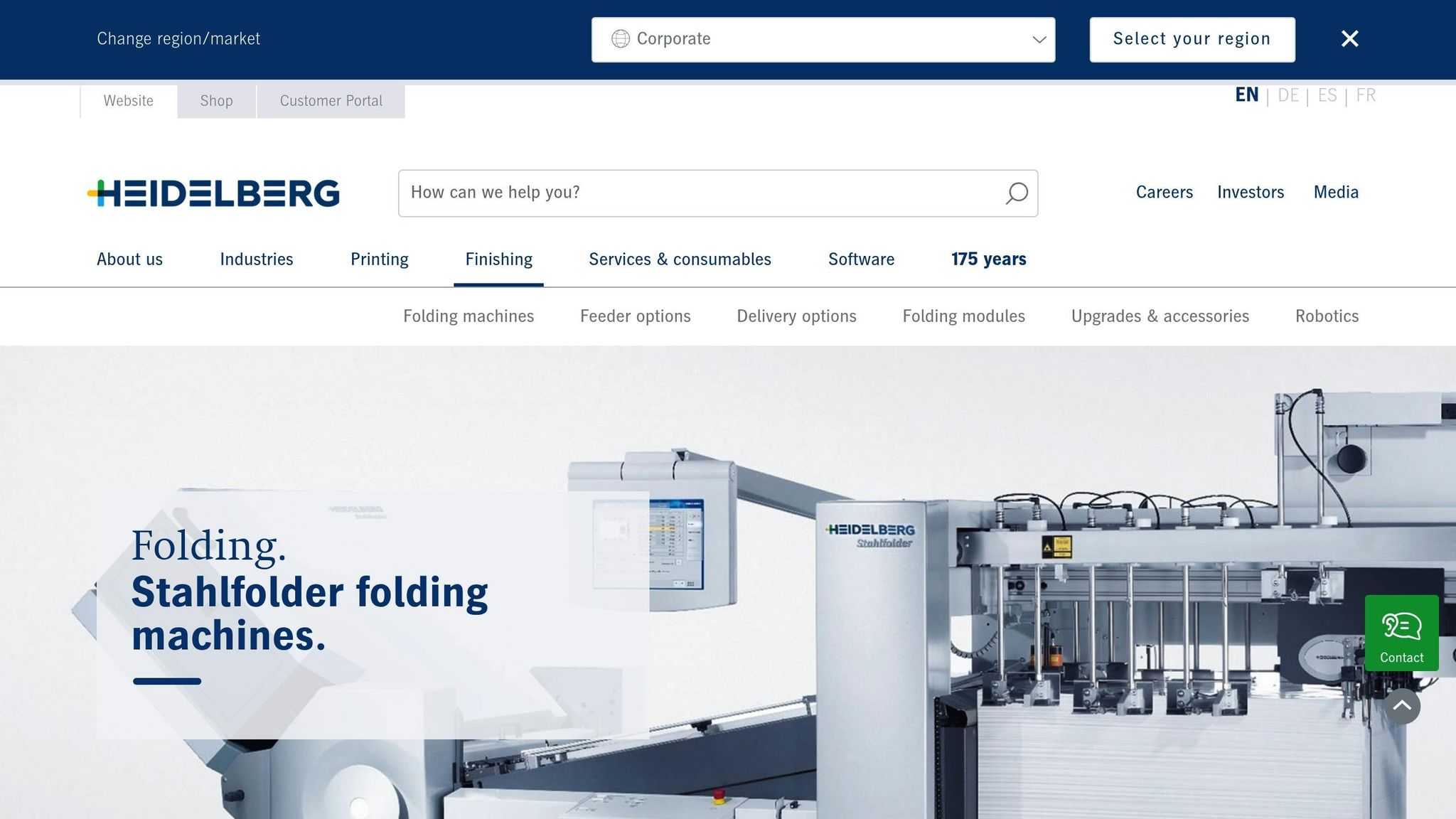
The Stahlfolder TH/KH series represents Heidelberg’s premier solution for high-volume commercial printing. By combining buckle fold and knife fold technologies, this system is built to handle a wide variety of folding tasks with precision and efficiency.
Folding Speed
The Stahlfolder KH 82 delivers impressive results, reaching speeds of up to 230 m/min with its automated cross-fold unit. This design not only doubles productivity but also slashes setup times by 80% – a game-changer for businesses managing high-volume printing demands.
Supported Fold Types
Thanks to its modular setup, the TH/KH series supports a broad spectrum of folding applications, such as signatures, package inserts, and flyers. The parallel fold units feature buckle plates with swing deflectors or combination options, accommodating up to eight plates. Additionally, the cross-fold units are available in six configurations, ensuring flexibility to meet diverse production needs.
Paper Size and Weight Compatibility
The TH/KH series excels in versatility, efficiently handling a wide range of paper sizes and weights. Whether you’re working with lightweight promotional materials or heavier commercial documents, this system delivers reliable performance. Its adaptability is further enhanced by scalable automation and modular design, making it a versatile choice for various printing requirements.
Automation and Modularity
Both the TH and KH machines are designed for seamless expansion, with patented Stahlfolder technology boosting overall productivity. The market has responded positively – over 400 Stahlfolder KH 82 machines have been installed, making it the top-selling fully automatic combination folding machine.
"We will continue to use our experience from 70 years of folding machines to expand our portfolio for industrial postpress with regard to digital integration." – Michael Neugart, Head of Heidelberg Postpress
This dedication to innovation ensures that the TH/KH series remains a leading choice for businesses aiming to enhance efficiency and stay ahead in the competitive world of commercial printing.
2. Formax FB 390 Air Feed Paper Folder
The Formax FB 390 Air Feed Paper Folder is designed to handle high-volume document processing, making it a solid choice for mailrooms and print shops. With its advanced air feed system, it ensures reliable performance across a variety of tasks, from routine office needs to specialized printing jobs. Let’s break down its key features.
Folding Speed
The FB 390 can process up to 35,000 sheets per hour, thanks to its air feed technology, which surpasses the efficiency of traditional friction-based systems. Its hopper holds up to 350 sheets, minimizing interruptions and keeping production running smoothly. To help track productivity, the machine includes a 5-digit counter, which accurately records the number of sheets processed during each session.
Supported Fold Types
This paper folder supports seven standard fold types: Letter Fold, Z-Fold, Half-Fold, French Fold, Fold Out, Double Letter Fold, and Double Parallel Fold. It also handles the specialized Engineering Fold (Short Z Fold).
With this variety, the FB 390 is versatile enough for everything from business letters to marketing materials and technical documents. Operators can manually set up the machine to select the specific fold type required for each project.
Paper Size and Weight Compatibility
The FB 390 works with paper sizes ranging from 3″ x 5″ to 14″ x 20″ and supports paper weights up to 65 lbs. This makes it suitable for lightweight flyers, standard office documents, and heavier marketing materials – all without requiring adjustments to the machine.
This flexibility allows businesses to handle a wide range of projects with one machine, while maintaining consistent folding quality regardless of paper type or thickness.
Automation and Modularity
Although fold selection is done manually, the FB 390 incorporates helpful automation features like an outfeed stacker, which simplifies the handling of folded documents. Additionally, an optional perforator/scorer attachment for 20–28 lb paper expands its capabilities even further.
The machine’s simple, durable design makes it easy to operate, even for those with limited experience, while still being robust enough for continuous use in demanding commercial environments.
3. Tamerica TPF-42 Commercial Paper Folding Machine
The Tamerica TPF-42 Commercial Paper Folding Machine is a dependable choice for mailrooms and copy shops that need consistent performance in high-demand folding tasks. Its standout feature is its ability to handle heavier paper stocks while maintaining steady output, making it ideal for large-scale operations.
Folding Speed
The TPF-42 delivers impressive speed, folding up to 8,000 sheets per hour for single folds and 7,000 sheets per hour for more intricate folding patterns. This level of efficiency makes it well-suited for high-volume environments where speed and reliability are critical.
Supported Fold Types
With the ability to perform seven different fold types, including single folds, double folds, and Z-folds, the TPF-42 offers exceptional flexibility. It’s designed to handle a variety of materials, such as heavier card stock, glossy sheets, and brochures, making it a versatile tool for creating marketing materials and other professional documents.
Paper Size and Weight Compatibility
The TPF-42 accommodates paper sizes ranging from 3.5″ x 5″ to 11″ x 17″, covering everything from standard business documents to larger-format materials. Popular sizes like 5″ x 7″ are also supported, making it a practical choice for invitations, promotional cards, and more. Its capability to manage heavier, premium-grade paper stocks ensures consistent performance, even with challenging materials.
Operation and Ease of Use
Built with durability and ease of operation in mind, the TPF-42 is designed for busy workplaces. Its straightforward controls reduce the need for extensive training, allowing users to achieve efficient and reliable folding, even under demanding conditions.
sbb-itb-ce53437
4. Neopost Commercial Paper Inserters
Neopost Commercial Paper Inserters, marketed under the Quadient brand, offer a streamlined solution for businesses that need reliable folding and inserting capabilities for high-volume tasks. These machines are particularly suited for environments like billing departments, direct mail operations, and large-scale correspondence management, where efficiency and precision are crucial.
Folding Speed
Neopost inserters are designed to handle high-speed processing, catering to various business needs. For example:
- DS-75i model: Processes up to 3,800 envelopes per hour.
- DS-65 folder inserter: Handles up to 2,400 envelopes per hour.
- DS-160HP: Reaches speeds of up to 4,500 envelopes per hour.
Quadient also offers options for different operational scales:
- Small business models: Up to 2,500 envelopes per hour.
- Mid-level units: Around 4,300 envelopes per hour.
- Production-grade systems: Capable of processing up to 12,000 envelopes per hour.
Supported Fold Types
Neopost inserters feature PowerFold™ technology, which accommodates five key fold types: no fold, single fold, letter fold, zig-zag fold, and double parallel fold. This versatility ensures they meet the common needs of invoices, letters, and marketing materials.
Automation and Modularity
These machines are built with automation and flexibility in mind. Features like automated job changeovers and a modular design make them adaptable to various needs. With support for up to 17 document feeders and optional software modules, they simplify mail center operations and save time. Additionally, the Automated Insertion Management System (AIMS) provides real-time tracking and enhances overall efficiency.
The benefits of these features are evident in real-world use cases. For instance:
"With our Quadient folder inserter, we have a reduction in manual mail assembly processes as well as an increase in employee and user satisfaction." – Janet Lee Preston, Business Professional, United Parcel Service
Another user, Heath Card from the Mashantucket Pequot Tribal Nation, shared:
"With our Quadient folder inserter, we have increased productivity and decreased labor costs."
From small businesses handling up to 20,000 envelopes monthly to large-scale operations processing over 1 million envelopes per month, Neopost inserters provide scalable solutions for a wide range of needs. Next, we’ll explore how these features compare to competing folding systems in our analysis of their advantages and limitations.
Advantages and Disadvantages
After our detailed machine-by-machine breakdown, let’s take a broader look at the overall benefits and trade-offs of folding machines. When it comes to high-volume printing, each type of folding machine has its strengths and challenges, depending on factors like budget, operational needs, and production goals.
Speed and Efficiency
One of the biggest advantages of folding machines is the massive boost in productivity compared to manual folding. For example, even a basic letter folding machine can process over 3,000 documents per hour. This is especially important in direct mail campaigns, which boast a 4.4% response rate, far outpacing email’s 0.12%.
High-performance machines, like those in the Heidelberg Stahlfolder series, are designed for industrial-scale operations. These machines deliver precision and speed, even with complex fold patterns, making them ideal for environments where consistency is critical. However, their sophisticated features come with a need for skilled operators and regular maintenance, which may not be practical for smaller businesses.
Cost and Return on Investment
The cost of folding machines varies widely, with entry-level models priced between $100 and $500, mid-range machines from $500 to $2,500, and high-end systems starting at $2,500. The return on investment largely depends on how much you’re producing daily. For businesses folding between 2,000 and 5,000 pieces a day, machines in the $500–$2,900 range are typically a good fit.
Manual folding machines are a budget-friendly choice for small-batch production, offering low upfront costs and minimal maintenance. On the other hand, automatic machines – while more expensive initially – provide faster processing and greater consistency for large-scale tasks. It’s all about aligning the machine’s capabilities with your production needs.
Paper Handling and Versatility
The type of feed system a folding machine uses can make a big difference in its performance. Friction-feed machines are best for uncoated paper and are reliable for standard office documents. However, if you’re working with glossy or coated paper, air-feed systems are the better option – though they come with a starting price of $5,000.
For instance, the Formax FB 390’s air-feed technology is excellent for handling tricky paper types that would jam a friction-feed system. That said, this feature comes with higher operational and maintenance costs. Meanwhile, for businesses primarily working with standard paper weights and sizes, the Tamerica TPF-42 offers solid performance at a more accessible price point.
Ease of Use and Training
The complexity of a folding machine often determines how much training and maintenance it requires. Desktop machines are straightforward and need minimal upkeep, making them accessible to almost anyone. In contrast, production-grade machines demand skilled operators and regular preventative maintenance to avoid costly downtime.
Take the Neopost Commercial Paper Inserters as an example. Their PowerFold™ technology and modular design offer incredible versatility, but operators must undergo thorough training to make the most of these features. On the flip side, basic folding machines can be operated with minimal instruction, making them ideal for less specialized staff.
| Feature | Entry-Level ($100-$500) | Mid-Range ($500-$2,500) | High-End ($2,500+) |
|---|---|---|---|
| Speed | 1,000–3,000 sheets/hour | 3,000–8,000 sheets/hour | 8,000–20,000+ sheets/hour |
| Fold Types | 2–4 standard folds | 4–8 fold options | 12+ programmable folds |
| Paper Compatibility | 20–24 lb standard paper | 16–32 lb various stocks | 12–80+ lb all paper types |
| Automation Level | Manual | Semi-automatic operation | Fully automated |
| Care | Minimal cleaning required | Regular lubrication needed | Professional service required |
| Training Time | 15–30 minutes | 2–4 hours | 1–2 days |
Matching Machines to Volume
Choosing a machine that matches your production volume is essential. For example, a government office using an MBM 206M paper folder for $2,833.60 achieved an output of 10,500 letters per hour. Meanwhile, a printing company with a Pitney Bowes FD40 tabletop folder, priced at $3,480.40 with an additional $485/year for maintenance, processed 20,000 letters per hour.
These examples highlight how selecting the right machine can directly impact efficiency and cost-effectiveness. Businesses handling fewer than 1,000 pieces daily often find entry-level machines sufficient. However, operations exceeding 10,000 pieces per day typically require industrial-grade equipment to meet demand without sacrificing performance.
Long-Term Costs
For high-volume operations, managing ongoing costs is just as important as the initial purchase price. Machines designed for heavy workloads, such as those handling up to 100,000 pieces per month, typically cost between $2,400 and $4,800+. While these systems represent a significant investment, their efficiency often offsets labor costs and increases throughput.
Regular maintenance, including cleaning and lubrication, is essential for all folding machines to prevent breakdowns and downtime. However, the complexity and frequency of maintenance vary depending on the machine, which can influence long-term expenses and staffing requirements.
Conclusion
Selecting the right folding machine is all about matching your production requirements with the right balance of speed, functionality, and cost. The machines we’ve covered cater to a variety of operational needs, from mid-sized businesses to large-scale enterprises. Here’s a quick recap of their strengths and ideal use cases.
For high-output environments, the Formax FD 38X shines with its impressive capacity of 20,100 sheets per hour and an easy-to-use color touchscreen interface. With a price range of $4,500–$6,000, it supports seven programmed folds and allows for 12 custom fold jobs, making it a great choice for businesses needing both efficiency and adaptability.
The Stahlfolder TH/KH Series is a powerhouse for industrial-scale operations. Known for its precision and durability, this machine is perfect for facilities handling massive monthly volumes. While it requires a higher initial investment and skilled operators, the consistent performance makes it worthwhile for large-scale production.
For mid-sized operations looking for reliable performance without overspending, the Tamerica TPF-42 offers excellent value. Its friction-feed technology works well with standard paper, delivering dependable results. Meanwhile, the Formax FB 390 uses an air-feed system, making it ideal for coated or glossy stocks by minimizing jams often seen with friction-feed machines.
If your enterprise deals with complex mailing tasks, the Neopost Commercial Paper Inserters are worth considering. These machines combine folding, inserting, and sealing functions into one system. However, they do require thorough operator training to achieve peak performance.
It’s also worth noting that direct mail boasts a 4.4% response rate compared to email’s 0.12%, underscoring the value of investing in folding equipment that enhances productivity.
Ultimately, focus on long-term reliability rather than just upfront costs. Machines priced between $2,500 and $6,000 often strike the right balance between speed, features, and durability, helping you maintain quality while reducing labor expenses.
At Miro Printing & Graphics Inc., we’re dedicated to helping you streamline your operations with dependable, high-performance equipment tailored to your needs.
FAQs
What should I look for in a folding machine for high-volume printing?
When choosing a folding machine for high-volume printing, it’s crucial to prioritize speed and efficiency to keep up with demanding workloads. Look into the machine’s paper handling abilities, including the range of paper types and sizes it can accommodate, ensuring it aligns with your specific production needs.
It’s also wise to focus on features that reduce interruptions, such as easy maintenance and long-lasting construction. A dependable feed system and intuitive controls can further streamline operations, making the machine a reliable partner in fast-paced production settings.
How does the feed system in a folding machine impact its performance with different types of paper?
The feed system in a folding machine is crucial for managing different types of paper effectively. Here’s a quick breakdown:
- Friction feed systems rely on rollers to pull paper into the machine. They work best with uncoated or standard paper, making them a solid choice for everyday office documents.
- Air feed systems use suction to handle glossy or coated papers, which tend to slip or jam in friction-based systems.
- For high-volume tasks, pile feed systems draw paper from a stacked pile, boosting efficiency and reducing the likelihood of jams.
Picking the right feed system for your paper type is key to achieving precise, clean folds while avoiding operational hiccups. Think about the type of paper you’ll use most often to ensure smooth performance.
What factors should you consider when evaluating the long-term costs of high-volume folding machines?
When considering the long-term costs of high-volume folding machines, you need to think beyond just the initial purchase price. Key factors like maintenance costs, potential downtime, and the machine’s durability play a big role in the overall expense. Regular servicing and easy access to spare parts can go a long way in preventing unexpected breakdowns, which helps avoid costly interruptions to your workflow.
While machines with a higher upfront price tag might seem expensive at first, they often prove to be a smarter investment in the long run. Why? They typically require fewer repairs, last longer, and operate more efficiently. Choosing a dependable machine can save you money over time by reducing disruptions and keeping your high-volume printing operations running smoothly.
Related posts
- How Automation Improves Print Turnaround Times
- 5 Tips to Prevent Cracking on Folded Prints
- 8 Common Folding Styles for Print Materials
- How Folding Machines Handle Complex Print Layouts
https://app.seobotai.com/banner/banner.js?id=68759e5e922d8ced135fdd8b
 BergenCountyPrintersBlogs