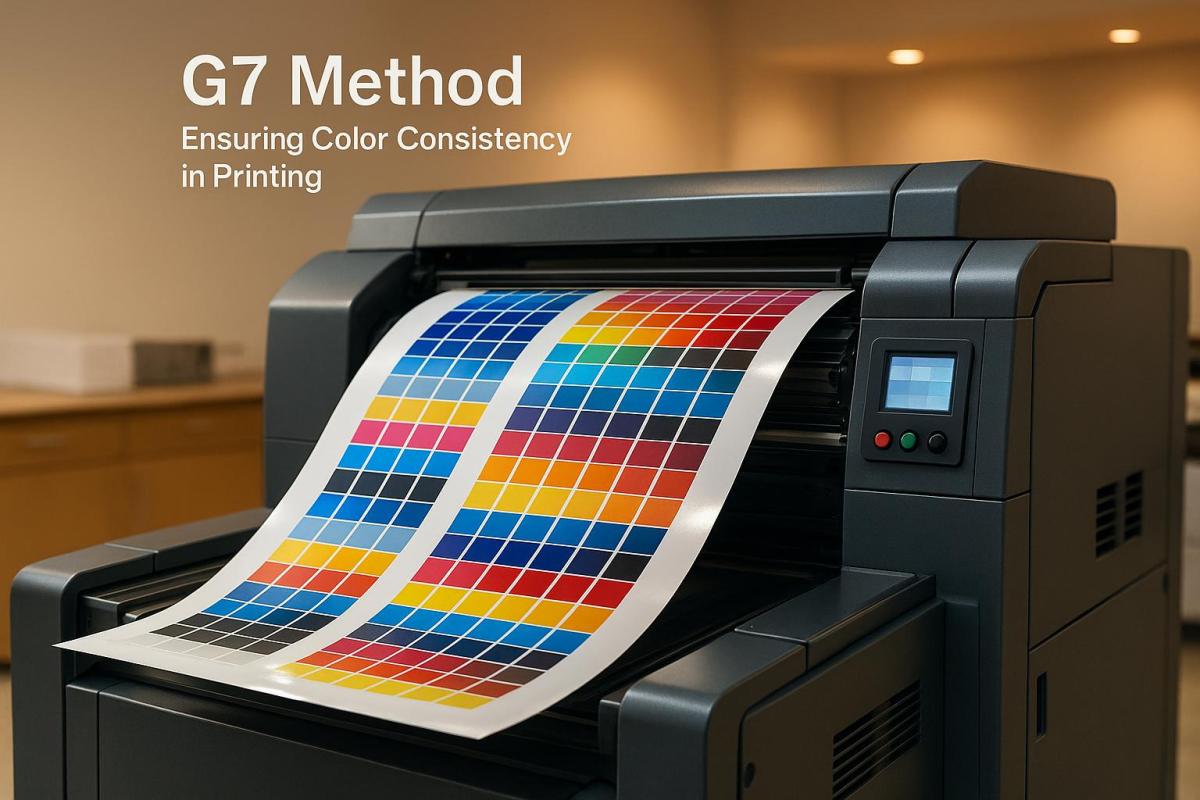
The G7 Method is a standardized calibration process for printing that ensures consistent color reproduction across various devices and materials. Developed in 2006, it focuses on grayscale accuracy using a Neutral Print Density Curve (NPDC), making it applicable to any CMYK printing system. This approach eliminates subjective adjustments, reduces color variation, and simplifies achieving uniform results for branding and print quality.
Key Takeaways:
- What It Does: Ensures consistent color output by standardizing gray balance.
- How It Works: Uses NPDC to maintain neutral tonality across devices.
- Why It Matters: Prevents color inconsistencies that can harm brand perception.
- Certification: Print shops can achieve G7 Master Qualification to validate quality.
G7 is widely used in modern printing, including large-format systems, and helps reduce waste, improve efficiency, and maintain brand integrity. Regular calibration and monitoring are essential to sustain consistent results over time. For businesses, G7 certification signals a commitment to reliable, high-quality printing.
G7 Basics – A Simpl(er) Explanation for Neutral Print Density Curves (NPDC)
How the G7 Method Works
The G7 Method operates on the idea that neutral tonality is the foundation of accurate color reproduction. Unlike older calibration methods that depended on mechanical tweaks and subjective judgment, G7 uses precise color data to establish a standardized process that works across all CMYK printing devices.
Neutral Print Density Curve (NPDC)
At the heart of the G7 Method lies the Neutral Print Density Curve (NPDC). This curve ensures consistent neutral tonality between any two G7-calibrated printing systems, regardless of their technology. The NPDC separates data for CMY (composite) and K (black), offering precise control over how neutral grays are rendered across different devices.
One of the key challenges NPDC addresses is tonal value increases (TVIs), often referred to as dot gain. Traditional calibration methods struggled with varying TVIs across computer-to-plate (CtP) systems and other devices. G7 bypasses this by mapping neutral density directly to halftone dot percentages, avoiding reliance on inconsistent TVI curves.
To implement NPDC, technicians compare the device-generated curve to the ‘ideal’ standard, make adjustments to the RIP (Raster Image Processor), and then revalidate the NPDC to ensure accuracy. This process ensures that the G7 target (P2P target) produces uniform measurement data across various printing systems. The result? Consistent gray balance across all devices.
Gray Balance and Tonality
Gray balance is a critical element of the G7 Method. The process defines gray balance and tonality in relation to the color of the paper or substrate, ensuring that neutral grays appear the same across different printing systems. This eliminates the color casts that often occur with traditional calibration techniques, leading to sharper, more accurate images.
To achieve proper gray balance, adjustments are made to screen values to counteract variations in primary ink absorption. Without these adjustments, gray balance errors can cause noticeable color shifts. As industry experts Steve Upton and Pat Herold explain:
"Gray balance and consistent tone curving is so important to image perception that a print job separated for one printing condition (say SWOP) will look VERY SIMILAR when printed using a different printing system (such as sheet fed GRACoL) when both presses have been gray balanced and toned using G7."
The G7 Grayscale Compliance process zeroes in on achieving neutral gray balance for all printed materials. This involves defining specific percentages of cyan, magenta, and yellow ink needed for gray balance, along with precise a* and b* values in the Lab color space. These detailed specifications set G7 apart from older calibration practices.
G7 vs. Older Calibration Methods
The G7 Method represents a significant shift from traditional calibration approaches. Older methods depended heavily on mechanical adjustments tied to press variability – a flawed strategy, as presses rarely operate identically unless they are identical machines in perfect condition.
Traditional techniques focused on mechanical print attributes like density and dot gain, which can vary widely across presses due to differences in substrate, mechanical setup, ink properties, and other factors. While these attributes are helpful for monitoring individual presses, they fall short when it comes to ensuring consistent color reproduction across multiple systems.
G7 revolutionized this process by using color measurements instead of mechanical attributes to achieve color consistency. It provides a unified target and set of aims for all devices in a printing facility, focusing on color rather than machine-specific characteristics. This makes G7 applicable to any CMYK printing device.
Another major difference is G7’s reliance on grayscale calibration. Unlike traditional methods that primarily targeted individual color channels, G7 recognizes that accurate gray balance is the key to achieving consistent and accurate color reproduction across all hues and tones. By focusing on neutral tonality, G7 eliminates the guesswork and subjectivity that plagued older density-based calibration techniques.
Using G7 for Large Format Printing
Large format printing comes with its own set of challenges, especially when it comes to maintaining consistent color output. Variations in substrates, inks, and environmental conditions can make it tricky to achieve uniform results. That’s where the G7 method steps in. By building on the principles of Neutral Print Density Curve (NPDC) and gray balance, G7 provides a structured way to ensure consistent color across wide-format printing systems.
Tools and Setup Requirements
To implement G7 for large format printing, you’ll need the following tools and equipment:
- Calibration Software: This software handles G7 targets and communicates with measurement devices. For instance, Curve+ supports a range of instruments and target types.
- Spectrophotometer: Essential for precise color measurement. Make sure your software is compatible with various spectrophotometers to future-proof your setup.
- G7 Targets: Standardized test patterns with specific color patches. Depending on your system, you might use the standard P2P target or smaller options like miniP2P or microP2P.
- Raster Image Processor (RIP): Your RIP must be capable of applying tone curves and making color corrections based on G7 measurements.
These tools are crucial for accurate measurements and NPDC corrections. Once everything is set up, proper procedures and routine maintenance will help you achieve and sustain consistent results.
G7 Calibration Steps
The G7 calibration process is designed to establish a neutral gray balance across your printing system. Here’s how it works:
- Choose the Right Target: Start by selecting a P2P target that fits your setup, such as P2P51, P2P25Xa, or P2P51 Randomized.
- Print and Measure the Initial Target: Use your current settings to print the target and establish baseline measurements.
- Analyze Results: Examine the gray balance measurements to identify any deviations from G7 standards. Pay close attention to the gray balance patches, as they are central to the process.
- Apply Correction Curves: Calibration software will generate NPDC curves based on your measurements. Apply these curves to your RIP to account for factors like ink absorption and substrate differences.
- Reprint and Verify: Print the P2P target again with the correction curves applied. Measure the patches to confirm that your system meets G7 specifications.
- Repeat if Necessary: Continue making adjustments until your system falls within G7 tolerances.
In December 2023, TKO Graphix highlighted the importance of their G7 Master Qualification, emphasizing how it ensures consistent and vibrant color profiles for their large format prints.
"By adhering to this standardized color process, we ensure that our client’s vision aligns seamlessly with the end product we produce."
– TKO Graphix
Once your system is calibrated, regular checks will help maintain these results.
Keeping Colors Consistent Over Time
Calibration isn’t a one-and-done process. Over time, factors like ink aging, environmental shifts, and equipment wear can cause your system to drift from its calibrated state. Regular recalibration is essential to keep things consistent.
Conditions such as temperature, humidity, and media variations can impact ink flow and color output. Additionally, both printers and monitors naturally drift over time, making periodic adjustments necessary.
To address these challenges, establish a calibration schedule based on your production needs. High-production environments might require weekly recalibration, while lower-volume operations could get by with monthly checks. Consistency in your routine is key to maintaining quality.
Monitoring your system through process control adds another layer of reliability. G7 Expert Trainer Ron Ellis from Ron Ellis Consulting puts it this way:
"Calibration is important, but I often tell my customers – that’s the easy part. Maintaining the calibration is the real challenge."
For example, one company uses a Techkon SpectroDrive to streamline their process. By placing a sheet on the console, they can gather all the necessary data in just 8 seconds to confirm if their prints meet G7 standards. This live data not only helps with immediate adjustments but can also be used for trend analysis.
Finally, regular color audits are a great way to ensure consistency. Compare new prints to established reference standards or previous batches to catch any drift before it becomes noticeable to clients. These ongoing checks and adjustments make it easier to maintain high-quality results over time.
G7 Method Pros and Cons
The G7 method comes with a mix of benefits and challenges that print shops need to weigh carefully. By understanding these factors, you can make smarter decisions about adopting the method and prepare your team for what’s ahead.
Benefits of G7 Calibration
The G7 method has become the go-to approach for ensuring consistent color quality in the printing industry. Its ability to work seamlessly across offset, digital, and large-format systems makes it widely applicable.
One of the standout benefits is its potential to cut costs and boost efficiency. By reducing waste from trial-and-error color matching and limiting reprints, G7 helps streamline operations and save time.
Javier Robles, Director of Technical Service – Digital at INX International, highlights its role in maintaining quality:
"G7 calibrated printing is important because it helps guarantee quality assurance across multiple printing devices."
For agencies and brand managers, G7 offers peace of mind. Its standardization ensures that the final printed product matches the original design, preserving the integrity of campaigns.
Additionally, these improvements naturally lead to happier clients. G7-certified printers are trusted to deliver consistent, high-quality results. As Kiran Deshpande, G7 Expert at Idealliance, explains:
"Regardless of how, when, or where a product is printed, the basis of G7® allows for visual consistency every time."
However, while the G7 method offers clear benefits, it also presents challenges that must be addressed.
G7 Challenges and Limits
One of the biggest hurdles is getting everyone on board. Implementing G7 can feel disruptive to some team members, making organizational buy-in a critical step. Success requires alignment across management, production, and prepress teams.
Before diving into G7, your printing process needs to be fine-tuned and validated for consistent performance. This often involves tackling issues with tooling, materials, and prepress workflows – efforts that can demand significant time and resources.
Ongoing maintenance is another challenge. Keeping the process within specifications requires regular monitoring and attention. Many print shops find value in hiring a G7 Expert or training an internal G7 Professional to oversee the implementation. While this adds upfront costs, it can lead to smoother operations and better long-term outcomes.
| Advantages | Challenges |
|---|---|
| Works across various printing technologies | Requires buy-in from all team members |
| Reduces waste and cuts costs | Printing process must be optimized first |
| Simplifies workflows and reduces manual adjustments | Demands ongoing monitoring and maintenance |
| Improves customer satisfaction | Requires time and resource investment |
| Ensures consistent brand colors | May involve hiring or training G7 specialists |
G7 and ISO Standards
The G7 method doesn’t replace ISO standards – it complements them. It provides practical steps for meeting ISO requirements, making compliance more manageable. Unlike methods focused solely on mechanical attributes like dot gain or density, G7 emphasizes gray balance and how it affects visual appearance. This makes the process more intuitive and visually driven.
"G7® methodology specifies requirements for print color that can be applied to any printing technology, substrate, or ink set."
This flexibility allows print shops to meet ISO standards across different equipment and materials while maintaining the visual consistency G7 is known for. According to ISO estimates, over 50,000 printers worldwide use G7 workflows. The method has proven its value in supporting standardization and delivering the high-quality results clients expect. Weighing these benefits and challenges is key for print shops aiming to build a reliable, ISO-compliant, G7-calibrated workflow.
sbb-itb-ce53437
G7 Certification for Print Shops
Earning G7 certification is a way for print shops to showcase their dedication to quality and precision. This globally acknowledged standard sets businesses apart in an industry where dependable color reproduction is crucial for upholding brand consistency.
What is G7 Certification?
G7 certification is a globally accepted benchmark for consistent color quality in printing. It acts as a universal calibration method across various systems, including digital, offset, and large-format printing. The program offers three levels of compliance:
- G7 Grayscale Compliance: Focuses on achieving a neutral gray balance in printed materials.
- G7 Targeted Compliance: Includes solid ink measurements for primary and secondary colors.
- G7 Colorspace Compliance: The highest level, ensuring alignment with an entire Reference Print Condition.
For print shops, this certification brings tangible benefits: happier customers, increased repeat business, and stronger brand loyalty. It also helps cut down on waste and boosts press efficiency.
Getting G7 Certified
The G7 certification process provides a structured path for print shops, though it requires careful planning and investment. The certification, known as G7 Master Facility Qualification, is granted by Idealliance and confirms that a facility’s equipment and systems meet G7 standards for gray balance and consistent print quality.
There are two main ways to achieve certification:
- Send an employee to a G7 Expert Training program.
- Hire a G7 Expert consultant to oversee the qualification process.
To become G7 Master Qualified, a print shop must have a G7 Expert on-site to review and submit calibration data to Idealliance. The costs associated with certification depend on the facility’s requirements and the number of devices involved. Here’s a breakdown of typical fees:
| Certification Component | Cost |
|---|---|
| New G7 Master Submission Application Fee | $800/facility |
| Renewal G7 Master Submission Application Fee | $550/facility |
| Grayscale or Targeted Compliance | $100/device |
| Colorspace Compliance | $150/device |
G7 certifications are valid for one year and must be renewed annually by a G7 Expert or G7 Professional.
According to Idealliance:
"For business owners, the benefits of being a G7 Master Facility are simple. Your print products are consistent, which helps maintain the integrity of your customers’ brand – and turns these customers into repeat customers. Your customer base will increase due to print buyers actively seeking out suppliers who are G7 certified. And lastly, your costs will go down because of reduced paper waste and ink consumption."
G7 at Miro Printing & Graphics Inc.
For companies like Miro Printing & Graphics Inc., G7 certification is a cornerstone of their operations. This full-service print shop in Hackensack, NJ, uses G7 standards to ensure consistent color quality across various printing methods. Whether it’s business cards, brochures, banners, or posters, G7 certification guarantees that colors remain uniform across different technologies and materials.
The certification supports their commitment to precise color management and simplifies the supply chain for clients who demand consistent branding across multiple projects. It also reduces production time, making it particularly useful for custom projects and complex campaigns.
In competitive markets like northern New Jersey, G7 certification is a clear marker of expertise and process control. It not only enhances a company’s reputation but also aligns with broader industry trends. For example, the printing industry was valued at $494.53 billion in 2023. As the sector evolves, standards like G7 continue to play a key role in delivering reliable, high-quality results.
Conclusion
The G7 Method transforms how color consistency is managed by relying on gray balance and neutral print density curves to maintain uniformity across different technologies, materials, and devices. This approach not only meets production standards but also safeguards brand identity, ensuring that colors remain true to their intended appearance. It’s a level of precision that builds trust and reinforces brand integrity.
Julie Thysse, Preflight and Color Management Manager, describes it best:
"Color management is what a printer does to accurately reproduce your brand colors across all print media. Clings, brochures, letters, displays, packaging, and signage are all made from different substrates on different print devices that use different inks. Color management is all about achieving consistent visual similarity across all those variables".
G7 simplifies workflows while ensuring consistent brand colors across all materials, regardless of printing method or location. This consistency is crucial, especially when studies show that up to 80% of instant judgments about products are based entirely on color.
G7 certification acts as a hallmark of quality for both print providers and their clients. The certification offers three levels of compliance – Grayscale, Targeted, and Colorspace – each demonstrating varying degrees of precision. At the highest level, G7 Master Colorspace Qualification ensures that color variations are imperceptible to the human eye, making it ideal for projects that demand absolute accuracy.
Whether using digital presses, offset printers, or large-format systems, G7 provides a universal framework for achieving predictable and consistent results. This standardization not only simplifies supply chain management but also makes it easier for businesses to collaborate with multiple vendors while maintaining high-quality output.
For businesses that depend on flawless color reproduction, working with G7-certified facilities like Miro Printing & Graphics Inc. ensures that brand colors are treated with the utmost care and precision. In a $494.53 billion printing industry, G7 certification sets apart providers who prioritize accuracy and consistency, making it a critical factor in delivering reliable results.
FAQs
What is the G7 Method, and how does it ensure consistent color quality in printing?
What Is the G7 Method?
The G7 Method is a color calibration technique that helps achieve consistent and accurate color reproduction, no matter the printing technology or material. By focusing on midtones and balancing grayscale, it ensures a uniform look across different printers, substrates, and inks.
This approach relies on neutral print density curves to standardize the way colors and tones appear, making it independent of specific devices. The result? Fewer color discrepancies between proofs and final prints, leading to predictable and reliable outcomes for every print job. It’s especially useful in large format printing, where maintaining consistent color is absolutely essential.
What is the process for a print shop to achieve G7 certification, and why is it important?
What Is G7 Certification?
G7 certification is a process led by a certified G7 Expert to fine-tune a print system, ensuring it meets the G7 grayscale standard. This standard emphasizes precise control of midtones, which helps achieve consistent and accurate color reproduction across various devices and materials. The certification process involves calibrating the system, submitting calibration data for review, and maintaining regular quality checks to ensure ongoing compliance.
Why does this matter? G7 certification offers several key advantages. It guarantees consistent color across all print jobs, enhances a print shop’s reputation for reliability, cuts down on material waste, and strengthens customer confidence by consistently delivering high-quality results. For companies like Miro Printing & Graphics Inc., earning G7 certification highlights their dedication to providing top-notch large-format and other printing services.
What makes maintaining a neutral gray balance essential in the G7 Method, and how is it different from traditional calibration techniques?
Maintaining a neutral gray balance is at the heart of the G7 Method, as it ensures consistent color reproduction no matter the printing process or material. By honing in on the visual appearance of grayscale tones, the G7 Method delivers stable and predictable color results that work smoothly across a range of devices and substrates.
What sets the G7 Method apart from traditional calibration techniques is its focus on how colors appear to the human eye rather than relying solely on mechanical measurements like ink density or dot gain. This makes it particularly effective for large-format printing, where achieving consistent, professional-quality results is absolutely essential.
Related posts
- How to Adjust Colors for Offset Printing
- How to Ensure Color Accuracy in Proofing
- ISO 2846: Ink Color Standards Explained
- Proofing Standards in Printing: Key ISO Guidelines
https://app.seobotai.com/banner/banner.js?id=6878476e2685a2f677e71faf
 BergenCountyPrintersBlogs