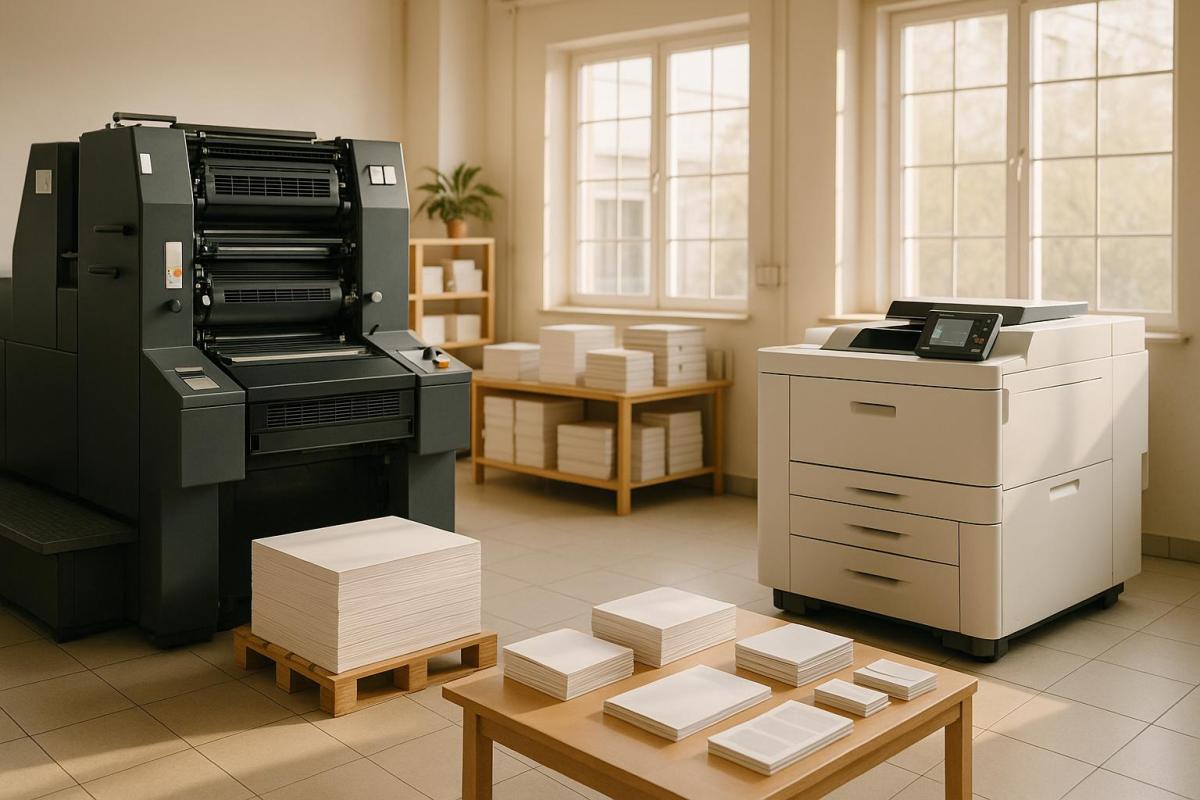
When choosing between offset and digital printing, the right option depends on your project’s size, budget, timeline, and customization needs. Here’s a quick breakdown:
- Offset printing is ideal for large print runs (1,000+ pieces). It offers lower per-unit costs, precise color matching (Pantone), and supports specialty finishes like metallic inks and embossing. However, it has high setup costs ($500–$2,000+) and longer turnaround times (3–7 days).
- Digital printing works best for short runs (1–500 pieces) or projects needing quick turnarounds (same day to 24 hours). It supports personalization (e.g., unique names or promo codes) and has low setup costs, but the per-unit cost remains higher and specialty options are limited.
Key Considerations:
- Quantity: Offset is cost-effective for bulk orders; digital suits smaller runs.
- Budget: Offset saves money on large projects; digital avoids upfront costs.
- Timeline: Digital is faster; offset takes longer due to setup.
- Customization: Digital handles variable data; offset produces identical copies.
For example, if you’re printing 10,000 brochures, offset printing may cost $0.10–$0.20 per piece, compared to $0.25–$0.40 with digital. But for fewer than 500 pieces, digital printing is more practical and flexible.
Quick Comparison:
| Factor | Offset Printing | Digital Printing |
|---|---|---|
| Best For | Large runs (1,000+ pieces) | Short runs (1–500 pieces) |
| Setup Cost | High ($500–$2,000+) | Low ($0–$50) |
| Per-Unit Cost | Low at volume ($0.05–$0.10) | Flat rate ($0.50–$1.00) |
| Turnaround Time | 3–7 days | Same day to 24 hrs |
| Customization | Not supported | Fully supported |
| Specialty Finishes | Extensive options | Limited options |
For businesses, combining both methods can be effective. Use offset for bulk orders like catalogs or brochures, and digital for personalized mailers or quick updates. Services like Miro Printing & Graphics Inc. in Hackensack, NJ, can guide you based on your project’s specifics.
Offset Printing Vs Digital Printing [ Difference & Best ]
Offset Printing: How It Works and When to Use It
Offset printing has long been a cornerstone of commercial printing, and for good reason. Knowing how it works and when it’s the right choice can help businesses make smarter decisions for their printing needs.
How Offset Printing Works
Offset printing starts with the creation of aluminum plates – one for each color. Most jobs require four plates for cyan, magenta, yellow, and black (CMYK), though additional plates might be needed for specialty colors or finishes. These plates are mounted onto the press, where they’re inked. The ink is then transferred to a rubber blanket cylinder, which applies the image onto paper or other materials. This indirect transfer is what defines offset printing.
Before production begins, operators run test sheets to ensure proper alignment and color balance. While calibration takes time, it’s critical for maintaining consistent quality. The process also involves using specialized inks, cleaning agents, and equipment for custom finishes. This meticulous setup is why offset printing is known for its superior results.
Offset Printing Advantages
Offset printing stands out for its outstanding print quality. It produces sharp details and accurate colors, making it ideal for brands that require precise color matching, such as those relying on the Pantone Matching System (PMS). When it comes to large print runs, the cost savings are hard to ignore. For example, printing 10,000 brochures via offset might cost $0.10–$0.20 per piece, compared to $0.25–$0.40 per piece with digital printing .
This method also supports a wide variety of specialty inks and finishes, including metallics, fluorescent colors, embossing, varnishing, and foil stamping. Additionally, it can handle many types of paper, from lightweight newsprint to heavy cardstock, offering creative freedom for designers and marketers.
Offset Printing Drawbacks
The biggest downside to offset printing is its high setup cost, which can range from $200 to $500 or more, depending on the complexity of the job and the number of colors involved. This upfront expense makes it less practical for smaller print runs, where the cost can’t be distributed across a large quantity.
Another limitation is its lack of flexibility for variable data. Since every copy is identical, offset printing isn’t suitable for projects that require personalization, like customized mailings or business cards. The calibration process also generates waste in the form of scrap sheets, which adds to material costs .
Given these factors, offset printing is best suited for high-volume projects that demand consistent, high-quality output. Think magazines, catalogs, corporate brochures, and marketing materials. Companies like Miro Printing & Graphics Inc. use offset printing to deliver precise color accuracy and custom finishes for large-scale projects, ensuring they meet even the most rigorous quality standards.
Digital Printing: How It Works and When to Use It
Digital printing offers speed, flexibility, and the ability to personalize content in ways traditional methods can’t match. Knowing how it operates – and when it’s the right choice – can help businesses make smarter decisions for their printing needs.
How Digital Printing Works
Unlike offset printing, which requires physical plates, digital printing works by transferring images directly from digital files to the printing surface. All you need is a PDF file sent straight to the digital press. Using either toner-based or inkjet systems, the image is applied and fused directly onto the material. This eliminates the need for lengthy setups, test sheets, or waiting for ink to dry. The result? A faster, more streamlined process that’s ready to go almost immediately.
Why Choose Digital Printing?
Digital printing shines when speed, flexibility, and customization are priorities. Here’s why:
- Quick Turnaround: Materials can be printed in just hours, making it a go-to solution for tight deadlines or last-minute projects.
- Cost-Effective for Short Runs: Without the hefty setup fees of offset printing, digital printing is ideal for smaller quantities. Whether you need one piece or a few hundred, the cost per unit stays consistent.
- Personalization: Variable data printing lets you customize each piece with unique details like names, addresses, or promotional codes. In fact, personalized campaigns using this method can boost response rates by up to 36% compared to generic ones.
- Eco-Friendly: Digital printing uses fewer chemicals and generates less waste. Plus, it’s easy to make last-minute updates to digital files without redoing any plates.
However, while digital printing has plenty of perks, it’s not without its limits.
The Drawbacks of Digital Printing
For all its advantages, digital printing does have some constraints:
- Higher Costs for Large Runs: If you’re looking to print thousands of copies (like 5,000 brochures), the per-unit cost of digital printing can add up, making offset printing a more economical choice.
- Limited Specialty Options: Digital presses don’t handle specialty finishes as well as offset presses. Metallic inks, embossing, spot varnishes, and textured papers may not be available or as effective.
- Color Accuracy: While digital printing has come a long way, achieving precise Pantone color matching can still be tricky. For projects requiring flawless color fidelity, offset printing might be a better fit.
Digital printing works best for short-run projects (under 500 pieces), on-demand jobs with tight timelines, or materials that benefit from frequent updates or personalization. Local print services, like Miro Printing & Graphics Inc. in Hackensack, NJ, use digital printing to help businesses produce high-quality, customized marketing materials quickly and efficiently.
sbb-itb-ce53437
Offset vs Digital: Side-by-Side Comparison
When choosing between offset and digital printing, it’s important to weigh how each method performs across key factors, especially when managing bulk orders versus on-demand projects.
Quality and consistency:
Offset printing is unmatched in color accuracy and detail, making it the go-to option for projects that demand precise Pantone color matching. Its plate-based setup ensures consistent quality, even across thousands of copies, which is ideal for high-end marketing materials and packaging. Digital printing, while greatly improved, delivers quality that meets most standard business needs. However, slight inconsistencies in color may appear during long runs or when working with specialty materials.
Cost structure:
Offset printing comes with steep upfront costs due to the need for plate creation and press setup, which can range from hundreds to thousands of dollars. That said, its per-unit cost drops significantly as volume increases, often reaching as low as $0.05 to $0.10 per piece for runs of 10,000 or more. Digital printing, on the other hand, has minimal setup costs, but its per-unit cost remains fixed, typically between $0.50 and $1.00 per piece, making it more cost-effective for shorter runs. This cost difference also impacts production speed and scheduling.
Turnaround time:
Speed is where digital printing shines. Without the need for plate creation or extensive calibration, projects can often be completed within hours. Offset printing, however, requires additional time for setup, including plate preparation and press adjustments, which can extend project timelines by several days. Once setup is done, though, the actual printing process for offset is very fast.
Flexibility and customization:
Digital printing is the clear winner for personalization. It supports variable data printing, allowing unique details – like names, addresses, or promo codes – to be incorporated into each piece without slowing down production. Offset printing, by contrast, is less adaptable; making changes typically requires new plates, adding to the cost and time.
Offset vs Digital Printing Comparison Chart
| Factor | Offset Printing | Digital Printing |
|---|---|---|
| Best For | Large runs (1,000+ pieces) | Short runs (under 500 pieces) |
| Setup Cost | High ($500–$2,000+) | Low ($0–$50) |
| Per-Unit Cost | Low at volume ($0.05–$0.10) | Flat rate ($0.50–$1.00) |
| Turnaround Time | 3–7 days | Same day to 24 hrs |
| Print Quality | Highest, with precise color matching | Very good; meets most needs |
| Color Accuracy | Excellent for Pantone matching | Good, with limits on specialty colors |
| Personalization | Not supported | Fully supported |
| Minimum Quantity | Typically 500–1,000 pieces | As low as 1 piece |
| Paper Options | Wide range, including specialty stocks | Standard to good variety |
| Specialty Finishes | Extensive (metallic, embossing, etc.) | Limited options |
| Environmental Impact | Higher waste and chemical use | Lower waste and fewer chemicals |
| Content Changes | Expensive (requires new plates) | Easy and cost-effective |
Substrate compatibility:
For projects requiring a variety of paper types, thicknesses, or specialty finishes like metallic inks and custom coatings, offset printing has the upper hand. Digital printing works well with most standard papers but can struggle with very thick, textured, or specialty materials.
Miro Printing & Graphics Inc., located in Hackensack, NJ, offers both offset and digital printing. Their expertise allows them to recommend the best approach tailored to your project’s volume, timeline, and customization needs.
How to Choose Between Offset and Digital Printing
Choosing the right printing method depends on a few key factors: project size, budget, timeline, and customization needs. By carefully weighing these elements, you can determine which option best suits your specific requirements.
Quantity is a good starting point. Offset printing becomes cost-effective when you’re producing 1,000 to 5,000 pieces or more. On the other hand, digital printing is ideal for smaller runs and even allows for single-copy orders without additional costs.
Next, think about total costs. Offset printing involves upfront expenses for plate creation and press setup, which can range from several hundred to thousands of dollars. However, the per-unit cost decreases significantly as your order volume increases. Digital printing, meanwhile, has consistent per-unit pricing regardless of quantity, making it a better choice for smaller budgets or short runs.
Deadlines and customization needs are also critical. Digital printing offers quick turnaround times and supports variable data, such as personalized names, addresses, or promo codes. In contrast, offset printing requires extra time for plate creation and press adjustments, making it better suited for projects with static content where every copy is identical.
Quality and material preferences should not be overlooked. If your project demands precise Pantone color matching, specialty inks, or premium finishes, offset printing generally delivers superior results. Digital printing, while sufficient for most standard business needs, may struggle with specialty materials or very thick paper stocks.
Your regular printing habits matter, too. For frequent small batches with updated content – like monthly newsletters or seasonal promotions – digital printing’s flexibility is a major advantage. However, for large-scale projects with static designs, such as annual reports or extensive marketing campaigns, offset printing offers better value due to its economies of scale.
Another consideration is environmental impact. Digital printing tends to produce less waste and uses fewer chemicals, making it a more sustainable option.
For expert guidance, companies like Miro Printing & Graphics Inc. in Hackensack, NJ, can help simplify the decision. With expertise in both offset and digital printing, they can evaluate your project and recommend the best approach.
"Let us know what type of project you are working on, and allow us to offer our expertise."
Beyond printing, Miro provides a range of services, including in-house design, bindery, large-format printing, and mailing fulfillment, ensuring your project is managed seamlessly from start to finish.
If minimizing costs per piece is your priority and your timeline is flexible, offset printing might be the way to go. But if speed, personalization, and flexibility are key, digital printing is likely your best bet.
Making the Right Printing Choice for Your Business
Understanding the benefits of offset and digital printing can help businesses manage costs, improve efficiency, and support growth. The trick is to align your printing method with the specific needs of each project instead of sticking to a one-size-fits-all approach.
Factors like print volume, budget, quality expectations, and deadlines play a big role in determining the best option. For a deeper dive into these considerations, check out the earlier sections.
Often, combining both methods delivers the best results. For example, offset printing works well for producing large quantities of marketing materials, while digital printing is ideal for personalized follow-ups or smaller updates. This blend of techniques offers both cost savings and greater flexibility.
Partnering with a comprehensive print provider, such as Miro Printing & Graphics Inc. in Hackensack, NJ, can simplify the process. Their expertise in both offset and digital printing ensures you’ll make informed choices tailored to your goals.
"Let us know what type of project you are working on, and allow us to offer our expertise."
As market needs evolve, choosing the right printing method remains essential. Offset printing shines for large-scale, budget-conscious projects, while digital printing is perfect for customized materials and fast turnarounds. By understanding both options, businesses can stay responsive to change while keeping costs and quality in check.
FAQs
How do I choose between offset and digital printing for my project?
When choosing between offset and digital printing, it’s important to weigh three key factors: quality, cost, and scalability. Offset printing shines when it comes to large-volume projects, delivering high-quality results and better cost efficiency for bulk orders. In contrast, digital printing is perfect for smaller, on-demand jobs, thanks to its fast turnaround and ability to accommodate customization.
Miro Printing & Graphics Inc., located in Hackensack, NJ, offers both offset and digital printing services, ensuring you get the best option to meet your specific needs. They also provide in-house bindery and design services, making them a one-stop shop for both personal and business printing projects.
What are the environmental differences between offset and digital printing, and which is more eco-friendly?
Offset and digital printing each have their own effects on the environment. Offset printing, which relies on plates and large presses, tends to generate more waste due to setup materials and uses more energy for large print runs. That said, it becomes more efficient for bulk orders, as the waste and energy consumption per unit decrease with higher quantities. In contrast, digital printing is generally a more eco-conscious option for smaller jobs. It eliminates the need for plates, produces less waste, and uses less energy overall.
The choice between these methods depends largely on the scope of your project. For smaller, on-demand printing, digital printing often proves to be the more environmentally friendly option. For large-scale projects, offset printing can be the better choice in terms of efficiency per unit. Consulting with a professional print provider like Miro Printing & Graphics Inc. can help you determine the best method to meet both your project needs and environmental priorities.
Can I use both offset and digital printing for the same project, and what are the advantages?
Yes, it’s possible to use both offset and digital printing for the same project, and this combination can deliver distinct advantages. Offset printing works best for large-volume jobs, offering consistent quality and precision. On the other hand, digital printing is perfect for smaller runs, providing quick turnaround times and flexibility at a lower cost. By blending these two approaches, you can balance affordability with customization, tailoring your project to meet specific requirements without sacrificing quality or efficiency.
Related Blog Posts
- Offset vs. Digital: Paper Size Considerations
- Top 5 Factors for Choosing Printing Methods
- Religious Book Printing: Offset vs. Digital
- Offset vs. Digital: Fogra Color Accuracy
https://app.seobotai.com/banner/banner.js?id=68faf1409cea6427b3fd751e
 BergenCountyPrintersBlogs