Print marketing can be effective, but it’s easy to waste money on avoidable mistakes. Businesses often overspend due to errors in planning, design, production, and distribution. Here’s a quick rundown of the key pitfalls and how to avoid them:
- Poor Planning: Skipping audience research, unclear goals, or ignoring message testing leads to materials that don’t connect or inspire action.
- Design Errors: Typos, outdated info, or technical mistakes (like wrong bleed settings or low-resolution images) result in costly reprints.
- Production Missteps: Using the wrong materials, formats, or print methods can escalate costs unnecessarily.
- Distribution Problems: Outdated mailing lists, duplicate addresses, or poor inventory management waste resources and damage credibility.
Avoid these costly mistakes by planning carefully, double-checking designs, and working with a reliable print partner. Simple steps like testing messaging, using clear CTAs, and tracking results can make a big difference in your ROI.
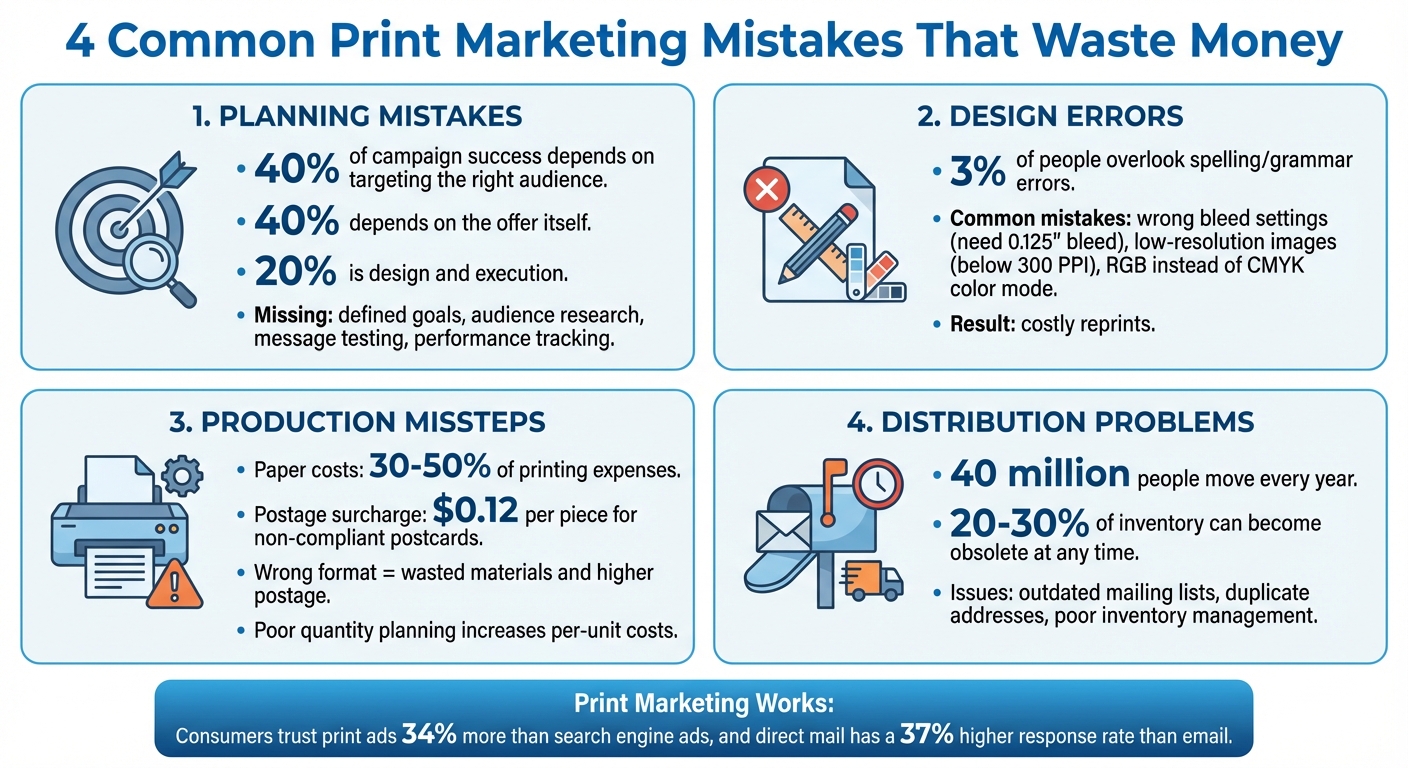
4 Categories of Print Marketing Mistakes That Waste Money
Planning Mistakes That Waste Your Budget
Having a solid plan is essential if you want to avoid throwing money at campaigns that don’t deliver. Rieva Lesonsky, CEO and President of GrowBiz Media, puts it plainly:
"No small business owner wants to waste money, but that’s exactly what you’ll be doing if you start marketing without a marketing plan in place".
Without proper planning, your budget can disappear quickly. Skipping the strategy phase often results in materials that fail to connect, go unused, or don’t achieve measurable outcomes. Let’s break down some common planning missteps.
Printing Without Defined Goals or Target Audience
Launching a print campaign without understanding who you’re targeting or what you want to achieve is a fast track to wasting money. The 40-40-20 rule in marketing highlights that 40% of a campaign’s success relies on reaching the right audience, while another 40% depends on the offer itself. That leaves just 20% for design, execution, and creativity.
If your mailing list is too broad or poorly aligned with your goals, your return on investment (ROI) will suffer. You might end up with stacks of brochures and flyers that don’t inspire action. Without a clear goal, a well-defined audience, and a strong call-to-action (CTA), your materials lose their punch. As Chilliprinting explains:
"If your print materials don’t have a clear call-to-action (CTA), then they are a waste of money".
Skipping Customer Research and Message Testing
Failing to research your audience or test your messaging can lead to campaigns that miss the mark entirely. If you don’t know what your customers care about, your materials are unlikely to resonate.
Smart businesses take the time to test different versions of their messaging with small groups before committing to a full rollout. This approach helps identify what works and what doesn’t. William Dixon, a business writer at OX Essays, emphasizes:
"Stick to one very clear CTA. Be clear and direct with what you want people to do. The CTA should be immediately visible and accessible. Make sure that it’s somewhere obvious on your campaign and that it leads to a goal, whether that’s a sale or a connection".
Not Tracking Results or Measuring Performance
If you don’t track your campaign’s performance, you can’t improve it – or even justify the money you’ve spent. Many businesses print materials without including tools to measure their effectiveness, making it impossible to calculate ROI or confirm that the right audience is being reached.
Incorporating tracking elements like QR codes that link to a specific landing page or custom URLs can help you measure your campaign’s success.
Design Errors That Force Expensive Reprints
Poor planning isn’t the only thing that can drain your budget – design mistakes can be just as costly. Imagine printing thousands of brochures or flyers only to discover glaring errors. There’s no undo button, and you might have to reprint the entire batch, doubling your expenses. The good news? Most of these issues can be avoided with careful attention to detail. Let’s break down some of the most common design missteps that can lead to costly reprints.
Amateur Design Without Print Specifications
One of the biggest culprits behind expensive reprints is ignoring print specifications. For instance, failing to account for bleed – a crucial 0.125-inch area beyond the trim line – can result in white borders or cut-off elements that ruin the final product. Another common mistake is using low-resolution images (anything below 300 PPI), which leads to blurry or pixelated prints. And don’t forget about color modes – designing in RGB instead of converting to CMYK can cause printed colors to look completely different from what you saw on screen. To avoid these headaches, always perform thorough prepress checks before sending files to print.
Overcrowded Layouts With Too Much Information
Even if your technical specs are flawless, a cluttered layout can still sabotage your project. Overloading your design with text and images makes it hard for readers to focus, and your message can get lost in the chaos. As Ann O’Brien from Dazzle Printing wisely points out:
"Always remember, less really is more when it comes to layout and design."
Using white space strategically gives your content room to breathe and ensures your call to action stands out. Stick to no more than two fonts, and keep body text at least 8pt or larger for better readability. When everything in your design demands attention, nothing truly stands out.
Spelling Errors and Outdated Contact Information
Nothing undermines your printed materials faster than a typo or outdated contact information. According to research from Standing Dog Interactive, only 3% of people overlook errors, while the majority see typos and grammar mistakes as deal-breakers. That’s why it’s crucial to have someone else review your content before it goes to print. Whether it’s a colleague or a professional proofreader, a second set of eyes can catch mistakes that spell-checkers might miss. A little extra effort here can save you from an embarrassing – and costly – reprint.
Production Decisions That Drive Up Costs
Once your design is finalized, the production phase can introduce unexpected expenses if you’re not careful. Choices around formats, materials, and printing methods can quickly escalate costs without necessarily improving results. These decisions not only impact your budget but also the overall success of your campaign.
Using the Wrong Print Format for Your Campaign
Picking the wrong format is a frequent misstep. For instance, printing full-size brochures when simple postcards would suffice wastes money on extra paper and postage. The format should align with your campaign’s purpose and how the materials will be distributed. If you’re mailing them, size becomes even more critical – postcards larger than 6″ x 11″ result in higher postage fees. Additionally, postcards must meet specific thickness requirements set by the US Postal Service, such as using a 100# cover stock or higher. Failing to meet these standards can lead to surcharges of $0.12 per piece.
Selecting Materials That Are Too Cheap or Too Expensive
Material selection is another area where costs can spiral. Paper, for example, can account for 30–50% of your printing expenses. Opting for cheap paper might save you money initially, but flimsy materials that tear easily or produce dull colors can ruin your marketing effort. On the other hand, splurging on premium or specialty papers may not always yield better results. For example, textured paper might make thin fonts harder to read or cause full-color images to appear darker than intended. Paper weight also affects mailing expenses – heavier stock leads to higher postage costs. A practical way to manage costs is by consulting your printer about "house sheets", which are often more economical due to bulk purchasing.
Ordering the Wrong Quantity or Using the Wrong Print Method
Ordering too much can leave you with outdated materials, while ordering too little increases your per-unit costs. The quantity also determines the best printing method – digital printing is ideal for small runs, while offset printing becomes more cost-efficient for larger orders. Designers unfamiliar with printing equipment can inadvertently create designs that don’t work with the machines, leading to extra costs. Vladimir Gendelman, Founder and CEO of Company Folders, explains:
"If your designer isn’t an expert on a print shop’s equipment, they may create a design that’s too big for your printer’s folding machine or has foil areas too far apart for one run. Then you end up paying extra because your designer doesn’t know what the machines can and can’t do".
Careful planning of your print specifications can also reduce waste and save money. For instance, adjusting a poster size from 8.5″ x 14″ to 8.5″ x 11″ could allow eight pieces to fit on a single press sheet, cutting paper waste by 25% and lowering press run times.
sbb-itb-ce53437
Distribution Problems That Waste Resources
Efficient distribution is just as crucial as planning, design, and production when it comes to protecting your investment. You could have the most well-thought-out campaign, but if your distribution methods fall short, all that effort and money can go to waste. Mistakes like poor mailing practices or sloppy inventory management can drain budgets and reduce your campaign’s impact. Tackling these issues with the same precision as earlier phases is essential to avoid jeopardizing your entire campaign.
Poor Mailing List Management and Postage Errors
Using outdated mailing lists is a common and costly misstep. With approximately 40 million people moving every year, addresses can quickly become outdated. Sending mail to old addresses not only leads to undeliverable pieces but can also result in additional postage fees from the USPS, even after your campaign ends. Many businesses neglect to update their lists against the National Change of Address (NCOA) database, missing crucial updates for movers.
Duplicate records are another major problem, doubling your postage and printing costs unnecessarily. On top of that, failing to apply suppression criteria means you might be mailing to individuals who are unlikely to respond – such as deceased persons, incarcerated individuals, or even current customers during a new acquisition campaign. Without proper segmentation, targeting prospects solely based on zip codes can misfire, sending your message to the wrong audience and reducing your campaign’s effectiveness. A reliable mail services provider should have tools to clean your data, remove duplicates, and ensure your mailing list is accurate before printing begins.
Mismanagement of Inventory and Outdated Materials
Beyond mailing errors, poor handling of printed materials can wreck your budget. Outdated inventory is a money pit. Research reveals that 20% to 30% of a business’s inventory can become obsolete at any time, often ending up as a financial loss. When materials contain time-sensitive information – like special offers, pricing, or contact details – and are stored for too long, they become unusable. Inefficient inventory tracking can lead to unnecessary reprints while perfectly usable stock goes unnoticed.
Mismanaging versions of materials adds another layer of waste and confusion. Without a proper system in place, you risk distributing outdated brochures with incorrect pricing or old contact information, which can damage your credibility and force costly reprints. These issues often stem from poor forecasting and inadequate tracking systems. Failing to meet customer demands due to inventory mismanagement not only leads to financial losses but also hurts your reputation and erodes trust.
Working With a Print Partner to Reduce Waste
Avoiding waste in print marketing often comes down to having the right expertise on your side. Instead of juggling design, printing, and mailing tasks across different providers, teaming up with a full-service print partner can help you sidestep common – and often costly – errors. A reliable print partner brings knowledge and coordination to every step of the process, from the initial brainstorming phase to the final delivery. This one-stop approach not only keeps your campaign aligned with your goals but also helps you stay on budget and avoid unnecessary headaches.
Getting Expert Input During the Planning Stage
Bringing a print professional into the fold early – right when you’re brainstorming and planning – can save you from running into expensive issues later on. These experts are well-versed in technical details that can easily slip through the cracks, like bleed specifications, color profiles (CMYK vs. RGB), press sheet optimization, and postal regulations. As print consultant Sam Ricco points out, even seasoned professionals benefit from clear guidance to meet budget constraints, comply with postal rules, and ensure designs are accurately reproduced.
By consulting with an expert at the outset, you can align your creative ideas with practical production realities. They can guide you on standard sizes, cost-effective production options, and potential technical challenges before your designs even hit the prepress stage. Since fixing errors after production begins can be far more expensive, this early collaboration helps safeguard your entire budget.
Using One Provider for Design, Printing, and Mailing
Choosing a single provider to handle design, printing, and mailing simplifies your workflow while reducing the risk of miscommunication. Companies like Miro Printing & Graphics Inc. offer an integrated approach, managing every aspect of the project to ensure consistent quality and smooth execution from start to finish.
This all-in-one solution doesn’t just prevent mistakes; it also enhances efficiency. For example, integrated providers can recommend cost-saving strategies like gang printing for multiple versions, optimizing press sheet usage to minimize paper waste, and cleaning up mailing lists with NCOA processing to avoid paying for undeliverable mail. Clients of Miro Printing & Graphics Inc. have praised their streamlined processes, with one highlighting their quick turnaround at a fair price and another noting their willingness to provide prompt, no-cost reprints for overlooked errors.
Conclusion
Mistakes in print marketing can drain your budget, but with thoughtful planning, smart design, and efficient production, they’re entirely avoidable. Planning with purpose helps set clear goals, focus on the right audience, and track outcomes effectively. Professional design ensures technical details are handled upfront, avoiding costly reprints. And efficient production tailors formats, materials, and quantities to minimize waste.
One of the best ways to avoid these pitfalls is by working with a full-service provider that manages everything from design to delivery. A single partner brings coordinated expertise to the table, catching errors early, streamlining production, and even cleaning up mailing lists for maximum effectiveness.
The results speak for themselves. Studies show that consumers trust print ads 34% more than search engine ads, and direct mail boasts a 37% higher response rate than email.
Miro Printing & Graphics Inc. provides end-to-end solutions, including planning, design, printing, bindery, and mailing. Their integrated approach safeguards your investment while delivering impactful print materials that stand out.
FAQs
How can I make sure my print marketing reaches the right audience?
To make sure your print marketing campaign hits the mark, start with solid market research. Pinpoint your ideal customers, understand their interests, and figure out the best ways to connect with them. Skipping this step can lead to wasted resources and disappointing results. Once you’ve nailed down your audience, keep your mailing list up-to-date and segmented. This ensures your materials reach only those who fit your target profile.
After identifying your audience, focus on personalizing your message. With variable-data printing, you can add customized details like names, past purchases, or location-specific offers. This transforms generic content into something that feels personal and relevant. Pair this with a clear, time-sensitive call-to-action – like "Order by December 31 to save 20%" – and include a way to track performance, such as a unique QR code or promo code. These tools help measure success and refine future campaigns.
Miro Printing & Graphics Inc. has the tools and expertise to help you run a targeted, effective print campaign. They handle everything from list verification and segmentation to high-quality, custom printing and fulfillment services. With their help, your campaign can be impactful, efficient, and easy to monitor.
How can I avoid costly reprints caused by design mistakes?
To avoid costly reprints, make sure your design files are set up to meet professional printing standards. Start with high-resolution images (at least 300 dpi), add proper bleed margins, and always work in CMYK color mode. Common problems like blurry images or unexpected color shifts often come from using low-resolution files or the wrong color format.
Carefully review all text for typos and errors. Better yet, have a second pair of eyes proofread your content – small mistakes can lead to big expenses if a reprint is needed. Before giving the green light on any project, always request a printed or digital proof. This step helps you verify colors, margins, and the overall layout, saving both time and money.
Partnering with a full-service print shop, such as Miro Printing & Graphics Inc., can make this process much smoother. Their in-house design team, file preflight checks, and fast proofing services ensure your materials are polished and ready to impress, catching potential issues before they become expensive problems.
How can I measure the success of my print marketing campaigns?
Measuring the success of your print marketing campaigns is essential for understanding your return on investment (ROI) and refining your strategy. Start by defining specific, measurable goals – like aiming to generate 200 new leads or achieve $5,000 in sales. To track progress, focus on key performance indicators (KPIs) such as:
- Response rate: The percentage of recipients who take action.
- Conversion rate: How many responses result in actual customers.
- Cost per lead: The expense associated with acquiring each lead.
- Overall ROI: The financial return compared to your investment.
To make tracking easier, include elements in your printed materials that can be measured. Think unique URLs, QR codes, special phone numbers, or coupon codes – these tools help directly connect customer actions to your campaign. For example, companies like Miro Printing & Graphics Inc. can integrate these features into your materials during production, making data collection straightforward.
After your campaign wraps up, dive into the results and compare them to your initial goals. Pinpoint what resonated most – whether it was a particular design, offer, or call-to-action – and use those insights to refine your next effort. By continuously analyzing your data, you can transform print marketing into a strategy that delivers measurable, impactful results.
Related Blog Posts
- How to Save on Print Marketing Costs
- 10 Tips for Cost-Effective Print Design
- Common Post-Press Quality Issues and Fixes
- 5 Ways to Cut Direct Mail Printing Costs
https://app.seobotai.com/banner/banner.js?id=69434a5412e0ddc125dbf966
 BergenCountyPrintersBlogs