
When printing banners, size and shape are critical for visibility and effectiveness. Here’s what you need to know:
- Text Visibility Rule: For every 10 feet of viewing distance, text should be at least 1 inch tall.
- Standard Sizes: Common options like 2’x4′, 3’x6′, or 4’x8′ fit various settings – from store shelves to outdoor events.
- Custom Sizes: Sizes can range from small (1’x2′) to large (up to 8’x20′), but larger banners may require seams.
- Shape Options: Rectangular banners are versatile, while flag or teardrop shapes are ideal for windy outdoor areas.
- Finishing Details: Grommets, pole pockets, and hems affect design margins – leave a 2-inch safe zone around edges.
- Material Choices: Vinyl (13 oz or 18 oz) suits most uses, while mesh works for windy conditions, and double-sided banners prevent light bleed.
Measure your display area carefully, consider viewing distance, and work with professionals for precise results.
Standard Banner Sizes and Their Uses
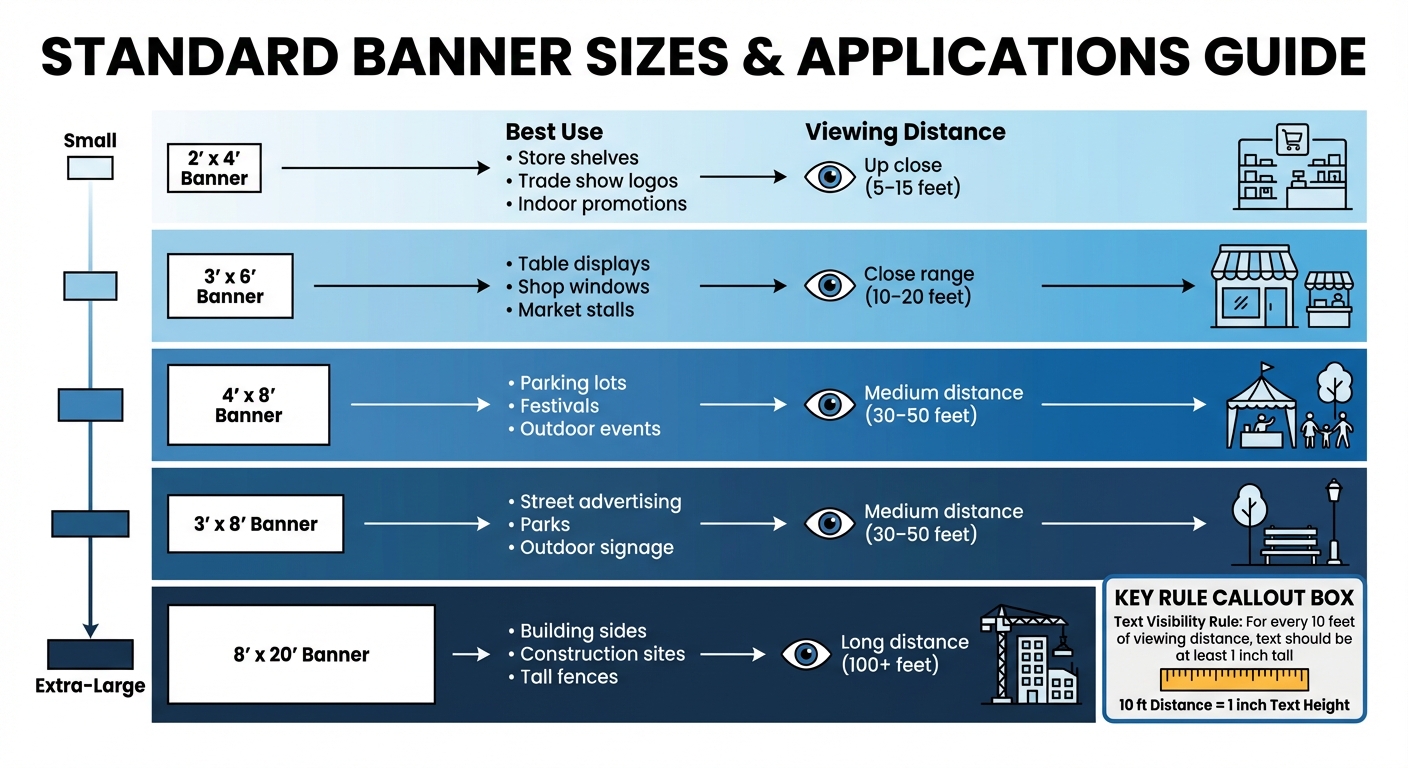
Banner Size Guide: Dimensions, Viewing Distance, and Best Use Cases
Common Sizes and Where to Use Them
Standard banner sizes are tailored to fit specific environments, making them versatile for various settings. For example, a 4′ x 8′ banner works perfectly outdoors – think parking lots, festivals, or open fields. On the other hand, a 2′ x 6′ banner is great for indoor events, fitting neatly across standard table fronts at trade shows or conferences. If you’re targeting outdoor advertising, a 3′ x 8′ banner is commonly used in places like street displays or parks.
Smaller banners, like the 2′ x 4′, are ideal for close-range indoor promotions. They’re perfect for store shelf call-outs, trade show logos, or checkout counter displays where the audience is just a few feet away. The 3′ x 6′ banner offers a middle-ground option, making it a good choice for market stalls or shop window displays . For large-scale impact, 8′ x 20′ banners are designed to cover building sides, construction sites, or tall fences, ensuring your message is visible even from a significant distance.
| Banner Size | Best Use Case | Viewing Distance |
|---|---|---|
| 2′ x 4′ | Store shelves, trade show logos, indoor promotions | Up close (5–15 feet) |
| 3′ x 6′ | Table displays, shop windows, market stalls | Close range (10–20 feet) |
| 4′ x 8′ | Parking lots, festivals, outdoor events | Medium distance (30–50 feet) |
| 3′ x 8′ | Street advertising, parks, outdoor signage | Medium distance (30–50 feet) |
| 8′ x 20′ | Building sides, construction sites, tall fences | Long distance (100+ feet) |
These standard sizes not only cater to a wide range of display needs but also simplify the production and installation process.
Why Standard Sizes Make Sense
Opting for standard banner sizes can save you time and money. Print shops often stock these dimensions, making production faster and more cost-efficient. While standard sizes typically take 1–5 business days to produce, custom-sized banners require additional setup and come with higher costs .
"Choosing the appropriate banner dimensions is the most crucial step before creating a design. Skipping this step can lead to potential problems during installation." – Nermae De Asis, 48HourPrint.com
Another advantage of standard sizes is their design convenience. Many print shops provide free templates with preset bleeds and margins, making it easier to create a polished and professional banner.
Custom Banner Sizes: What’s Possible
What Limits Custom Sizes
Custom banners can be tailored to almost any size, but there are practical limits dictated by equipment capabilities, materials, and local rules. Typically, banners start as small as 1′ x 2′ or 2′ x 2′, with tabletop retractable banners being even more compact at 11.5" x 16". For larger displays, standard equipment can handle sizes up to 8′ x 20′ or 20′ x 10′.
Digital printers generally max out at 52 inches in width for a single piece, meaning larger banners require seams and additional finishing work like stitching and hemming.
Other factors like viewing distance, the space available, and your budget also influence banner size. Oversized banners can dominate a space in an unflattering way, and their larger dimensions can significantly increase costs for materials, ink, and labor. Additionally, local zoning regulations may impose restrictions on the maximum allowable size.
Given these constraints, taking precise measurements is key to ensuring your banner fits perfectly.
Getting Your Measurements Right
Getting the dimensions right is crucial for a banner that fits well and grabs attention. Before placing an order, measure the installation area carefully. Always present the dimensions in Width by Height (W x H) format, where the width is listed first.
To account for finishing touches like grommets, leave a 2-inch margin around all edges. For artwork, vector files such as AI, EPS, or PDF are ideal since they can scale to any size without losing quality. If you’re using raster files like JPEGs, follow these resolution standards: 100% scale at 100 dpi, 50% scale at 200 dpi, or 25% scale at 300 dpi.
Banner Shape Options
Square and Rectangular Banners
Square and rectangular banners are go-to choices for custom printing, thanks to their versatility and ease of use. These shapes naturally align with architectural features like walls, fences, and building exteriors, making installation straightforward with options like grommets, pole pockets, or hems.
Horizontal banners – such as a 3′ x 10′ design – are perfect for outdoor spaces like fences or building walls, especially when showcasing longer text. On the other hand, vertical banners – like a 6′ x 2′ format – are well-suited for pole displays, narrow indoor areas, and concise messaging like logos or short phrases.
These standard rectangular shapes also help keep costs manageable. They’re easier to produce, ship, and store, plus they work seamlessly with widely available mounting hardware.
If you’re looking to stand out further, exploring non-standard shapes can make your banner design more distinctive.
Non-Standard Shapes
While rectangles and squares cover most needs, unique shapes can serve specific purposes. Flag banners – such as feather, teardrop, and angled styles – are especially effective in high-motion outdoor settings like roadsides or trade shows. Feather flags, for instance, provide ample vertical space for text, while teardrop flags stay taut within their frames, ensuring visibility even in windy conditions.
For interactive displays, breakaway banners feature a two-piece design with a Velcro strip in the center, often used in athletic events. Wall stickers, on the other hand, can be custom-cut into nearly any shape to match your branding or message.
That said, custom shapes come with added complexity and higher costs. Designers often rely on 3D modeling tools to perfect these designs before printing, minimizing the risk of errors. Additionally, mounting these banners requires careful planning, as non-standard shapes need specialized hardware to maintain proper tension and avoid distorting the message.
Choosing a dynamic banner shape not only impacts the design but also influences finishing and mounting decisions. These considerations play a key role in ensuring your banner’s overall effectiveness.
sbb-itb-ce53437
How Finishing Options Affect Banner Dimensions
Common Finishing Methods
The finishing choices you make for your banner can significantly influence how much of its surface is available for your design. For instance, grommets, typically spaced every 2 feet, provide sturdy mounting points for ropes, zip ties, or bungees. However, they require a consistent 2-inch safe zone from all edges to ensure that text and graphics remain unobstructed .
Another popular option is pole pockets, which create a sleeve along the top or side of the banner for inserting a pole or rod. These come in standard sizes – 2 inches for poles with a 1-inch diameter and 4 inches for poles with a 2-inch diameter. Keep in mind that the material used for the pole pockets won’t be visible in the final design, so you’ll need to account for this extra material during the design process.
Reinforced edges and hemming are essential for durability, especially for outdoor banners. Heat-welded hems form a strong, permanent bond, often more reliable than sewn edges. Adding webbing – nylon strips sewn into the hem – further reinforces the banner, reducing the risk of grommets tearing out in windy conditions. These reinforcements can add bulk to the edges, potentially obscuring parts of your design if not accounted for during layout.
Each finishing method impacts the design process, so careful planning is crucial to ensure your artwork fits seamlessly.
Designing Around Finishing
To avoid issues with finishing elements, always adhere to the 2-inch margin guideline mentioned earlier when placing text and logos . This ensures critical design elements remain clear and unaffected.
For retractable banner stands, anticipate losing up to 6 inches of artwork at the bottom where the banner connects to the base, as well as an additional 0.5 inches at the top for the hanger. Adjust your design accordingly to avoid cutting off important details.
Before submitting your artwork, convert fonts to outlines to prevent any unexpected shifts during production. If your banner requires extra material for attachment – such as a flex face banner needing 6 inches on all sides for frame mounting – be sure to include these measurements in your file dimensions.
"If extra material is needed beyond the graphic, it must be included in the file. Gregory, Inc. is not liable for missing margin material if not included."
It’s also worth noting that large-format printing typically has a tolerance of 1/8 inch per foot when cutting to size. Building some flexibility into your design can help accommodate these minor variations.
How Material Choice Affects Size and Shape
The material you choose for your banner plays a big role in determining its size options and durability in various conditions. Vinyl stands out as one of the most versatile materials, supporting dimensions from 2’x2′ to 10’x50′. The material’s weight, measured in ounces per square yard, is a key factor in deciding its suitability for specific applications.
Let’s dive into how different vinyl weights and other materials perform under various conditions.
Vinyl Banners: 13 oz vs. 18 oz Vinyl
Standard 13 oz vinyl is a reliable choice for most indoor and outdoor uses. It strikes a good balance between durability and cost, with an outdoor lifespan of about 2–3 years. This option works well for banners within the common size range of 2’x2′ to 10’x50′, making it a popular pick for general advertising.
Heavy-duty 18 oz vinyl, on the other hand, is built for tougher conditions. With a lifespan of 3–5 years outdoors, it’s ideal for high-stress environments like pole-mounted banners exposed to strong winds. For banners wider than 9.5 feet, regardless of weight, multiple pieces must be welded together, and double-sided printing isn’t an option for these larger sizes.
For specific environmental needs, materials like mesh and double-sided vinyl offer specialized solutions.
Mesh and Double-Sided Banners
Mesh banners, weighing 8 oz, are designed for large outdoor setups. Their perforated structure allows wind to pass through, preventing the banner from acting like a sail, which could lead to tears or hardware damage. Although mesh banners have about 70% opacity, they’re a top choice for windy locations like fence wraps, where solid vinyl might not hold up as well.
Double-sided banners require a different approach to material selection. To prevent light bleed and maintain image clarity, blockout vinyl – typically a 13 oz material labeled as DSS – is essential. Without this layer, the reverse image can show through, reducing the banner’s readability. These banners are great for displays viewed from multiple angles, such as hanging signs in retail spaces or banners suspended from ceilings. However, they’re limited to standard sizes and aren’t available in the oversized dimensions used for single-sided banners.
Choosing the Right Banner Size and Shape
When selecting a banner, think about where it will be displayed, how far viewers will be from it, and its purpose. A good rule of thumb is the 1-inch-per-10-feet rule: for every 10 feet of viewing distance, the font height should be at least 1 inch . For instance, if your banner will be viewed from 50 feet away, the text should be at least 5 inches tall.
The banner’s location also influences its dimensions. Smaller banners, like 2′ x 3′ or 4′ x 2′, are great for close-range displays such as checkout counters or window signage . For high-traffic areas like busy streets or intersections, bigger banners – 8′ x 4′ to 10′ x 5′ – stand out better amidst the visual clutter . In malls, vertical banners (e.g., 2′ x 6′ or 4′ x 6′) work well since they’re often viewed from below. Horizontal banners, on the other hand, are ideal for storefronts and fences . Tailoring your banner size and shape to the setting ensures it grabs attention, whether in a quiet retail spot or at a lively event.
Before placing an order, measure your display space carefully. For example, trade show booths, which are typically 10′ x 10′, pair well with banners sized 4′ x 4′ or 8′ x 4′. To boost readability, aim for 30%–50% of the banner space to remain as whitespace . Using sans-serif fonts, such as Helvetica or Arial, also helps keep the design clean and easy to read on larger banners. Precise measurements and thoughtful design margins, as previously discussed, are crucial for creating an effective banner.
Working with experts can make all the difference. Clients often praise Miro Printing & Graphics Inc., based in Hackensack, NJ, for their attention to detail. Their team ensures your design scales perfectly, avoiding common issues like distorted images or cropped text during production . They also offer personalized consultations tailored to your needs and budget, along with pre-press services like layout adjustments, color correction, and design assistance.
"I even received a video of my print sample… for approval before they proceeded with the rest. Best service I’ve ever received from a printer." – Julia I.
"Miro Printing & Graphics Inc. will work with a professional, personal approach to better understand your company’s needs. The end result is a finished piece that exceeds your highest expectations but never your budget!" – Miro Printing & Graphics Inc.
FAQs
How can I choose the right banner size for my event?
Choosing the right banner size for your event involves a few important considerations. Start by thinking about the purpose of the banner and the location where it will be displayed. Be sure to measure the available space to ensure the banner fits well and can be easily seen from the intended viewing distance.
Another key factor is whether the banner will be used indoors or outdoors. Outdoor banners often need to be larger to grab attention in open spaces. Also, consider your audience and how far away they’ll be when reading the banner. A size that makes your message clear and readable from a distance is essential for making an impact.
By keeping these factors in mind – purpose, location, and viewing distance – you’ll be able to choose a banner size that works perfectly for your event.
What are the advantages of choosing unique banner shapes?
Choosing distinctive banner shapes can instantly set your display apart, grabbing attention more effectively than traditional rectangular designs. Custom shapes bring a fresh visual element while strengthening your brand identity by leaving a lasting impression. Plus, they can be designed to fit unique spaces or align with specific themes, ensuring your message is showcased in the most eye-catching and impactful way.
How does the material you choose impact a banner’s durability?
The choice of material is key to how well a banner holds up, particularly against weather, water, and regular wear. Vinyl and mesh vinyl are standout options for outdoor banners. They’re waterproof and can endure harsh conditions, often lasting more than three years. Meanwhile, fabric banners, though they offer a polished and attractive look, don’t hold up as long. They’re best suited for indoor settings or short-term displays.
To ensure durability, think about where the banner will be placed and select a material that aligns with its purpose.
Related Blog Posts
- Standard Print Sizes Explained
- Indoor vs Outdoor Banners: Key Differences
- How to Choose Durable Banner Materials for Outdoors
- Checklist for Custom Banner Dimensions
https://app.seobotai.com/banner/banner.js?id=6972bc8812006df351784588
 BergenCountyPrintersBlogs