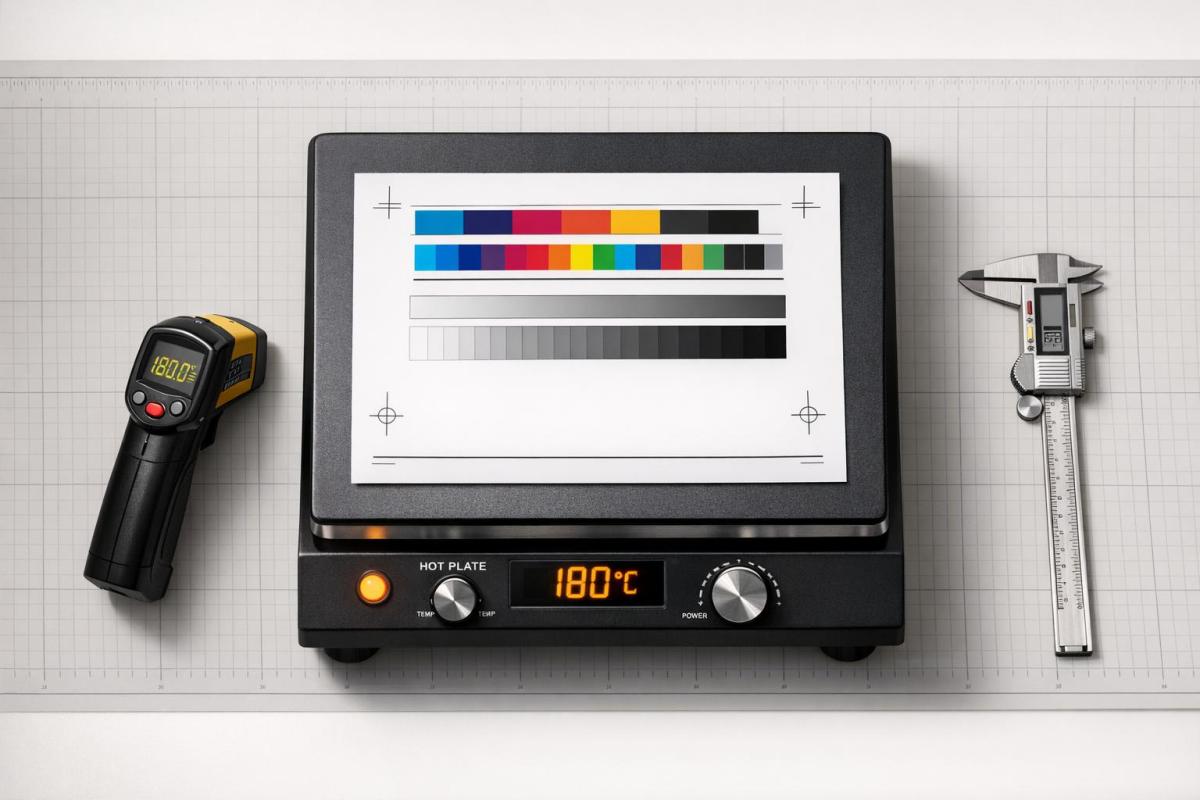
Heat testing in printing ensures materials like inks, substrates, and coatings can withstand high temperatures and stress during production and use. It’s crucial for maintaining quality, preventing defects, and meeting performance expectations. Standards from ISO and ASTM guide these processes, offering benchmarks for consistent results across various printing methods, including offset and digital. Key points include:
- ISO Standards: Cover ink color, transparency, and drying methods (e.g., ISO 2846-1, ISO 12647-2).
- ASTM Standards: Focus on testing methods like ink setting speed (e.g., ASTM D6073-08a) and substrate heat resistance (e.g., ASTM D648).
- Applications: Used in packaging, signage, and specialty prints (e.g., labels for refillable bottles).
International Standards for Heat Testing
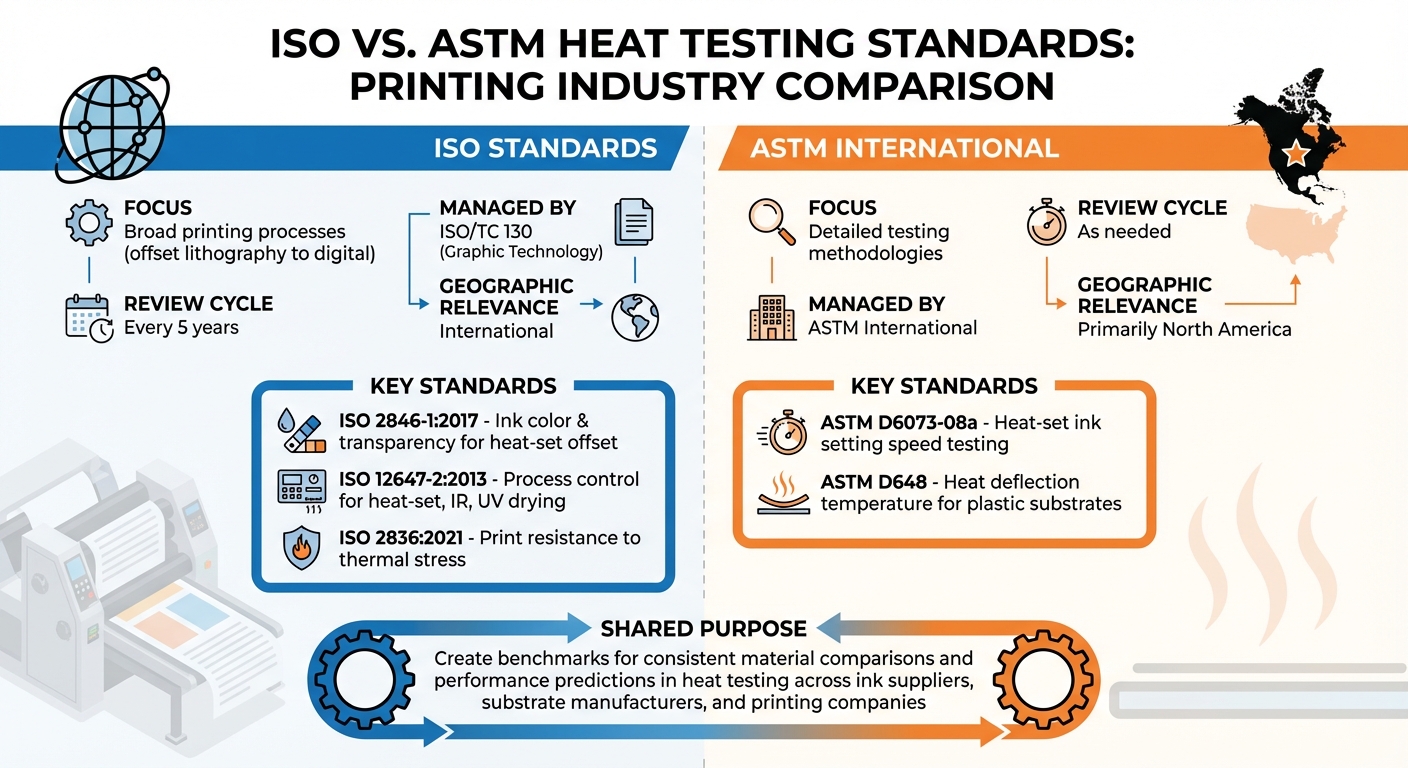
ISO vs ASTM Heat Testing Standards for Printing Industry
Two major organizations – ISO and ASTM International – set the standards that allow for direct comparisons of materials and accurate performance predictions in heat testing. These benchmarks create a shared framework for ink suppliers, substrate manufacturers, and printing companies, ensuring everyone is on the same page about performance expectations before production starts. Without these guidelines, it would be nearly impossible to reliably compare materials or predict how printed products will behave under thermal stress.
ISO focuses on a broad range of printing processes, from traditional offset lithography to advanced digital methods. These standards are managed by ISO/TC 130 (Graphic Technology) and are reviewed every five years to stay aligned with technological progress. Meanwhile, ASTM standards are particularly relevant in North America, offering detailed testing methodologies that ensure consistent procedures across the board. Below are some of the key ISO and ASTM standards shaping the industry.
ISO Standards for Heat Resistance
- ISO 2846-1:2017: This standard specifies ink color and transparency under controlled conditions, ensuring ink sets used in heat-set web offset lithography meet strict requirements. Laboratory printability testers are used to verify performance, supporting consistent quality control in printed materials.
- ISO 12647-2:2013: Currently under revision (Stage 90.92), this standard defines process control parameters for various drying methods, including heat-set, infrared, and ultraviolet. It focuses on offset lithography, setting clear guidelines for maintaining consistent quality during production.
- ISO 2836:2021: This standard addresses the resistance of prints to various agents, including thermal stress. It applies to both traditional methods like offset and flexography and digital techniques such as inkjet and electrophotography. By ensuring printed materials can endure environmental challenges, it supports reliable quality control throughout the product lifecycle.
ASTM Standards in Heat Testing
While ISO sets overarching performance criteria, ASTM focuses on precise testing methods to measure these properties.
- ASTM D6073-08a: This method tests the heat-set ink setting speed using a controlled hot-air oven and print delivery system. It helps verify that printed materials can perform under thermal stress. The test is often conducted in direct letterpress mode, as the thicker ink films in this setup make it easier to detect subtle differences in setting speeds. However, it’s important to note that lab results may not directly predict performance on large-scale production presses.
- ASTM D648: This standard measures the heat deflection temperature of plastic substrates, ensuring they maintain structural integrity under high temperatures. It’s particularly important for specialty applications involving synthetic substrates that need to stay dimensionally stable during thermal processing.
sbb-itb-ce53437
ISO 2846-1: Ink Quality in Heat-Set Offset Printing
ISO 2846-1:2017 sets precise color and transparency standards for process color inks – cyan, magenta, yellow, and black – used in sheet-fed, heat-set, and radiation-curing lithography. This standard ensures that inks from different manufacturers produce consistent colors when applied to a common reference substrate at the correct film thickness, which is crucial for maintaining uniformity across production sites. Below, you’ll find details on the testing methods and conformance criteria that make this standard a cornerstone of quality control.
The standard accounts for both physical drying (like evaporation in a forced-air oven) and chemical drying (via oxidation or absorption), ensuring inks meet stringent quality expectations.
Using the CIELAB system, ISO 2846-1 defines specific color targets. For example:
- Yellow ink must reach L* = 91.00, a* = –5.08, and b* = 94.97, with a tolerance of ΔE_ab ≤ 4.0.
- Black ink must have an L* value no higher than 18.0.
These detailed measurements help ensure printed materials can withstand heat without compromising quality, meeting the demands of modern printing standards.
Test Methods for Ink Performance
To verify ink performance, specific testing procedures are carried out under controlled conditions.
Color measurements follow ISO 13655 guidelines, using either 0°:45° or 45°:0° geometry. Test prints are created on a laboratory tester (per ISO 2834-1), then dried according to the manufacturer’s instructions before analysis. Transparency testing involves printing chromatic inks on a black substrate at different film thicknesses. The transparency value (T) is determined as the reciprocal of the slope of the regression line between ink film thickness and the resulting color difference (ΔE*ab). Minimum transparency thresholds are:
- Yellow ink: T ≥ 0.08
- Magenta ink: T ≥ 0.12
- Cyan ink: T ≥ 0.20
Conformance Requirements for Offset Printing
Meeting ISO 2846-1 conformance criteria ensures inks perform reliably across various production settings.
To comply, inks must meet the defined colorimetric and transparency standards at film thicknesses between 0.7 and 1.1 µm. This range reflects typical production variability. Tests are conducted using the C2846 reference substrate, which replaced the older APCO II/II substrate in the 2017 update. The standard underwent its latest review in December 2022 and remains valid through 2026.
For manufacturers seeking certification, Fogra offers testing services for UV and heat-set inks. Costs are $2,186.67 for members and $2,934.75 for non-members. Additionally, the ISO 2846-1 document can be purchased for $100.
At Miro Printing & Graphics Inc., we adhere to these internationally recognized standards in our heat-set offset printing operations. This commitment ensures every project meets rigorous color and transparency benchmarks, delivering consistent, high-quality results.
ISO 12647 Series: Printing Process Standards with Thermal Factors
The ISO 12647 series fine-tunes printing process control by incorporating thermal factors into its standards, building on established heat testing criteria.
This series sets detailed guidelines for printing, with Part 2 focusing on offset lithography and heat-based drying methods. It applies to heat-set, infrared (IR), and ultraviolet (UV) drying processes, ensuring consistent quality across these thermal methods. The standard addresses parameters like color separations, printing forms, and production prints, emphasizing how heat impacts the final output.
"ISO 12647-2:2013… is applicable for all kinds of drying methods such as heat-set, infrared, and ultraviolet."
Key thermal parameters defined in the standard include ink transparency, TVI (tone value increase) per paper type, and CIELAB solid-tone values. These measurements ensure color accuracy and consistency for heat-set web offset printing. The current 2013 version is undergoing updates, with Edition 4 registered as a committee draft on November 10, 2025. These updates aim to align the standards with advancements in thermal printing technology.
Updates to ISO 12647-2 for Heat-Set Web Offset
Recent revisions to ISO 12647-2 focus on improving the alignment between proof and production prints by updating ink solids and TVI curves. A significant change is the mandatory use of measurement mode M1, which simulates D50 lighting with UV content. This adjustment accounts for optical brightening agents (OBAs) often found in modern papers used in heat-set processes.
The updated standard also introduces new data sets – FOGRA51 for premium coated papers and FOGRA52 for wood-free, high-OBA, uncoated papers. These data sets provide precise CIELAB values tailored for heat-set operations, ensuring compliance with earlier colorimetric benchmarks. Visual evaluations should be conducted under D50 norm light as specified in ISO 3664:2009, and processes should be calibrated using the specific TVI curves for the chosen paper type and drying method.
Applications for Digital Printing Quality
The principles from earlier standards extend to digital printing, ensuring it meets rigorous thermal quality control requirements. ISO 12647-7 applies these thermal process standards to digital proofing, enabling digital proofs to accurately simulate production conditions for heat-set offset and other thermal-based methods. This 23-page standard (priced at CHF 135) offers a framework for digital systems to replicate the appearance of materials produced using heat-set drying. It complements ISO 12647-8, which focuses on validation prints for digital systems.
Practical Applications and Benefits of Heat Testing Standards
Heat testing standards play a crucial role in improving performance and reducing waste by establishing clear benchmarks. These benchmarks allow businesses to predict how materials will perform before moving into full production.
Maintaining Consistency Across Printing Projects
Achieving uniformity across print runs depends on managing key factors like ink drying and color reproduction. For instance, ASTM D6073 evaluates the setting speed of heatset inks, offering a dependable standard for agreements between ink suppliers and printers. Similarly, ISO 12647-8 ensures that digital proofs closely match production results, cutting down on the need for multiple physical proofs. These standards not only streamline the printing process but also improve the durability and quality of the final products.
Improving Durability of Printed Materials
Beyond consistency, heat testing strengthens the long-term durability of printed materials. Standards such as ISO/TS 21139-1, ISO 18930:2011, and ISO/IEC 22592-3:2025 help safeguard material integrity throughout a product’s lifecycle. For example:
- ISO/TS 21139-1:2019 simulates environmental stressors for commercial prints like flyers, signage, and packaging, ensuring they hold up under real-world conditions.
-
ISO 18930:2011 addresses physical degradation issues, highlighting that factors like embrittlement, cracking, or delamination often determine a material’s lifespan rather than image stability. As noted:
physical degradation such as support embrittlement, image layer cracking, or delamination of an image layer from its support, rather than image stability, will determine the useful life of a print material.
- ISO/IEC 22592-3:2025 evaluates thermal blocking to ensure that office color prints remain intact when exposed to heat during transport or use.
Additionally, accelerated aging tests, such as ASTM D6819, use dry oven exposure to measure the mechanical strength of paper over time. This helps manufacturers identify stable materials early on, reducing waste and avoiding product failures that could disappoint customers.
At Miro Printing & Graphics Inc., we strictly follow these rigorous heat testing standards to ensure our printing processes deliver consistent, durable, and high-quality results every time.
Conclusion
Heat and thermal resistance testing plays a crucial role in maintaining quality assurance within the printing industry. These standards ensure that inks dry properly under specific thermal conditions while preventing defects like blistering on coated papers during heatset printing. Without such guidelines, achieving consistent results and reliable performance predictions would be nearly impossible.
These standards also foster clear communication between suppliers and customers. As highlighted in ASTM D6073-08a:
The setting speed of heatset printing inks is important because it influences the efficiency of the drying process.
By providing a standardized framework, both parties can agree on measurable performance benchmarks, reducing uncertainty and minimizing waste.
Beyond consistency, these standards open doors to global markets. The Association for PRINT Technologies explains:
These standards allow manufacturers to design and build equipment to a single set of safety standards, regardless of the country of import/export.
This uniformity simplifies international trade, ensuring that quality expectations remain consistent across different regions.
For businesses and clients alike, adhering to heat testing standards delivers practical benefits: prints that withstand environmental stress, materials that remain intact during transport and storage, and final products that meet durability requirements. By controlling factors like forced air temperature, airflow rates, and heat exposure time, these standards help prevent physical damage that could jeopardize a project’s success.
At Miro Printing & Graphics Inc., we are dedicated to following stringent heat testing protocols to ensure every project meets the highest quality expectations, delivering results you can count on.
FAQs
Which ISO and ASTM standards should I use for my print job?
For heat testing in printing, here are some key standards to follow:
- ASTM D6073-20: Focuses on evaluating heatset inks to ensure their performance under heat conditions.
- ASTM D6819-02e3: Covers accelerated temperature aging of paper, helping to assess how paper withstands prolonged exposure to heat.
- ISO 2834-1:2020: Provides methods for preparing test prints using paste inks, crucial for consistent testing.
These standards help maintain accuracy and reliability when assessing thermal resistance and durability in printing materials.
How do I choose the right heat test conditions for my materials?
To determine the best heat test conditions, aim to mimic your actual printing environment as closely as you can. Pay attention to key factors such as the type of substrate, the thickness of the ink film, air temperature, airflow, and the duration of heat exposure. For consistent and reliable comparisons of heatset ink performance, use established methods like ASTM D6073-20. These standards help maintain uniformity in testing under controlled conditions.
Why can lab heat-test results differ from production press results?
Lab heat-test results often vary from production press outcomes because of differences in testing conditions, substrates, load variations, and external factors. These elements can influence how well the test results reflect actual production performance. It’s crucial to keep these variables in mind when analyzing and applying the findings.
Related Blog Posts
- ISO 2846: Ink Color Standards Explained
- Proofing Standards in Printing: Key ISO Guidelines
- How ISO 12647 Ensures Print Quality
- Binding Quality Control: Strength Testing Insights
https://app.seobotai.com/banner/banner.js?id=698fc036efc60cc2af06e5bf
 BergenCountyPrintersBlogs