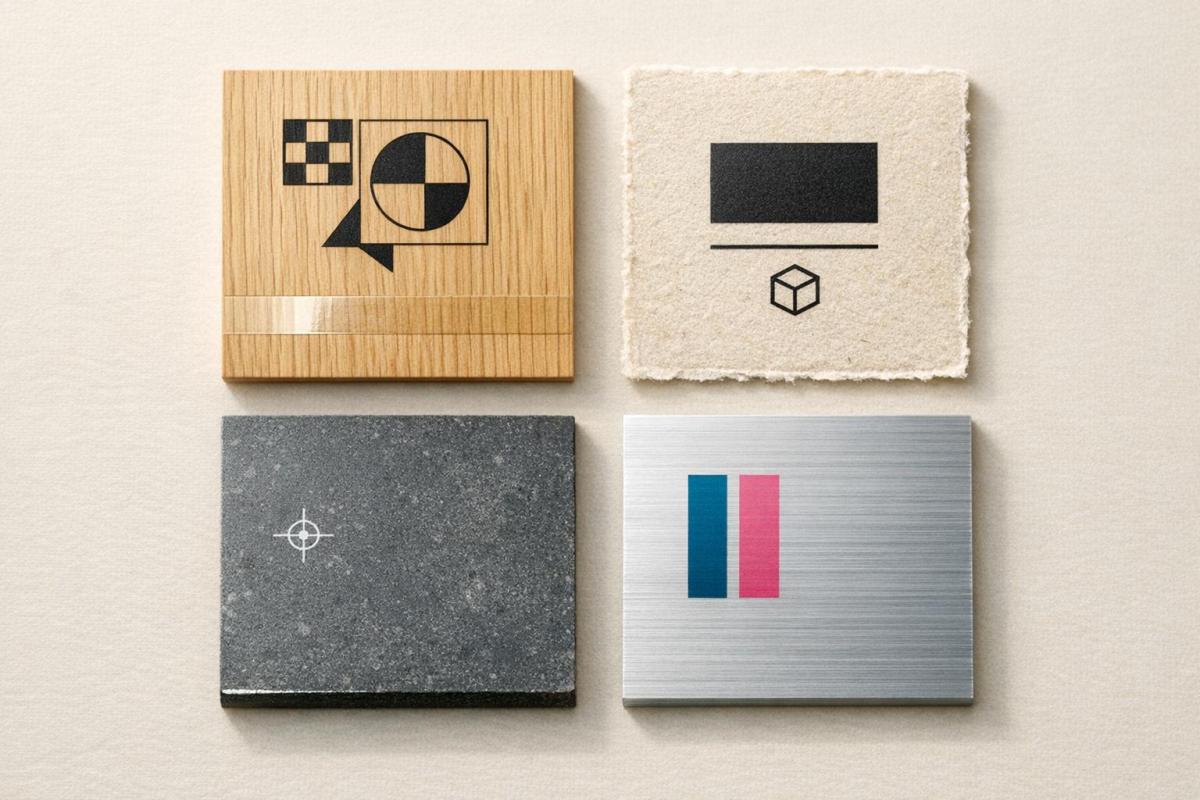
Specialty substrates are transforming the printing industry by offering materials beyond paper and cardboard. These include wood veneer, bamboo, hemp, stone-based papers, metal, and glass. They deliver unique textures, durability, and eco-conscious options for businesses aiming to stand out. Here’s what you need to know:
- Materials: Options like wood veneer, natural fibers (bamboo, hemp, cotton), and stone-based papers offer durability, moisture resistance, and premium aesthetics.
- Applications: Perfect for signage, luxury packaging, custom awards, and promotional items.
- Preparation & Printing: Proper surface prep (sanding, sealing) and using the right printing techniques (UV inkjet, offset) are critical for high-quality results.
- Benefits: These substrates resist wear, water, and chemicals, making them ideal for outdoor or high-touch uses.
For businesses, partnering with experts ensures flawless execution and long-lasting results. Specialty substrates aren’t just a surface – they’re a statement.
Golden Digital Ground – Printing on Specialty Papers
sbb-itb-ce53437
Wood Veneer Substrates
Wood veneer adds a sophisticated, natural touch to custom printing projects. It’s made by bonding a thin decorative wood layer – typically between 1/25" and 1/50" (1.0 mm to 0.51 mm) thick – to a core material like MDF, particleboard, or plywood. This combination offers not just visual appeal but also structural stability, making wood veneer a standout choice among specialty substrates.
Natural wood veneers dominate the market, accounting for about 60% of total sales. These veneers are sliced directly from logs such as oak, walnut, cherry, mahogany, and maple, showcasing the unique grain patterns of each species. For projects requiring uniformity over large areas, engineered wood veneers are created by reconstructing natural wood fibers into consistent patterns. Reconstituted veneers – making up around 25% of the market – are crafted from real wood fibers (commonly poplar or pine) and designed to mimic the appearance of rarer species. This option is both cost-effective and environmentally conscious. The fastest-growing segment, digitally printed wood veneer, enables custom high-resolution designs, from logos to intricate imagery, offering unmatched flexibility.
"Opt for natural wood veneer if you want to highlight the natural beauty of wood, especially in projects where grain patterns are a key design feature."
– Steve Kitts, JSO Wood Products
Types of Wood Veneer
Each type of wood veneer brings its own strengths to the table:
- Natural veneer: Perfect for luxury designs where organic grain patterns add character and uniqueness.
- Engineered veneer: Offers consistent patterns, making it ideal for sleek, modern spaces.
- Reconstituted veneer: Balances affordability and sustainability, catering to high-volume needs.
- Digitally printed veneer: Delivers limitless design possibilities, making it a favorite for branded or themed environments.
Surface Preparation Methods
Achieving professional results on wood veneer starts with proper surface preparation. Begin by cleaning the veneer with 99% isopropyl or denatured alcohol to remove dust and residues. Always handle the material with gloves to avoid contamination from skin oils.
For MDF or particleboard cores, lightly sand the surface with 80-grit sandpaper to create a texture that improves ink or adhesive bonding. Test readiness with a water drop test – if water doesn’t absorb within 10 seconds, additional sanding is needed.
Since untreated wood veneer is porous, UV ink can sometimes absorb unevenly, leading to fuzzy prints. To prevent this, apply a sanding sealer, primer, or a 25% matte varnish as a pore sealant before printing. Allow the veneer and core to acclimate together for 48 hours to avoid warping during production.
Ink Adhesion Problems and Fixes
Even with careful preparation, adhesion issues can occur. For example:
- Ink beading: This happens when the surface is too smooth or has low energy. A quick scuff sanding with 60- to 100-grit sandpaper can fix this.
- Fuzzy or ghosted images: High porosity can cause ink to diffuse into the fibers. A sealing coat applied beforehand can resolve this.
- Ink cracking: Heated conveyor dryers can over-dry wood fibers, causing cracks. Air drying is a better option, as it allows moisture to dissipate naturally. For UV printing, regularly inspect curing lamps to ensure even curing and prevent tacky spots.
"Untreated wood might need a primer or 25% matte varnish layer to seal it. Otherwise, UV ink may partially absorb into the surface and ‘spread out,’ which may lead to lower image quality."
– Philip Chu, Product Manager for UV and Specialty Devices, Roland DGA
To confirm proper ink adhesion, perform a cross-hatch tape test. With these steps in place, wood veneer becomes a versatile and reliable substrate for premium printing projects. Next, we’ll delve into natural fiber substrates to explore even more specialty printing options.
Natural Fiber Substrates
Building on our discussion of wood veneers, natural fiber substrates offer a blend of organic textures and eco-friendly aesthetics. These materials fall into three primary groups: cellulose fibers (plant-based, such as cotton), bast fibers (stem-based, like hemp, linen, and jute), and protein fibers (animal-based, including silk and wool). Each category has unique traits that influence how ink interacts with the surface and affects overall print quality.
Cotton is the most commonly used natural fiber. Its softness and absorbency make it ideal for both screen and digital printing. Typically, cotton used for printing ranges from 120 to 180 GSM (grams per square meter). However, it’s prone to shrinking, so heat fixation must be handled with care.
Linen, derived from flax, stands out for its strength and quick-drying abilities. With weights generally between 150 and 200 GSM, it’s heavier than cotton and has a natural sheen. However, its low elasticity makes it stiffer and more likely to wrinkle, although it softens over time. Bold designs tend to work better on linen, as its coarse texture can obscure finer details.
Hemp is incredibly strong, with a tensile strength of 550–900 MPa. It resists mold naturally and can absorb 7–9% of its weight in moisture without feeling damp. Despite these advantages, hemp paper is about six times more expensive than traditional wood-fiber paper due to limited processing facilities. Jute, another bast fiber, is a more affordable option with moderate strength (250–500 MPa) and a higher moisture regain of 10–12%. Its rough texture is well-suited for industrial uses, packaging, and home décor.
"The fabric directly affects the value proposition behind the final product."
– Nessan Cleary
Each fiber type requires specific pre-treatment methods to achieve the best printing results.
Properties of Natural Fibers
The chemical composition of natural fibers plays a key role in their print performance. For instance, hemp contains 70–74% cellulose and only 5–8% lignin, contributing to its exceptional strength and durability. Linen has a similar cellulose content (64.1–71.9%), while jute features slightly lower cellulose levels (60–70%) and higher lignin content (10–13%), giving it a rougher texture.
All natural fibers are hydrophilic, meaning they naturally absorb water due to the hydroxyl groups in their lignocellulose structure. While this property enhances ink absorption and produces vibrant colors, it can also lead to excessive ink spread (dot gain) and bleeding if not properly managed.
The growing demand for environmentally friendly materials has made natural fibers increasingly popular. By 2024, 67% of fashion and merchandise companies were expected to require suppliers to use eco-friendly materials. Hemp, for example, absorbs more carbon dioxide than trees and uses significantly less water compared to cotton. These sustainable materials often command a 15–30% price premium over conventional textiles.
Wool is known for its excellent moisture management, capable of absorbing up to 30% of its weight in moisture without feeling wet. It’s highly valued for insulation and luxury winter clothing. Silk, the only natural filament fiber, creates a unique shimmering effect due to its triangular prism-like structure. Its high tensile strength and dyeability make it a favorite for upscale printing projects, although it requires acid dye inks and careful steaming post-print for the best results.
Pre-Treatment for Ink Application
Proper pre-treatment is essential for achieving high-quality prints on natural fibers. Industry data shows that 60–80% of textile printing defects can be traced back to issues in fabric preparation. As the saying goes:
"The golden rule in the dyeing of textiles is that a fabric well prepared is a fabric half dyed."
– CottonWorks
The preparation process begins with scouring, which removes dirt, oils, and natural waxes that can interfere with ink absorption. Natural fibers often have a waxy outer layer that must be stripped away to allow for even ink bonding. Next, bleaching eliminates color and impurities, creating a uniform white base for accurate color reproduction. For cotton, mercerization – a treatment with caustic soda – enhances strength, luster, and dye absorption, resulting in brighter, longer-lasting prints. Finally, singeing burns off loose fibers to create a smoother surface, improving the sharpness of printed designs.
Before printing, ensure the fabric is absorbent, clean, and flat – commonly referred to as "Prepared for Printing". A quick water drop test can verify readiness: if water beads on the surface instead of soaking in, additional scouring may be needed.
Chemical coatings and primers are applied as a final step to optimize the fabric for printing. These coatings often include thickeners to prevent ink bleeding and maintain sharp image quality. The type of coating depends on the ink being used. For reactive dyes (suitable for cellulose fibers like cotton and linen), alkali-based top coatings enable the dyes to form chemical bonds with the fibers. For pigment inks, which don’t naturally adhere to fibers, binders or resin systems are used to secure the color particles to the fabric surface.
"Pigments exist in a particle state… The process of pigment printing utilizes a binder system since pigments inherently lack an affinity for cotton fabric."
– Faujia Mushtari, TexSPACE Today
Once printed, fixation processes lock the design in place. Reactive dyes require steaming and washing to remove unreacted dyes and restore the fabric’s softness. Pigment inks, on the other hand, need dry heat curing at 300–325°F to set the binders. When working with pigments, finding the right balance is crucial – while more binder improves durability, it can also make the fabric feel stiff.
For digital inkjet systems, pre-heating the fabric or using specialized coatings helps control ink spread and bleeding. This step is especially important for bast fibers like hemp and linen, as their coarse textures can cause unpredictable ink behavior. Additionally, always preshrink natural fibers before printing to prevent image distortion during heat fixation, as natural fibers are prone to shrinking. These preparation techniques ensure the unique qualities of each material are preserved while delivering top-tier print results.
Next, we’ll dive into printing methods that maximize the potential of these substrates.
Printing Techniques for Specialty Substrates
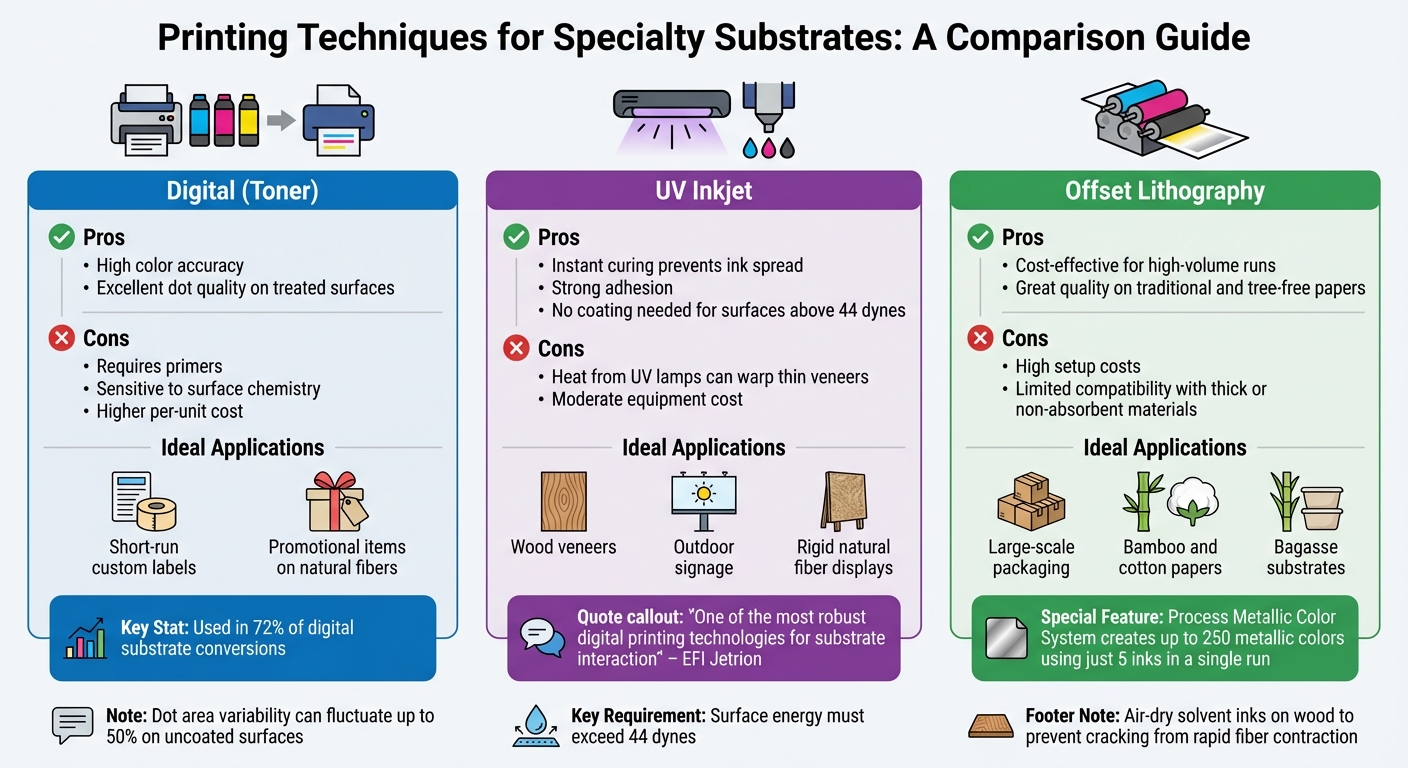
Comparison of Digital, UV Inkjet, and Offset Printing Techniques for Specialty Substrates
When working with wood veneers and natural fibers, selecting the right printing method is key to achieving high-quality results. The interaction between the substrate and printing technology can make or break the final product.
Digital, UV, and Offset Printing
Different printing technologies offer unique benefits depending on the substrate. UV inkjet is particularly versatile for specialty materials. Its instant curing process prevents ink from soaking into porous materials, making it a great choice for wood veneers and coarse natural fibers.
"UV inkjet is one of the most robust digital printing technologies around in terms of substrate interaction" – EFI Jetrion
For optimal results, ensure the substrate’s surface energy exceeds 44 dynes. If not, treatments like corona or flame must be applied.
Liquid toner technology is another strong option, used in about 72% of digital substrate conversions. It offers exceptional color accuracy but requires precise surface preparation. The ink bonds at a molecular level, sometimes as thin as 50 layers, making surface chemistry critical. Substrates like natural fibers and wood veneers often need pre-applied coatings or primers to ensure consistency. Without these treatments, dot area variability can fluctuate by up to 50% on uncoated surfaces.
Offset lithography works well for tree-free papers like bamboo, cotton, and bagasse, especially for high-volume projects. However, it’s less effective with thicker or less absorbent materials.
"Offset lithography is more limited in substrate choice… But exotic choices are available, workable, and more readily obtainable" – Trish Wales
When using natural fiber papers such as bagasse, confirm the fiber strength with your supplier. Shorter fibers can negatively impact print quality. For wood veneers, pre-optimized surfaces are essential to prevent ink absorption issues. Applying a sanding sealer can help block ink absorption, while solvent-based inks should be air-dried to avoid rapid fiber contraction.
"Drying ink on a wood surface is especially troublesome when using a heated conveyor dryer, because the wood fibers dry and contract too rapidly, which results in cracks" – Johnny Shell, Vice President of Technical Services at SGIA
Printing Technique Comparison
| Technique | Pros | Cons | Ideal Applications |
|---|---|---|---|
| Digital (Toner) | High color accuracy; excellent dot quality on treated surfaces | Requires primers; sensitive to surface chemistry; higher per-unit cost | Short-run custom labels, promotional items on natural fibers |
| UV Inkjet | Instant curing prevents ink spread; strong adhesion; no coating needed for surfaces above 44 dynes | Heat from UV lamps can warp thin veneers; moderate equipment cost | Wood veneers, outdoor signage, rigid natural fiber displays |
| Offset | Cost-effective for high-volume runs; great quality on traditional and tree-free papers | High setup costs; limited compatibility with thick or non-absorbent materials | Large-scale packaging, bamboo and cotton papers, bagasse substrates |
For specialty projects, the Process Metallic Color System offers a unique advantage, allowing up to 250 metallic colors to be produced using just five inks in a single run. This feature enhances the natural look of materials like wood and fibers.
These techniques provide a solid foundation for creating custom printed items, from signage to promotional products, while maintaining the integrity of specialty substrates.
Applications in Custom Printing
Specialty substrates like wood veneer bring a distinct charm to printing projects, turning them into memorable branding opportunities. The natural warmth and texture of wood veneer make it a standout choice for both signage and promotional uses.
Signage and Packaging
Wood veneer is often the go-to material for high-end signage and architectural branding. From lobby signs to wayfinding elements and dimensional branding, it provides a polished, professional look that’s hard to match. It’s even ideal for construction site signs like "Future Home of…" displays or corporate lobby installations where a sophisticated appearance is key.
"Wood is an eye-catching alternative to synthetic materials, offering warmth, texture, and durability that stands out in both indoor and outdoor applications." – Steve, Thysse
In the world of packaging, wood veneer brings an unmistakable luxury feel. Popular uses include wine bottle boxes, labels, candy boxes, and flower packaging. Retailers also use wood substrates for pedestals, footwear walls, platforms, and freestanding point-of-purchase displays, combining strength with visual appeal.
Choosing the right wood type is critical. Plywood-based veneers are excellent for outdoor signage due to their durability and resistance to weather. On the other hand, MDF (Medium-Density Fiberboard) works best for indoor displays, as it’s prone to warping in moist environments.
Beyond signage and packaging, wood veneer shines in creating unique awards and promotional items.
Awards and Promotional Items
Wood veneer’s natural beauty makes it a perfect choice for custom plaques, nameplates, and interior decor like wall art or branded conference room accents. Techniques like laser engraving and etching add precision and dimension, making awards and promotional pieces truly stand out.
For items with curved surfaces, such as electronics casings, 0.6 mm paper-backed veneers offer the flexibility needed for a perfect fit. Plus, wood veneer is incredibly resource-efficient, offering a 40:1 surface ratio advantage over solid wood. This means a single log can produce 40 times more usable material while reducing carbon emissions by 40% to 70%. Fast-growing species like bamboo and poplar provide renewable options, with bamboo maturing in just 3–5 years and poplar in 10–15 years. For environmentally conscious brands, FSC or PEFC certifications ensure sustainability.
Reclaimed wood offers an additional layer of uniqueness. Salvaged from old barns or industrial buildings, it brings a rich patina and a compelling story of sustainability to any project.
Working with Miro Printing & Graphics Inc.
Full-Service Solutions for Specialty Substrates
When it comes to custom projects that require specialty substrates like wood veneer or natural fibers, Miro Printing & Graphics Inc., based in Hackensack, NJ, is a standout partner. They bring extensive expertise to every stage of the process, from substrate testing to finishing, ensuring a tailored and high-quality result. Their direct-to-substrate printing technology skips the need for transfer paper, allowing digital images to be printed directly onto materials with exceptional detail and precision.
Using UV-curing inks, Miro ensures strong adhesion to textured surfaces such as wood and specialty fibers. Their two-stage UV curing process not only secures the print but also enhances its durability, helping your wood veneer signage or natural fiber packaging look great even under tough conditions. This attention to detail ensures long-lasting results that meet both functional and aesthetic needs.
In addition to printing, Miro offers a full range of in-house finishing services, including die-cutting, scoring, folding, and laminating. Whether you need slip-resistant laminates for wood displays or custom shapes for unique promotional items, they handle it all under one roof. Their digital, offset, and large-format printing capabilities provide the flexibility to tackle projects of all sizes, from small custom awards to large-scale signage. This combination of advanced technology and comprehensive services makes partnering with a local expert like Miro a smart choice.
Benefits of Working with Local Experts
Collaborating with a local provider like Miro Printing & Graphics Inc. offers more than just technical expertise – it adds a layer of personalized service that enhances the entire process. Their team works closely with clients to select the right materials, whether it’s wallcoverings, textiles, rigid boards, or synthetic papers, ensuring the project aligns with both functional and aesthetic goals. During early consultations, they address key factors such as project goals, application (indoor or outdoor), installation surface, appearance, durability, budget, and timeline.
"In digital print, the substrate isn’t just something you print on – it’s a strategic tool. It influences quality, sustainability, cost, and customer satisfaction." – Substrate Bank
Local expertise also ensures consistency across materials and locations. Miro’s understanding of how inks interact with challenging surfaces like metal, wood, and plastic helps avoid common problems like bleeding, warping, or poor adhesion. Their quick turnaround times and personalized service make it easy to conduct test runs and make adjustments as needed. For businesses looking to create tactile, memorable branding through alternative surfaces, Miro offers both the quality and convenience needed to bring those ideas to life.
Conclusion
Specialty substrates like wood veneer and natural fibers bring a rustic charm and a high-end feel to custom printing that standard paper simply can’t replicate. But getting great results means understanding the quirks of each material. For instance, wood substrates absorb moisture unevenly, while natural fibers can vary in quality from batch to batch.
Preparation is critical when working with these materials. Wood often needs a sanding sealer to manage ink absorption, and natural fibers may require pre-treatment to ensure the ink adheres properly. As Johnny Shell, Vice President of Technical Services at SGIA, wisely points out:
"The end result is only as good as the compatibility between the ink and the wood sealer; therefore, test before you print."
Skipping these steps can lead to problems like ink bleeding, warping, or a lack of durability. Taking the time to prepare properly sets the stage for printing success.
Choosing the right printing method is just as important. UV-cured inks, for example, provide strong adhesion on textured surfaces, while digital printing offers the precision needed for intricate designs. Each material-ink pairing has unique requirements – heated dryers might crack wood fibers, and some materials need longer curing times for adhesives to fully set.
Working with experienced professionals can make all the difference. Miro Printing & Graphics Inc., based in Hackensack, NJ, is a great example of a company that blends technical know-how with a range of in-house services. From testing substrates to using advanced direct-to-substrate printing and two-stage UV curing, they ensure your wood veneer signage or natural fiber packaging looks stunning and holds up over time.
Whether you’re crafting eco-friendly packaging, tactile promotional materials, or custom awards, the substrate you choose plays a key role in shaping the customer experience. Partnering with local experts who understand the complexities of these materials ensures your project delivers the quality and professionalism your brand demands.
FAQs
What is the best specialty substrate for outdoor use?
Polycarbonate and acrylic are strong options for outdoor applications because they offer UV resistance, long-lasting durability, and the toughness to handle different weather conditions. These materials are built to hold up well, even under constant sunlight and challenging environments.
Do I need primers or sealers before printing on wood or fabric?
Primers or sealers are commonly suggested to improve ink adhesion and ensure better print quality when working with materials like wood or fabric. Whether or not they’re required largely depends on the surface characteristics of the material and any existing coatings. Performing a few quick tests can help you figure out if applying a primer or sealer is necessary.
How can I prevent warping, bleeding, or poor ink adhesion?
When working with specialty substrates, issues like warping, bleeding, or poor ink adhesion can arise if the materials and techniques aren’t well-matched. To avoid these problems, it’s crucial to select compatible materials and printing methods. Here’s what to focus on:
- Ink selection: Use inks specifically formulated for the substrate you’re working with.
- Moisture content: Ensure the substrate’s moisture level falls within the ideal range of 4.7% to 5.3%.
- Heat resistance: Verify that the substrate can withstand temperatures of up to 200°C.
For substrates like wood veneer or natural fibers, proper surface preparation and thorough testing are essential. Always align your printing technology to the substrate and conduct preliminary tests to guarantee a smooth process.
Related Blog Posts
- Substrate Selection for Digital Printing
- Common Substrate Defects in Printing
- Ultimate Guide to Textured Printing Effects
- Substrate Selection for Print Quality
https://app.seobotai.com/banner/banner.js?id=699bdad8efc60cc2af093f63
 BergenCountyPrintersBlogs