When shipping packages, understanding the difference between tracking and delivery confirmation is key to choosing the right service for your needs. Here’s the quick breakdown:
- Tracking: Provides updates on your package’s journey, from drop-off to final delivery. Ideal for monitoring progress, addressing delays, and managing time-sensitive shipments.
- Delivery Confirmation: Offers proof of delivery with a timestamp showing when and where the package was delivered. Best for verifying receipt, especially for legal or high-value items.
Key Points:
- Use Tracking: When you need real-time updates and visibility into the shipping process.
- Use Delivery Confirmation: When proof of delivery is the priority, especially for critical documents or contracts.
Choosing the right option helps you save costs, avoid disputes, and ensure your shipments meet their goals. Let’s dive deeper into how these services work and when to use each.
Joe explains how to get cheap tracking for a letter
sbb-itb-ce53437
What Is Tracking?
Tracking is a system designed to monitor a package’s journey from the sender to the recipient. Each shipment is assigned a unique tracking number, which acts as its identifier throughout the delivery process. This number allows you to check the package’s location at any point, from the initial acceptance scan to its final delivery.
The process relies on barcode scans at various transit points. These scans capture critical details like the package’s identity, location, time, and status in real time. This information is then made available online, giving you access to the package’s current status, its transit history, and even specific delivery details – such as whether it was left in a mailbox, at a reception desk, or with a neighbor.
How Tracking Works
Once a package enters the postal system, it is scanned at every major stop along its route – sorting facilities, warehouses, and transit hubs. Each scan creates a chronological record of its progress. For example, you might see updates showing when the package left the origin facility, reached a regional distribution center, departed for the destination city, and arrived at the local post office for final delivery.
USPS retains tracking records for varying lengths of time based on the service type. Standard USPS Tracking data is stored for 120 days, while Certified Mail and Registered Mail records are kept for up to two years. Some advanced tracking systems even monitor environmental factors like temperature, humidity, and pressure, which is particularly useful for sensitive shipments such as specialized printing materials.
Benefits of Tracking for Custom Printing Shipments
Tracking is especially valuable for custom printing projects, offering full visibility into the shipment’s progress. For time-sensitive materials – like event invitations or promotional brochures tied to specific dates – tracking helps you monitor delivery timelines and address potential delays before they become a problem.
Studies reveal that 93% of consumers want to track their items at every stage of delivery. On average, customers check tracking pages 3.5 times per order. Proactive tracking updates can also help reduce the roughly 21% of customer inquiries related to "Where Is My Order".
At Miro Printing & Graphics Inc. (https://bergencountyprinters.com), we use advanced tracking systems to keep a close eye on every custom printing order. This approach ensures transparency and gives our clients peace of mind, allowing them to focus on their projects while we handle the logistics.
With tracking providing visibility into shipment progress, the next section will delve into delivery confirmation, which offers the final proof of receipt.
What Is Delivery Confirmation?
Delivery confirmation focuses on verifying the final delivery of a package, unlike tracking, which follows every step along the way. It provides proof of delivery by recording details like the date, time, and status of the package’s arrival. While it doesn’t offer updates on the package’s journey, it uses scans at the start and end points to confirm delivery. This makes it a simple and budget-friendly solution when you need evidence that your package was received.
How Delivery Confirmation Works
When your package is delivered, the postal worker scans its barcode, creating a timestamped record of the delivery. This record includes the exact date and time, making it easy to verify later. USPS keeps these records for one year for standard services and two years for Certified Mail .
For items of higher value or importance, you can choose Signature Confirmation. This option requires the recipient to sign for the package, providing an added layer of accountability by documenting the recipient’s signature. It’s an extra step that ensures secure delivery for sensitive or critical items.
Benefits of Delivery Confirmation for Custom Printing Orders
Delivery confirmation is particularly useful for items like legal documents, contracts, or other confidential materials. For example, when Miro Printing & Graphics Inc. handles sensitive projects such as compliance notices or business communications, delivery confirmation offers clients the reassurance of proof that their materials reached their destination.
"If your document or record is lost or stolen, your Certified Mail receipt constitutes legal proof that you sent it." – Pitney Bowes
This service is included at no extra charge with Priority Mail, Priority Mail Express, and Parcel Select, making it an affordable option for custom printing needs. For highly sensitive deliveries, you can add Restricted Delivery, which ensures only the intended recipient can sign for the package. This is especially helpful for handling medical records, proprietary business information, or legal agreements.
Main Differences Between Tracking and Delivery Confirmation
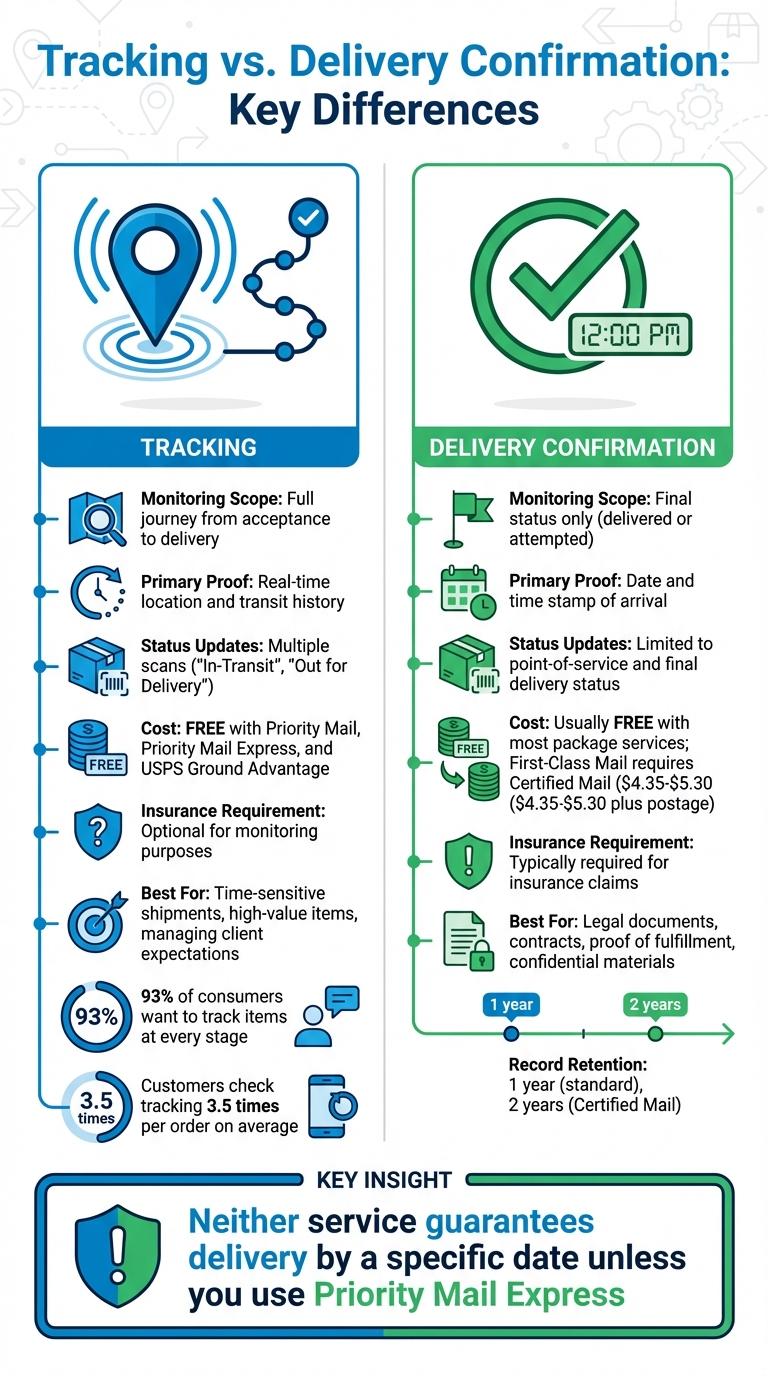
Tracking vs Delivery Confirmation: Key Differences Comparison Chart
Tracking and delivery confirmation serve different purposes when it comes to shipping custom printed materials. Tracking provides a detailed record of a shipment’s journey, while delivery confirmation focuses solely on verifying that a package was delivered – or that delivery was attempted – by recording a timestamp.
The key difference lies in visibility versus verification. Tracking offers continuous updates, helping clients stay informed about their shipment’s progress. Delivery confirmation, on the other hand, provides documented evidence that the package reached its destination. As one industry expert puts it:
"The only way to track your mail or have visibility from mailing to destination points is to send it via Express Mail… delivery confirmation is an inexpensive service that a customer must add… it does not track your mail, it only confirms the date and time of delivery." – VIPparcel
Neither service guarantees delivery by a specific date, but both are useful for documenting the shipping process, especially for custom printing orders. Below is a comparison of their primary features.
Comparison Table: Tracking vs. Delivery Confirmation
| Feature | Tracking | Delivery Confirmation |
|---|---|---|
| Monitoring Scope | Full journey from acceptance to delivery | Final status only (delivered or attempted) |
| Primary Proof | Real-time location and transit history | Date and time stamp of arrival |
| Status Updates | Multiple scans like "In-Transit" or "Out for Delivery" | Limited to point-of-service and final delivery status |
| Cost | Included free with Priority Mail, Priority Mail Express, and USPS Ground Advantage | Usually free with most package services; for First-Class Mail, add Certified Mail ($4.35–$5.30 plus postage) |
| Insurance Requirement | Optional for monitoring purposes | Typically required for insurance claims |
| Custom Printing Use | Helps manage shipping timelines and client expectations | Provides proof of fulfillment for contracts and legal documents |
When to Use Tracking or Delivery Confirmation for Custom Printing
Deciding between tracking and delivery confirmation depends on your specific custom printing needs. Tracking is ideal for keeping an eye on your shipment’s journey, while delivery confirmation works best when you need proof that the package arrived.
Use Tracking for Real-Time Updates
Tracking is perfect for situations where you need up-to-the-minute updates on your shipment. Services like Express Mail offer detailed tracking with multiple status updates, such as "Moving Through Network", "Out for Delivery", and "Delivered".
This is especially useful for time-sensitive or large-scale print orders, like marketing materials for a product launch, event handouts, or business cards for an upcoming trade show. Tracking helps you anticipate delays and keep your clients informed if something goes off schedule. As an added bonus, Express Mail includes $100 of insurance in its standard price.
But when your primary concern shifts to confirming receipt, delivery confirmation becomes the better option.
Use Delivery Confirmation for Documented Receipt
Delivery confirmation is the go-to choice when you need official proof that your custom printing order has been delivered. This is critical for items like legal documents, contracts, tax forms, or insurance claims. Certified Mail is a great option here, as it provides a mailing receipt and retains delivery records for a full year after the package is delivered.
For high-value shipments or items that shouldn’t be left unattended, you can add a signature requirement. This ensures the package is handed directly to the recipient, creating a clear chain of custody.
Conclusion: Choosing the Right Option for Your Needs
As we’ve explored, tracking offers continuous updates throughout a package’s journey, while delivery confirmation provides proof that the item has reached its destination with a recorded date and time. Each serves a distinct purpose, helping you make an informed decision based on your shipping priorities.
For shipments requiring close monitoring – like high-value items, large-scale signage, or urgent proofs – tracking is the better choice. Many premium services, such as Express Mail, include tracking and even offer perks like $100 of insurance. On the other hand, for routine or high-volume mailings, delivery confirmation offers a cost-effective way to verify receipt without the need for detailed transit updates.
It’s important to note that neither option guarantees a specific delivery date unless you opt for a service like Priority Mail Express.
At Miro Printing & Graphics Inc., we’re here to guide you toward the best shipping solution for your needs. Whether you require full tracking for critical deliveries or economical delivery confirmation for bulk orders, we’ll help ensure your custom printing projects are handled with care and precision.
FAQs
Can I get both tracking and delivery confirmation on one shipment?
Tracking and delivery confirmation are two separate but complementary services that can give you peace of mind when shipping packages. Tracking lets you follow your shipment’s journey, offering updates on its location and status. Meanwhile, delivery confirmation provides proof that the package was successfully delivered to the recipient. Many carriers now combine these features, allowing for real-time updates along with verification of delivery. This is especially useful for sending important or high-value items.
What should I do if my tracking hasn’t updated in days?
If your tracking information hasn’t been updated, give it a few days to see if there are any changes. If the status still doesn’t update, reach out to USPS customer service or stop by your local post office. They can help look into the delay and give you more details about your package’s whereabouts.
Do I need a signature for high-value printed orders?
For high-value printed orders, a signature is usually required upon delivery. This helps ensure secure receipt and serves as proof that the item was delivered. It’s especially crucial for items that are considered valuable or sensitive. Be sure to check with your shipping provider for any specific guidelines or requirements.
Related Blog Posts
- What Are Mailing and Fulfillment Services?
- 8 Metrics to Track Direct Mail Success
- Checklist for Packaging and Delivery Quality
- Checklist for Direct Mail Compliance
https://app.seobotai.com/banner/banner.js?id=69c67eae1b352ff267cc4d73
 BergenCountyPrintersBlogs