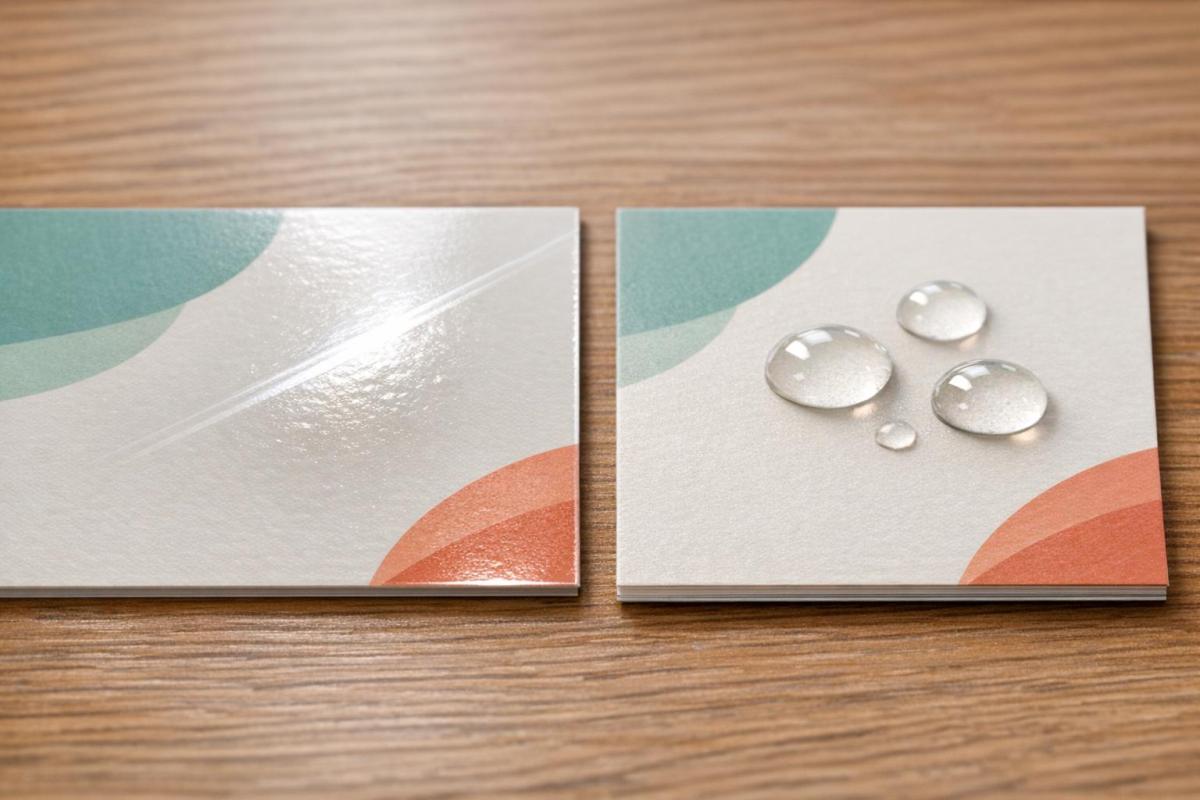
When deciding between UV coating and lamination, it’s all about matching the finish to your project’s needs. UV coating is a liquid resin cured with UV light, offering a glossy or matte finish that enhances color vibrancy, resists light scuffs, and speeds up production. It’s affordable and great for short-term materials like postcards or flyers but cracks along folds and isn’t waterproof.
Lamination, on the other hand, applies a plastic film to printed surfaces, making it more durable, water-resistant, and ideal for items like menus or book covers that face heavy use. It costs more and takes longer to produce but provides better protection and a premium feel.
Quick Comparison
| Feature | UV Coating | Lamination |
|---|---|---|
| Material | Liquid cured by UV light | Plastic film bonded to paper |
| Durability | Moderate; prone to cracking | High; resists wear and moisture |
| Finish Options | Gloss, Matte, Spot UV | Gloss, Matte, Soft-touch |
| Water Resistance | Minimal | High |
| Cost | Lower | Higher |
| Best For | Short-term marketing materials | Long-term, frequently used items |
Choose UV coating for quick, budget-friendly projects with eye-catching visuals. Opt for lamination when durability and long-term use are priorities.
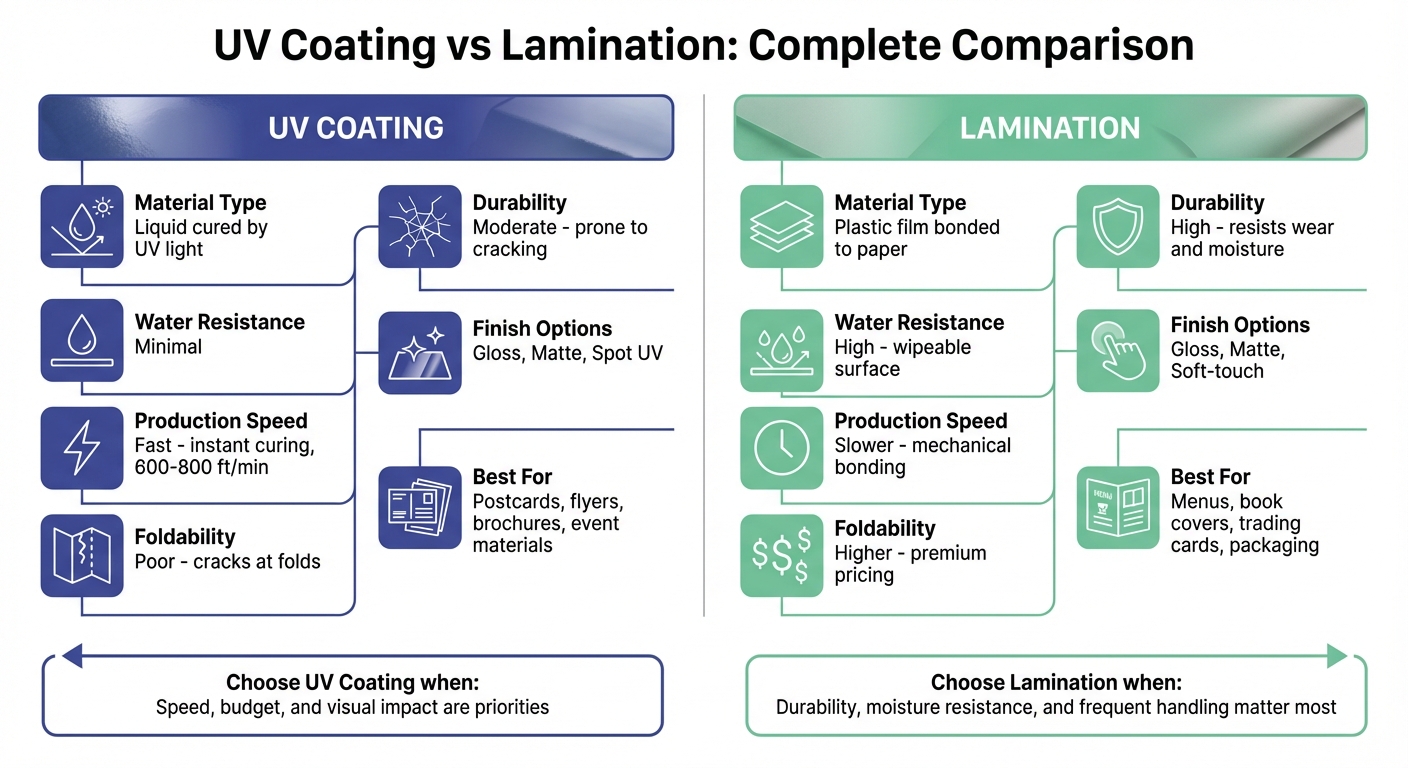
UV Coating vs Lamination: Side-by-Side Comparison Chart
UV Coating vs Lamination
sbb-itb-ce53437
What is UV Coating?
UV coating is a liquid polymer resin applied to printed materials, then hardened almost instantly using ultraviolet light. This process involves applying the liquid to wet paper and curing it with UV light in just milliseconds, allowing for immediate cutting and binding steps. This quick drying time is a major advantage, significantly speeding up production.
The coating forms a protective layer that helps guard against scratches, fingerprints, and ink smudges. It also boosts color vibrancy. As Color Vision Printing explains:
Gloss UV makes the underlying ink colors more vibrant and intense. Hence, the brilliance and sparkle provided by a gloss UV coating is the perfect complement for any printed piece that needs to stand out.
UV coating works best on heavier, coated paper stock (around 80 lb. or more) to prevent excessive absorption. It can be applied as a "Flood Coat" to cover the entire page or as "Spot UV" to highlight specific design elements like logos or images, creating striking visual contrast.
While it provides moderate resistance to scratches and moisture, UV coating is water-resistant but not waterproof. It’s also an environmentally friendly option since it releases no volatile organic compounds (VOCs) once cured and remains fully recyclable. However, it’s not suitable for areas meant for writing, as the slick surface resists most pens and toners.
These features make UV coating an appealing option, especially when compared to lamination, in terms of durability and cost.
UV Coating Finish Options
UV coating offers various finishes that can dramatically change the look and feel of your printed materials. The high gloss finish is the most popular choice. It delivers an ultra-shiny surface that makes colors appear more vivid and adds a sleek, polished feel.
For a more understated look, matte UV provides minimal shine, creating a natural, non-reflective surface that reduces glare and conceals fingerprints better than gloss. This finish is often used for premium marketing pieces or high-end catalogs. Soft-touch UV adds a velvety, suede-like texture and slightly mutes colors, offering a subtle elegance perfect for luxury packaging or upscale business cards. Lastly, textured UV adds a tactile, dimensional feel to the surface, making it a popular choice for specialty invitations or artistic covers.
These finishing options highlight the versatility of UV coating for different design and marketing needs.
Common Uses for UV Coating
UV coating is ideal for eye-catching marketing materials where visual appeal is critical. Common applications include postcards, brochures, presentation folders, magazine covers, rack cards, and business cards. For example, PsPrint offers UV glossy coating for both sides of 1,000 business cards for under $10, making it a cost-effective way to elevate your designs.
This coating works best on prints that don’t require heavy folding. It’s perfect for projects where you want vibrant colors, decent protection, and quick turnaround times without breaking the bank.
What is Lamination?
Lamination involves applying a plastic film to a printed sheet to create a protective layer. This film covers the entire surface of the print and is trimmed to fit the final product. The result is a durable shield that adds thickness and protects the material from damage caused by moisture, scratches, and heavy use.
This protective barrier also makes laminated items easy to clean without damaging the underlying paper. Printing expert John Monson explains it this way:
Lamination is a plastic film bonded to the sheet. Think ‘wrap the paper in a protective jacket.’ It adds thickness, can change the feel a lot, and usually takes more abuse before it looks tired.
Lamination is particularly useful for materials that need to be folded. Unlike UV coatings, which can crack at fold lines, lamination remains intact, making it ideal for booklets and other folded items. However, this durability comes at a cost: lamination is a slower process compared to faster UV coating methods, which can run at speeds of 600–800 feet per minute.
Despite being slower, lamination outperforms UV and aqueous coatings in terms of long-term durability, making it the preferred choice for items that face frequent handling and wear.
Lamination Finish Options
Lamination offers a variety of finishes to suit both functional and aesthetic needs:
- Gloss laminate: This finish provides a shiny, vibrant look that enhances colors but is prone to showing fingerprints and glare. Its high moisture resistance makes it ideal for items that require frequent cleaning.
- Matte laminate: A modern, low-shine option that reduces glare and hides fingerprints better than gloss. This finish is often chosen for projects that aim for a sleek, professional appearance.
- Soft-touch laminate: Known for its velvety, suede-like texture, this finish adds a luxurious feel to materials. It minimizes glare and fingerprints but works best with thicker cover stocks rather than lighter text-weight papers.
- Special textures: Patterned films are available for a unique, tactile experience, often used in high-end retail packaging and branding projects.
These finishes showcase lamination’s ability to adapt to different design and usability requirements.
Common Uses for Lamination
Thanks to its durability and attractive finishes, lamination is the go-to solution for materials that need to endure frequent use. For example, restaurant menus often use lamination to protect against spills and repeated cleaning. Similarly, book covers benefit from lamination’s ability to prevent wear and cracking along the spine.
Lamination is also a favorite for trading cards and game cards, which must withstand constant handling. As Monson puts it:
If you’re printing something that gets handled like a playing card, lamination often wins on toughness.
Other applications include jewelry boxes and rigid packaging, where a premium feel and long-lasting durability are essential. Premium brochures and presentation materials also benefit from lamination, as it allows for folding without cracking. Additionally, outdoor stickers and labels often pair lamination with vinyl for waterproof protection.
In short, lamination is built to handle the challenges of frequent use, friction, and exposure to the elements while keeping materials looking sharp and intact over time.
Durability Differences
When it comes to durability, lamination stands out as the stronger option compared to UV coating. While UV coating forms a thin resin layer on the surface, lamination involves bonding a plastic film over the entire print, creating a more resilient finish.
The difference becomes especially clear in terms of scratch and scuff resistance. UV coating provides moderate protection against light scuffs, which is a step up from uncoated paper. However, it’s still vulnerable to scratches caused by sharp objects or repeated friction. Lamination, on the other hand, offers a tougher shield thanks to its plastic layer, effectively guarding against deeper scratches and wear.
Moisture resistance is another key distinction. UV coating offers only minimal protection against water, while lamination delivers a near-waterproof seal. This makes it ideal for items like restaurant menus or materials used in humid environments. The laminated surface is also wipeable, allowing for easy cleaning without damaging the print underneath.
When it comes to foldability, UV coating falls short. It’s brittle and prone to cracking along crease lines. Lamination, however, remains flexible and even reinforces folds, although stress marks can appear if not properly scored. Printing expert John Monson captures this difference perfectly:
UV coating is a hardened coating. Lamination is a bonded film. Different tools, different results.
These durability factors highlight why lamination is often the go-to choice for projects requiring long-term use and resilience.
Durability Comparison Table
| Feature | UV Coating | Lamination |
|---|---|---|
| Scratch/Scuff Resistance | Moderate; resists light scuffs but can scratch | High; plastic film protects against deep scratches |
| Tear Resistance | Low; provides no structural reinforcement | High; plastic film makes paper difficult to tear |
| Water Protection | Low; provides slight moisture resistance | High; creates a wipeable, protective barrier |
| Foldability | Poor; prone to cracking at the fold line | Good; flexible, though may show stress marks |
| Handling Durability | Moderate; best for short-term use | Excellent; designed for frequent long-term use |
Appearance Differences
When it comes to visual appeal, UV coating and lamination each bring their own flair to the table. UV coating is all about delivering an ultra-high shine that makes colors leap off the page, especially deeper tones like blacks and blues. It’s the kind of finish that grabs attention instantly. As print expert John Monson explains:
"Gloss UV coating is the classic ‘wow’ look for marketing pieces. Gloss lamination is more of a ‘this will survive anything’ look."
On the other hand, lamination offers more variety in texture. While UV coating creates a thin, glossy, and hard surface, lamination can be customized with finishes like Soft Touch, which gives a velvety, almost suede-like texture that UV simply can’t replicate. Additionally, UV coating allows for Spot UV, which adds selective, high-gloss accents to specific areas for a dramatic effect.
Fingerprint visibility also sets them apart. High-gloss surfaces, whether UV or laminated, tend to highlight fingerprints, while matte and soft-touch laminations are better at concealing them. The choice here comes down to what you value more: a dazzling, high-shine look or a luxurious, tactile experience.
Appearance Comparison Table
| Feature | UV Coating | Lamination |
|---|---|---|
| Maximum Gloss Level | Ultra-high shine; "super high shine" effect | High gloss, but generally less reflective |
| Color Vibrancy | Enhances brightness and makes colors "pop" | Clean, professional finish; may slightly mute colors |
| Tactile Feel | Smooth, hard shell; thin cured layer | Adds thickness; ranges from plastic-smooth to velvet |
| Specialty Finishes | Spot UV, Raised (3D), Orange Peel, Glitter, Scented | Soft-Touch (Velvet), Suede-like, scuff-resistant matte |
| Fingerprint Visibility | High (gloss); low (matte) | High (gloss); very low (matte/soft-touch) |
| Best Visual Use | High-impact marketing, photography, product catalogs | Premium packaging, business cards, durable menus |
Cost and Production Differences
Budget constraints and production timelines often dictate whether UV coating or lamination is the better choice. UV coating stands out for its speed and affordability, making it a go-to option for large-scale projects like brochures, postcards, and flyers. The process involves applying a liquid polymer that cures instantly under ultraviolet light, allowing materials to be packed immediately after processing. With conveyor lines operating at 600–800 feet per minute, UV coating significantly outpaces traditional solvent-based coating lines, which only manage 5–10 feet per minute.
On the other hand, lamination adds a layer of plastic film to printed materials, which increases both material costs and production time. The mechanical bonding process is slower than liquid coating, and the added thickness requires extra handling. These factors make lamination a pricier and lengthier option, often unsuitable for short-term marketing materials where cost and speed are priorities.
However, lamination’s higher cost is worth it for items that demand durability. Products like restaurant menus, book covers, and trading cards benefit from the protective film, which guards against moisture, spills, and frequent handling. If your material needs to endure constant use, such as being wiped down or carried around in bags and pockets, the added expense of lamination can pay off in the long run.
This contrast in production methods ties back to durability. UV coating is ideal for fast and cost-efficient projects, offering a polished finish without straining the budget. Lamination, while slower and more expensive, provides unmatched protection for items requiring long-term resilience. The choice ultimately depends on whether speed or longevity takes precedence for your project.
Cost and Production Comparison Table
| Factor | UV Coating | Lamination |
|---|---|---|
| Relative Cost | Lower; economical for high-volume runs | Higher; premium pricing due to materials/labor |
| Production Speed | Extremely fast (instant curing) | Slower (mechanical bonding process) |
| Line Speed | 600–800 feet per minute | Much slower |
| Downtime | None; ready for packing immediately | Requires additional processing steps |
| Material Type | Liquid polymer | Plastic film |
| Best Run Volume | High-volume, quick-turnaround projects | Low-to-medium volume or premium runs |
| Ideal Use Case | Marketing handouts, event materials | Heavy-use items needing maximum protection |
When to Choose UV Coating
UV coating is a smart choice when speed, budget, and visual appeal are key priorities. It’s a popular finish for high-volume materials like postcards, brochures, and flyers that need a polished, professional look without the higher cost of lamination. For large-scale runs on tight deadlines, UV coating delivers both efficiency and eye-catching results.
One of its standout features is instant curing. The liquid resin hardens immediately under ultraviolet light, allowing materials to be stacked, cut, and shipped right away – no waiting around for drying. This quick turnaround makes it perfect for time-sensitive projects like event promotions or seasonal campaigns where every minute matters. While UV coating excels in speed and appearance, it’s better suited for projects where durability isn’t the top concern.
Designs with heavy imagery gain a lot from UV coating’s high-gloss finish. It adds a "wet-look" effect, enhancing deep colors like black and blue to make them richer and more vibrant. This makes it an excellent choice for product catalogs, photography brochures, and packaging materials. For an extra touch, spot UV coating can be used to highlight specific elements – like logos or product images – creating contrast and drawing attention to key details.
That said, UV coating is best suited for flat materials that won’t be folded frequently. Items like business cards, presentation folders, and postcards are ideal because the hardened coating can crack along fold lines. If your project involves multiple folds, it’s wise to test a sample first. Additionally, UV coating should only be applied to coated paper stocks of 80 lb. or heavier to avoid issues like curling on thinner paper.
It’s also worth noting that UV-coated surfaces aren’t suitable for writing with ink or using rubber stamps, as the slick finish makes it difficult for these to adhere. For short-term marketing materials where lamination feels excessive, UV coating strikes a great balance between affordability, speed, and an impressive appearance.
When to Choose Lamination
Lamination is your best bet when durability and long-term protection are a priority. Unlike UV coating, which creates a hardened liquid layer, lamination involves bonding a plastic film directly to your printed material. This not only adds thickness but also reinforces the structural integrity of the item. It’s a smart choice for materials that will face constant handling, friction, or exposure to moisture.
"Pick lamination when the piece will live a hard life (handling, wiping, constant friction)." – John Monson, Printiverse
Take restaurant menus, for instance. These are handled countless times every day, often exposed to spills, and need regular cleaning with damp cloths. Lamination provides a moisture barrier, allowing surfaces to be wiped clean without harming the print. It’s also a practical solution for outdoor labels, packaging in humid conditions, or anything requiring a finish that can handle frequent cleaning. Similarly, book covers and trading or game cards benefit from lamination because it protects against scuffing and wear caused by repeated handling and stacking. This durability makes lamination a go-to option for both everyday items and projects that need a polished, tactile finish.
For premium materials, soft-touch lamination offers a velvet-like feel that’s not only durable but also hides fingerprints. This luxurious finish is perfect for jewelry boxes, presentation folders, and upscale product packaging, adding a professional and sophisticated touch. The added thickness enhances the overall quality, making it ideal for high-end applications.
UV Coating vs Lamination: Complete Comparison
This section breaks down the main differences between UV coating and lamination. The table below highlights key factors like material, finish, durability, water resistance, production speed, cost, and overall visual appeal. As mentioned earlier, factors like durability, appearance, and speed play a big role in making your choice.
| Feature | UV Coating | Lamination |
|---|---|---|
| Material Type | Liquid cured by ultraviolet light into a hard shell | Plastic film bonded directly to the paper |
| Finish Options | Gloss, Matte, Satin, Spot UV | Gloss, Matte, Satin, Soft-touch (velvet) |
| Thickness Added | Negligible (thin layer) | Noticeable (adds physical bulk and weight) |
| Durability | Scuff-resistant but cracks on folds | Highly durable; resists tears, spills, and heavy handling |
| Water Resistance | Moisture-resistant only (not waterproof) | High (safe for wipe-downs and cleaning) |
| Production Speed | Fast (instant curing) | Slower (requires film bonding step) |
| Relative Cost | Lower (economical for bulk orders) | Higher (due to film materials and labor) |
| Visual Effect | Makes colors "pop"; high-gloss punch | Provides a protective, cohesive appearance; changes tactile feel |
| Best For | Postcards, flyers, brochures, event handouts | Menus, trading cards, book covers, premium packaging |
| Folding Tolerance | Poor (prone to cracking at creases) | Better (but may show white stress if not scored) |
| Premium Options | Spot UV for selective gloss highlights | Soft-touch for velvet-like luxury feel |
The choice between UV coating and lamination boils down to your project’s specific needs. UV coating is ideal when you need a quick turnaround, vibrant color enhancement, and protection for short-term materials like flyers or postcards. On the other hand, lamination is a better fit for items that require durability, moisture resistance, or a luxurious tactile finish – think menus, book covers, or premium packaging. This comparison helps you pinpoint the finish that aligns perfectly with your goals.
Conclusion
Deciding between UV coating and lamination comes down to the functional and visual demands of your project. UV coating offers a quick and budget-friendly way to enhance colors while adding some scuff resistance – ideal for items like flyers and postcards that need to stand out but don’t undergo heavy use. Lamination, however, provides better durability and protection against moisture, making it a reliable choice for frequently handled items such as restaurant menus, book covers, or playing cards.
It’s important to match the finish to your specific needs. Using the wrong finish can lead to issues like cracked UV coatings on fold lines or stress marks in laminated pieces if proper scoring isn’t done. Early prototyping and consulting with experts can help you avoid these common pitfalls. For projects involving intricate folds or heavy wear, testing and professional advice are essential to prevent costly mistakes.
For tailored guidance, Miro Printing & Graphics Inc. offers expert consultation to help you choose the right finish for your project. Whether you’re aiming for vibrant marketing materials or durable, long-lasting products, working with professionals ensures your final piece meets your expectations.
FAQs
Which finish is best for folded pieces?
Lamination tends to be a better option for folded materials. While UV coating does a great job of boosting color vibrancy and adding a glossy, smooth finish, it has a downside – it can crack when subjected to repeated folding. This can compromise the durability of the piece. On the other hand, lamination, which involves bonding a plastic film to the surface, provides stronger protection against wear and tear. This makes it a more durable choice for items that are frequently handled or folded multiple times.
How do UV coating and lamination affect print color?
UV coating gives prints a shiny, high-gloss finish that makes colors pop with added vibrancy and saturation. It creates an eye-catching effect, perfect for grabbing attention. Lamination, on the other hand, not only enhances color vibrancy but also adds a thicker, protective layer. Gloss lamination works similarly to UV coating by intensifying colors, while matte lamination offers a softer, velvety texture for a more subdued look. However, UV coating lacks flexibility and can crack on folds, whereas lamination provides better durability and helps preserve colors over time.
Can I write on UV-coated or laminated paper?
Writing on UV-coated paper can be tricky due to its glossy, slippery surface, which often struggles to hold ink properly. On the other hand, laminated paper, especially those with matte or textured finishes, generally makes writing easier when using pens or markers. That said, how well the ink adheres can still depend on the specific type of lamination. To ensure the best outcome, select the finish that aligns with your particular writing requirements.
Related Blog Posts
- UV Printing vs. Lamination: Which Protects Better?
- Lamination vs Coating: Which Offers Better Protection?
- Anti-Scratch Coatings for Book Covers
- How Post-Press Finishing Impacts Print Quality
https://app.seobotai.com/banner/banner.js?id=69cb0f3b1b352ff267ccb78e
 BergenCountyPrintersBlogs