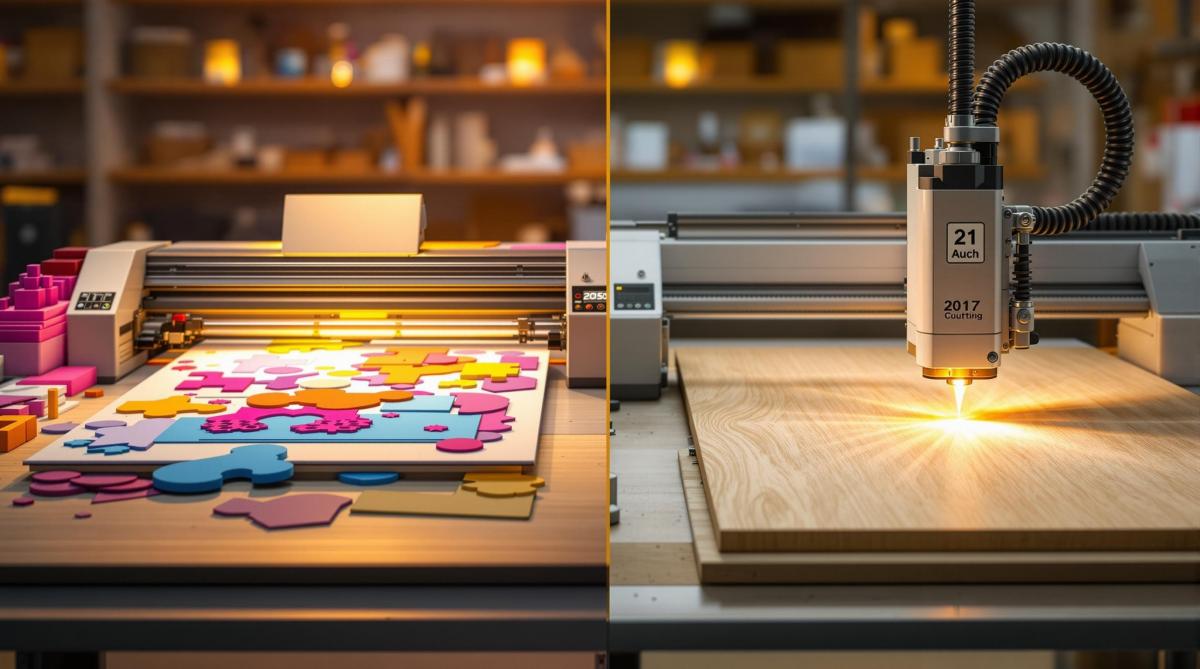
Which cutting method is best for your project?
If you’re working with flexible materials like paper, cardboard, or vinyl, die-cutting is the way to go – it’s efficient for simple shapes and high-volume production. For rigid materials like wood, acrylic, or thin metals – or when intricate designs are required – laser cutting offers unmatched precision.
Here’s a quick breakdown of the two methods:
- Die-Cutting: Uses metal dies and mechanical pressure to cut flexible materials. Best for high-volume, simple shapes.
- Laser Cutting: Uses a concentrated beam to vaporize tougher materials. Perfect for detailed designs and smaller production runs.
Quick Comparison
| Feature | Die-Cutting | Laser Cutting |
|---|---|---|
| Contact | Physical contact | Contactless |
| Cutting Action | Mechanical pressure | Thermal vaporization |
| Best Materials | Paper, vinyl, foam, textiles | Acrylic, wood, metals, leather |
| Ideal Use | High-volume, simple shapes | Intricate designs, heat-tolerant materials |
Key takeaway: Use die-cutting for cost-effective, repetitive cuts on flexible materials. Choose laser cutting for precision and complex designs on rigid or heat-resistant materials.
How Die-Cutting and Laser Cutting Work
Die-Cutting Process
Die-cutting relies on custom metal dies and flatbed or rotary presses to cut flexible materials into uniform shapes. This method is ideal for high-volume projects requiring consistent results. At Miro Printing & Graphics Inc., die-cutting is commonly used for large production runs where precision and uniformity are key.
Laser Cutting Process
Laser cutting uses computer-controlled lasers to vaporize material along precise vector paths. This method excels at creating intricate and highly detailed cuts that go beyond the capabilities of mechanical dies. Since it’s a contactless process, it works well on materials that might not withstand physical pressure.
Main Differences Between Methods
| Feature | Die-Cutting | Laser Cutting |
|---|---|---|
| Contact | Direct physical contact | Contactless |
| Cutting Action | Mechanical pressure | Thermal vaporization |
| Setup | Custom die fabrication | Digital file preparation |
| Precision | Best for simple to moderately detailed shapes | Ideal for intricate, highly detailed cuts |
| Material Suitability | Flexible materials that withstand pressure | Rigid and heat-tolerant materials |
Die-cutting is your go-to for high-volume, simple shapes in materials that can handle mechanical pressure. On the other hand, laser cutting is the better choice for intricate designs, especially when working with heat-resistant materials. Now, let’s look at the materials that work best with each method and how these processes influence performance.
Materials for Die-Cutting
Best Materials for Die-Cutting
Die-cutting works best with materials that are flexible, evenly dense, and strong enough to handle mechanical pressure without losing their shape. Here are some common materials that perform well in die-cutting:
- Paper and Cardstock: Perfect for creating business cards, greeting cards, and folders.
- Vinyl and Thin Plastics: Great for labels, decals, and lightweight packaging.
- Foam and Corrugated Board: Used for gaskets, padding, boxes, and displays.
- Fabrics and Textiles: Ideal for tags, appliqués, and custom shapes.
For clean, precise results, materials need consistent density, good tensile strength, and a reliable fiber structure.
Die-Cutting Pros and Cons
Die-cutting has clear benefits but also comes with some limitations depending on the materials used:
Advantages:
- Handles a wide range of materials, including multi-layered ones, with precision.
- Perfect for high-volume production runs.
- Does not produce heat, making it safe for heat-sensitive materials.
Limitations:
- Not suitable for brittle, delicate, or easily crushed materials.
- Requires strict adherence to material thickness for optimal results.
- Fibrous or loosely woven materials may have frayed edges.
At Miro Printing & Graphics Inc., we carefully assess each project’s material needs – focusing on factors like thickness, flexibility, and durability – to ensure the best results with our die-cutting equipment.
Next, we’ll take a look at materials designed for laser cutting.
DIE CUTTING Leather vs LASER CUTTING Leather – What’s …
sbb-itb-ce53437
Materials for Laser Cutting
Laser cutters are perfect for substrates that absorb heat or melt easily. Here’s a breakdown of the materials they work with:
Materials
Non-metallic options
- Acrylic: Produces smooth, clear edges with little to no finishing required.
- Wood: Works with both hardwoods and softwoods; charred edges can be sanded away.
- Paper and Cardstock: Enables detailed patterns without warping or tearing.
- Leather and Fabrics: Cuts cleanly, with edges that resist fraying.
- ABS and Mylar Plastics: Suitable for cutting with proper settings.
Metallic options (requires higher-power systems)
- Stainless Steel: Commonly used for parts and decorative panels.
- Aluminum: Thin gauges allow for clean cuts.
- Brass: Achieves detailed results when settings are adjusted correctly.
Laser Cutting Pros and Cons
Advantages
- Precision: Perfect for intricate shapes and fine details.
- Non-contact process: Eliminates mechanical stress on materials.
- Consistency: Delivers uniform results across multiple runs.
- Heat-sealed edges: Prevents fraying or splintering in certain materials.
Limitations
- Heat effects: May cause discoloration or charring on some materials.
- Reflective metals and certain plastics: Can cut poorly or damage optics.
- Depth restrictions: Limited by material density and laser power.
- Costs: Higher setup and maintenance expenses for simple, high-volume jobs.
For a detailed comparison, see how these laser-compatible materials stack up against die-cutting substrates in the chart below.
Material Comparison Chart
Here’s a quick guide to match your material with the best cutting method:
-
Paper & Cardstock
- Die-Cutting: Great for high-volume, simple shapes.
- Laser Cutting: Ideal for intricate patterns and smaller production runs.
-
Vinyl & Thin Plastics
- Die-Cutting: Perfect for consistent label cuts.
- Laser Cutting: Best for custom prototypes and creating sealed edges.
-
Foam & Corrugated Board
- Die-Cutting: Works well for bulk padding and display items.
- Laser Cutting: Not recommended.
-
Acrylic & Wood
- Laser Cutting: Provides smooth edges and detailed cuts.
- Die-Cutting: Not suitable.
-
Fabrics & Leather
- Laser Cutting: Produces fray-resistant edges and handles complex designs.
- Die-Cutting: Suitable for basic tags and appliqués.
-
Thin Metals (Aluminum, Brass, Stainless Steel)
- Laser Cutting: Offers precise, clean cuts.
- Die-Cutting: Not applicable.
Use this chart to ensure your material and cutting method are a perfect fit!
How to Choose Your Cutting Method
Now that you understand the materials and methods, it’s time to weigh the factors that will help you decide between die-cutting and laser cutting.
Key Factors to Consider
- Production Volume: If you’re working with large production runs, die-cutting becomes more cost-efficient after the initial die is made. For smaller batches, laser cutting is a better option since it eliminates tooling costs.
- Design Complexity: Simple, repeatable shapes are ideal for die-cutting, while laser cutting handles intricate patterns and tight curves with precision.
- Project Timeline: Laser cutting is great for quick turnarounds, especially for smaller or urgent jobs. On the other hand, die-cutting requires more setup time but is perfect for planned, high-volume projects.
What Miro Printing & Graphics Inc. Offers
Miro Printing & Graphics Inc. provides both die-cutting and laser-cutting services tailored to your needs. Here’s how we can assist:
- Evaluate your material and design requirements.
- Recommend the best method based on your production volume for cost-effectiveness.
- Ensure timely production scheduling to meet your deadlines.
Need help deciding? Reach out to us for expert advice on the best cutting solution for your project.
Conclusion
Deciding between die-cutting and laser cutting comes down to your project’s size, complexity, and the materials you’re working with. Flexible materials are better suited for die-cutting, while rigid or highly detailed designs often require laser cutting. Refer to our material comparison chart to ensure you’re making the right choice.
At Miro Printing & Graphics Inc., we help align your materials and design with the best cutting method to achieve precision, efficiency, and cost-effectiveness. Get in touch with us to find the ideal solution for your next project.
Related posts
- How Die-Cutting Impacts Waste Reduction
- How to Create Die-Cut Templates for Printing
- How to Prepare Files for Die-Cutting and Laser Cutting
- How Digital Die-Cutting Works for Packaging
https://app.seobotai.com/banner/banner.js?id=6805afcf360079f947b8817d
 BergenCountyPrintersBlogs