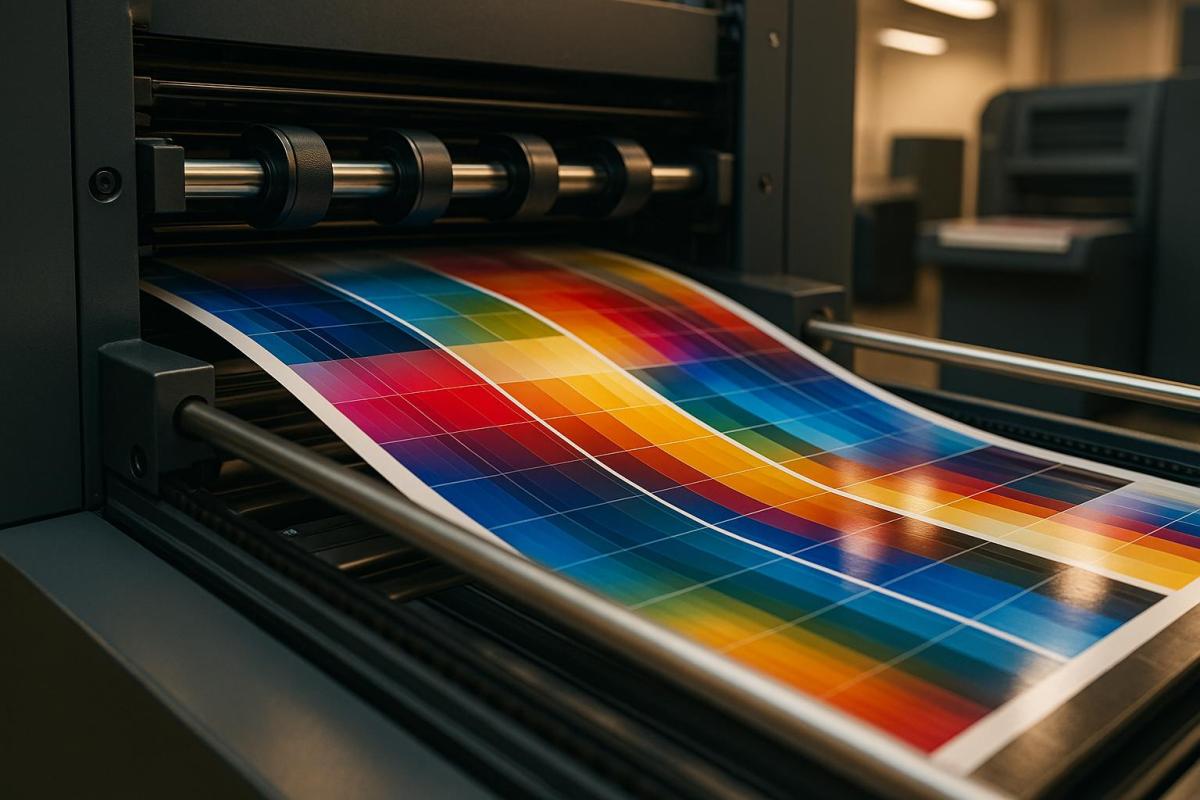
Want perfect print quality every time? Fogra standards ensure reliable color accuracy and consistency across different printing methods. Here’s what you need to know:
- What is Fogra? A German research institute specializing in graphic technology for over 75 years, offering globally recognized certifications.
- Why it matters: Fogra standards help print shops reduce errors, streamline workflows, and earn client trust with consistent, high-quality results.
- Key standards:
- Fogra39: Ensures color accuracy in offset printing.
- ProcessStandard Digital (PSD): Tailored for digital printing, focusing on color matching and workflow management.
- Benefits of certification: Improved print quality, fewer errors, cost savings, and stronger client relationships.
- Certification costs: Start at $2,753 for members, with options for smaller certifications like PrintCheck or PSD Colour Data for lower budgets.
Quick Tip: Temperature, humidity, and equipment calibration are as crucial as following Fogra guidelines for maintaining consistent print results.
Fogra certification isn’t just about meeting standards – it’s a smart way to improve efficiency, reduce waste, and gain a competitive edge in the printing industry. Ready to dive deeper? Keep reading for more details!
de FOGRA 39 a FOGRA 51. APRENDE, CONVIERTE y MIGRA a la nueva ISO 12647 de IMPRESIÓN

Main Fogra Color Standards
Fogra has developed key color standards that help ensure consistent print quality, no matter the substrate, equipment, or environment. Two of the most prominent standards in the printing world are Fogra39 for offset printing and ProcessStandard Digital (PSD) for digital printing. Each serves specific needs while maintaining the overarching aim of achieving reliable color reproduction and process control.
Fogra39 and ICC Profiles
Fogra39 is one of the most widely used standards in commercial offset printing, especially in Europe. Introduced by Fogra in 2006, it defines expected color reproduction for offset lithographic printing on gloss or matte coated paper, adhering to ISO 12647-2:2004 guidelines.
What makes Fogra39 so effective is its use of smoothed data from multiple print runs to establish a dependable color reproduction target. ICC profiles, such as the popular ISOcoated_v2_300_eci.icc, are built on this data, ensuring consistent results across various printing environments.
Fogra39 plays a critical role throughout the print workflow. It’s used to:
- Convert RGB files to CMYK.
- Set output intents for PDF/X files.
- Calibrate soft proofing displays and hard copy proofing systems.
One standout feature of Fogra39 is its ink coverage allowance of 330%, which is higher than the 300% limit found in some other profiles. This flexibility allows printers to achieve richer, more saturated colors while maintaining quality standards.
Updates like Fogra51 and Fogra52 address modern printing needs, incorporating optical brighteners and ISO 13655:2009 M1 measurement conditions. While Fogra39 is the go-to for offset printing, digital printing demands a more customized solution, which is where PSD comes in.
ProcessStandard Digital (PSD)
Digital printing has brought unique challenges, requiring a dedicated quality standard. Fogra’s ProcessStandard Digital (PSD) was created to address these needs, focusing on output control, color accuracy, and workflow management.
PSD is tailored to the nuances of digital printing, such as differences in substrate handling, toner or ink application, and the absence of traditional printing plates. It provides a framework for maintaining consistent quality, even across mixed production runs or reprints where precise color matching is essential.
Achieving PSD certification demonstrates a print shop’s ability to control its digital processes and create accurate ICC profiles for various substrates. Certification costs as of 2025 are $2,753 for members and $3,933 for non-members, with recertification every two years at $2,118 for members and $3,025 for non-members.
The benefits of PSD certification extend beyond quality assurance. Veit Rudolph, Managing Director of Rudolph Printing, shared his thoughts:
"I am very pleased with our PSD certification. Not only are we protected, but there are also practical benefits. For reprints, but also for mixed productions, even experts can see no difference in colour reproduction and quality. We can only recommend certification to everyone."
To maintain PSD compliance, print shops must keep their equipment calibrated, regularly update ICC profiles, and use handheld measurement tools. Proper lighting, conforming to ISO 3664 standards, is also required. Additionally, the use of M1 measurement conditions ensures accurate color evaluation by simulating D50 lighting with UV content. This is especially important given the variety of materials used in digital printing.
In the United States, companies like Miro Printing & Graphics Inc. in Hackensack, NJ, rely on Fogra standards to deliver consistent, predictable results across different printing methods and substrates. These standards have become essential tools for ensuring quality in today’s competitive printing landscape.
Fogra Certification Requirements
Fogra’s certification programs build upon their core color standards to ensure top-notch process quality. These certifications provide independent validation that digital production processes meet the highest industry benchmarks. For print providers, this not only offers a competitive edge but also reassures clients of consistent output quality. These certifications are recognized globally, covering various areas such as prepress, offset and digital printing, packaging, finishing, materials, environmental factors, and security. Below, we’ll dive into two key certification options that highlight both overall process control and specific aspects of print quality.
PrintCheck Certification
PrintCheck certification is a straightforward way to confirm color accuracy and production stability in digital printing, whether for small- or large-format projects. It’s essentially a simplified version of the full PSD certification, focusing on the quality of digital print sheets rather than analyzing the entire workflow.
For small-format (cut sheet) printing, companies are required to produce 200 copies of the PrintCheck test forms using the Fogra MediaWedge CMYK. From these, 20 samples are randomly selected, with one designated as the OK sheet. Large-format printing requirements depend on the print width, requiring 9, 18, or 27 test forms that are then cut into A3 format. Starting June 1, 2025, the print run requirement for small-format operations will drop from 500 to 200 prints.
The evaluation focuses on key factors like color accuracy, print consistency, uniformity, and resolution. Companies must also prepare a quality report aligned with PSD standards and submit an order sheet for each printing combination.
PrintCheck certification costs vary based on Fogra membership status:
| Certification Type | Fogra Member | Regular Price |
|---|---|---|
| PrintCheck Digital & LFP (one system) | $430.25 | $615.00 |
| Additional system combination | $210.00 | $300.00 |
| Spot Color Check (up to 3 colors) | +$42.00 | +$60.00 |
In 2024, Canon’s ProStream 1800 became the first digital printing system to achieve FOGRA59 Certification. This system operates at speeds of up to 133 meters per minute and can reproduce 93% of Pantone colors, depending on the paper type. Similarly, Konica Minolta’s AccurioPress C14000 and C4080 Series earned FograCert Validation Printing System (VPS) certification by meeting PDF/X conformance and demonstrating exceptional color accuracy.
PSD Colour Data Certification
PSD Colour Data Certification is designed for print service providers who want to automate the verification of color accuracy using the Fogra MediaWedge. Unlike full PSD certification, this program focuses solely on validating color data.
To qualify, participants need either a Fogra-qualified inline measurement device or a calibrated handheld measurement tool. The process involves printing and measuring the Fogra MediaWedge, then saving the measurement data along with details like the date, device model, serial number, and method used. Once completed, this data, along with an order sheet for each printing combination, is submitted to PSDColourData@remove-this.fogra.org. Fogra evaluates the data using a specialized Matlab routine and assigns a quality rating of A, B, or C.
PSD Colour Data certification pricing is more affordable than full PSD certification:
- $80.50 for Fogra members
- $115.00 for non-members
This cost-effective option appeals to companies looking to validate color accuracy without undergoing a full audit. It also highlights a print shop’s ability to maintain automated quality control – essential for managing mixed production runs or ensuring precise color matching for reprints.
Helen Kennett, Managing Director at Henry Ling, a UK-based book and journal specialist, shared how Fogra certification has benefited their operations:
"Having the Fogra certification gives us confidence in the predictability of the print quality."
Their certification covers workflows involving systems like the ProStream 1000 and Canon’s PRISMA ColorSuite software, emphasizing how certification can validate an entire production process.
For companies like Miro Printing & Graphics Inc. in Hackensack, NJ, Fogra certifications offer clear business advantages. They establish objective quality benchmarks, demonstrate a commitment to excellence, and build client trust in consistent results. Additionally, these certifications help reduce waste and reprints caused by color mismatches, enhancing overall efficiency.
sbb-itb-ce53437
How to Maintain Print Consistency with Fogra Guidelines
Fogra guidelines emphasize the importance of integrating color verification and automated quality control into daily operations to achieve consistent print quality. Let’s delve into how these processes can ensure precision and reliability in your printing workflow.
Color Verification and Tolerances
Color verification relies on spectrophotometric measurements to keep colors within predefined tolerances. This involves printing color patches or test charts and using a spectrophotometer to confirm that the colors match the intended results within acceptable limits. By doing so, it removes the guesswork from ensuring color accuracy.
Harvey Block, a technical sales representative at INX International Ink Co., highlights the value of this method:
"Color verification provides a scientific approach to color accuracy, something manual checks simply can’t match. It minimizes errors, reduces waste, and boosts client confidence."
Advancements in measurement standards have significantly improved visual acceptance rates – from 75% under DE76 to 95% with the current DE2000 standard. This makes modern measurement protocols indispensable for today’s print shops.
To ensure success, establish clear, project-specific color targets before printing begins. These targets should align with client requirements or industry standards. Setting acceptable dE tolerance margins ahead of production is critical, and tools like the Fogra MediaWedge are invaluable for automating color accuracy checks.
Incorporate regular color checks at various stages of the workflow to catch potential issues early. As Harvey Block explains, this approach creates "a shared language using spectral data and standardized color models like Gracol or Fogra".
Finally, standardize your workflow from design to final output. This ensures everyone follows the same protocols and uses calibrated equipment, which is especially important when managing mixed production runs or reprints where precise color matching is essential.
While color verification ensures initial accuracy, automated quality control ensures this precision is maintained throughout production.
Automated Quality Control
Automated quality control systems take quality assurance to the next level by streamlining processes, reducing errors, and ensuring consistent results in digital printing. Inline measurement devices, qualified by Fogra, validate color in real time during printing. This proactive approach allows companies to catch deviations instantly, cutting down on operational costs.
Ulrich Schätzl, CEO of Schätzl Druck & Medien GmbH & Co. KG, explains the practical advantages of this system:
"We are very satisfied. The Fogra PSD certification is more and more a requirement of our customers. Our employees have a clear work quality standard and we have a clear criterion towards our customers."
The ProcessStandard Digital (PSD) certification provides a structured framework for implementing internal quality management systems. It defines clear procedures that improve products, processes, and services. By establishing objective benchmarks and eliminating guesswork, PSD certification ensures consistent quality.
Automation also simplifies record-keeping for processes, equipment calibration, and quality checks. These detailed records not only demonstrate compliance during audits but also help identify trends that could indicate equipment issues. Additionally, they provide essential documentation to meet client quality assurance demands.
For companies like Miro Printing & Graphics Inc., adopting automated quality control systems aligned with Fogra guidelines delivers clear competitive advantages. The combination of real-time monitoring, standardized workflows, and objective measurements builds a reliable foundation for consistent results, ultimately earning client trust.
As production volumes grow, manual quality checks quickly become impractical. Automated systems ensure precision remains consistent, whether you’re handling small custom projects or large-scale commercial runs. This scalability supports businesses in maintaining high-quality standards regardless of throughput demands.
How Environment Affects Print Consistency
Even with automated quality control systems in place, environmental factors play a critical role in maintaining print consistency. Without stable conditions, even the most advanced systems can falter.
Temperature and Humidity Control
Temperature and humidity are two of the biggest environmental variables that can disrupt printing. Temperature fluctuations can cause paper to expand or shrink, leading to misaligned colors and distorted designs. On the other hand, humidity impacts how ink dries and how paper behaves, often resulting in issues like curling, wrinkling, or uneven prints. Industry research shows that maintaining temperatures between 65°F and 75°F (18°C to 24°C) and humidity levels between 45% and 55% is ideal for most printing processes. These ranges help prevent problems like ink bleeding and smudging.
Steve Freeman, Jet Press Solutions Manager at Fujifilm, highlights the importance of these conditions:
"Humidity control is important for paper handling consistency when running lighter weight stock on the Jet Press 720S in both the feeder and jetting area. We aim to maintain an RH of between 40% and 60%. Below this could potentially cause an increase in paper handling issues on light weight paper."
Low humidity can cause inkjet printers to dry out prematurely, while materials like cardboard and fabric absorb moisture, further complicating the process. Paper is especially sensitive – under low humidity, it can undergo dimensional changes of 1–2% in just 10 minutes.
Proper paper storage is also crucial. Storage areas should be kept at temperatures between 68°F and 76°F (20°C to 24.4°C) with humidity levels between 35% and 55%. Paper should remain in its original packaging and stored flat to avoid warping.
Jan Thidex Kristensen, Maintenance & Engineering Manager at Elopak, shares how proper humidity control transformed their operations:
"We can clearly see a difference in our production after we got the new humidification system. We experience less variation in our production, which means we can ensure a uniform and stable quality for our customers."
To maintain these optimal conditions, consider investing in temperature-controlled environments, dehumidifiers, or humidifiers. Smart sensors can provide real-time updates, allowing for quick adjustments. Monitoring air quality can further safeguard print quality.
However, controlling the environment is only part of the equation. Regular equipment calibration is just as important to ensure consistent results.
Equipment Calibration and Measurement
Once environmental conditions are stabilized, equipment calibration becomes the next step in maintaining high-quality prints. Calibration ensures that environmental changes don’t disrupt measurement accuracy, ink performance, or color reproduction.
Automated calibration systems are particularly helpful, as they can adapt to environmental shifts in real-time, ensuring consistent inspection standards across production batches. Without proper calibration, up to 30% of print jobs fail due to environmental influences on uncalibrated equipment.
Chris Fyfe, Quality Assurance Manager at John Watson & Co, explains:
"When paper loses moisture, ink will not adhere properly, which could cause a problem for our printing company whose reputation for quality is high. Not only has the JetSpray been proven in our industry, it is also uncomplicated, energy efficient and extremely hygienic in operation."
Companies like Miro Printing & Graphics Inc. have found that combining environmental monitoring with regular calibration significantly improves print consistency. Monitoring temperature and humidity daily and adjusting equipment settings accordingly can prevent issues like smudging or fading caused by environmental fluctuations. Establishing a structured quality control process that includes prepress, in-process, and post-printing inspections ensures that all steps are aligned with current conditions.
The most effective calibration routines are dynamic, adjusting to real-time environmental data rather than sticking to rigid schedules. Immediate recalibration when conditions deviate from the optimal range can prevent waste, improve efficiency, and save costs over time.
Conclusion
Fogra standards lay the groundwork for achieving precise color accuracy and consistent results in every print job. By removing the uncertainty from the printing process, these standards offer a dependable framework that benefits both print providers and their clients.
Fogra certification goes beyond meeting technical requirements – it delivers measurable business advantages. Take Miro Printing & Graphics Inc., for example. By adhering to Fogra guidelines, they’ve gained a competitive edge that directly contributes to their success. With global recognition across the industry, Fogra certification signals a dedication to quality that clients notice and appreciate.
This commitment also leads to cost savings. Standardized processes minimize errors and waste, cutting down on both time and expenses. Businesses that implement Fogra-certified workflows often see notable reductions in costs while boosting client satisfaction. For instance, a digital book publisher that transitioned to smaller print runs using Fogra-certified digital printing processes reported less waste and lower costs, which allowed them to offer more competitive pricing to their clients.
Fogra standards also improve communication and transparency throughout the printing process. By using standardized terminology and workflows, print providers and their clients can avoid misunderstandings, leading to smoother operations and stronger professional relationships. This clarity, along with consistent quality, fosters trust and encourages repeat business.
Additionally, Fogra standards align with eco-conscious practices, which resonate with today’s environmentally aware market. For example, a marketing agency that opted for Fogra-certified recycled paper and eco-friendly inks successfully positioned itself as a green brand, attracting like-minded clients and boosting customer satisfaction.
As the printing industry evolves, Fogra standards offer the reliability and consistency businesses need to succeed. Whether it’s digital printing, offset printing, or large-format projects, these standards ensure consistent quality across all methods and equipment. For print providers, Fogra certification isn’t just a technical achievement – it’s a strategic move toward long-term quality and success in a competitive market.
FAQs
How do Fogra standards ensure consistent and high-quality printing results?
Fogra standards are essential for achieving consistent and reliable print quality. They establish clear guidelines for color accuracy, print stability, and overall performance, which are validated through certification programs. These certifications ensure that both digital and offset printing align with industry expectations.
Following Fogra standards allows printers to deliver predictable results across different projects and settings. This not only minimizes inconsistencies but also strengthens brand consistency and ensures customers are pleased with the final product every time.
What does it cost for a print shop to obtain Fogra certification, and are there budget-friendly alternatives?
The cost of securing Fogra certification depends on several factors, such as the size of your print shop, the type of certification you’re aiming for, and any upgrades or changes needed to meet the required standards. While achieving certification guarantees consistent, high-quality printing, the process can represent a notable expense for some businesses.
For a more budget-friendly alternative, you might focus on adopting best practices in color management and utilizing Fogra-compliant tools and workflows without committing to the full certification. This can still elevate your print quality while managing expenses effectively.
How do temperature and humidity affect print quality, and what can be done to ensure consistent results?
Temperature and humidity are key factors in preserving print quality. When temperatures rise or fluctuate, paper can expand or shrink, leading to misalignment or uneven colors. Likewise, shifts in humidity can impact how ink dries and may cause paper to curl, wrinkle, or behave unpredictably.
To achieve consistent printing results, aim to keep the temperature steady between 68°F and 70°F and maintain relative humidity levels within 30% to 55%. Tools like dehumidifiers, humidifiers, and hygrometers can help you monitor and regulate these conditions effectively. It’s also a good idea to store your printing materials in climate-controlled environments to shield them from environmental shifts. By taking these precautions, you can produce reliable, high-quality prints every time.
Related posts
- How to Adjust Colors for Offset Printing
- Soft Proofing Techniques for Accurate Colors
- ISO 2846: Ink Color Standards Explained
- Proofing Standards in Printing: Key ISO Guidelines
https://app.seobotai.com/banner/banner.js?id=684ca7e65559d477e756be27
 BergenCountyPrintersBlogs