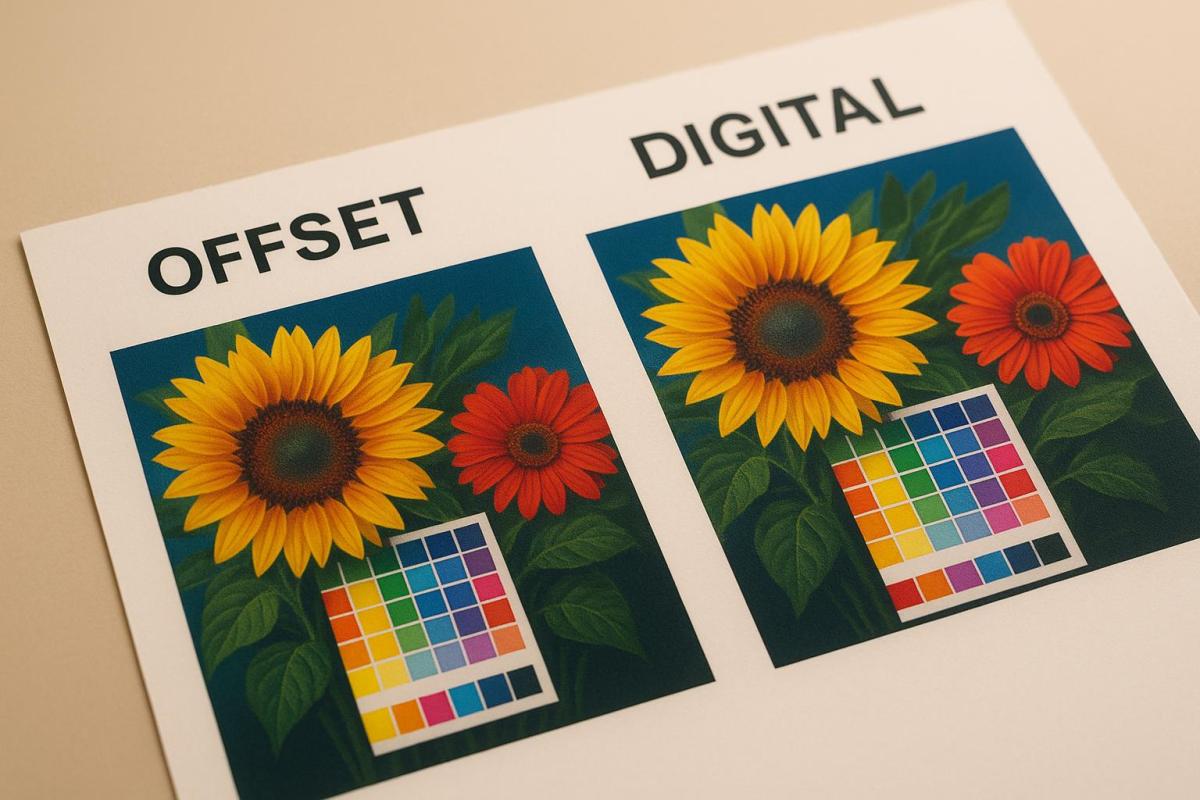
Offset and digital printing both aim for precise color accuracy, guided by Fogra standards, which align with ISO certifications. Offset printing excels in large-scale projects, offering consistent results with profiles like Fogra39 for coated papers and Fogra52 for uncoated. However, it faces challenges with ink absorption on uncoated stock, leading to muted colors. Digital printing, certified under Fogra PSD, provides vibrant colors, especially on coated papers, and is ideal for short runs or personalized materials. While offset is cost-effective for high volumes, digital printing offers faster setup and flexibility for smaller jobs. Choosing the right method depends on your project’s size, timeline, and color needs.
Offset Printing and Fogra Color Accuracy
How Offset Printing Works
Offset printing relies on an indirect transfer method that sets it apart from other printing techniques. The process starts with aluminum plates, where the images are etched directly onto the surface. These plates are then mounted onto the press, forming the basis for precise image reproduction.
Here’s how it works: ink is applied to the image areas of the plate, while the non-image areas attract water to stay ink-free. From there, the ink moves from the plate to a rubber blanket and finally to the paper. This indirect transfer process – where the ink doesn’t go straight from plate to paper – is what gives offset printing its name. It’s also the key to its ability to produce sharp, high-quality images.
Offset printing is ideal for large-volume projects because the fixed setup costs are spread out over the run. It also supports a broad range of colors, including the Pantone Matching System (PMS), which allows for the use of spot colors beyond the standard CMYK palette.
This reliable process is the foundation for meeting the stringent requirements of Fogra certification.
Fogra Certification for Offset Printing
Fogra certification for offset printing is built on the Process Standard Offset (PSO) framework, which aligns with the ISO 12647 standards. This system ensures consistent color quality across various print jobs and materials.
To achieve Fogra certification, print providers must undergo rigorous testing and documentation. This includes producing test prints, measuring color values against predefined benchmarks, and maintaining detailed process control records. Regular verification ensures ongoing consistency in color reproduction.
One widely used standard in commercial offset printing is Fogra39, which allows for ink coverage up to 330%. This higher ink limit produces richer, more saturated colors compared to many digital printing methods. For specific paper types, Fogra offers tailored profiles like FOGRA51 for coated papers and FOGRA52 for uncoated papers, which adjust color separations and ink limits to account for how different substrates absorb and reflect ink.
The cost of certification starts at $2,753 for members, a significant investment in quality assurance. However, this expense often pays off by reducing reprints, boosting client trust, and enabling printers to handle complex projects requiring precise color consistency.
Even with these standards in place, offset printing still faces challenges when working with certain materials.
Offset Printing Color Accuracy Challenges
Offset printing is not without its hurdles, especially when it comes to achieving consistent color accuracy across different paper types. One of the biggest challenges is ink absorption on uncoated paper stocks. Uncoated papers soak up more ink than coated ones, which can cause colors to appear lighter and less vibrant than intended.
For instance, black ink on uncoated paper often looks gray rather than deep black. While profiles like PSO uncoated v3 FOGRA52 are designed to optimize color separations for these substrates, they can only do so much to counteract the physical limitations of the paper.
Environmental factors like temperature and humidity also play a role. These variables can affect ink flow, paper stability, and overall color consistency. To address this, print shops must maintain strict environmental controls alongside their Fogra compliance measures.
Using specific ICC profiles for coated and uncoated papers helps ensure consistent results. Additionally, regular press calibration and frequent checks against Fogra reference values are essential for maintaining accuracy over time.
Digital Printing and Fogra Color Accuracy
How Digital Printing Works
Digital printing skips the need for traditional plates by working directly from digital files. Instead of relying on plates, it uses toner or ink applied through toner-based or inkjet methods. This direct approach has a major perk: there’s almost no ink spread or diffusion in toner-based digital printing. That precision means colors are reproduced instantly, without the lengthy plate-making process that offset printing demands.
Modern digital systems use CMYK with extended color gamuts to meet strict Fogra standards. For example, the ProStream 1000 can reproduce an impressive 2,182 out of 2,334 PANTONE colors using just four on-press colors. Plus, the direct-to-print nature of digital printing minimizes setup times, making it perfect for short-run projects or jobs with tight deadlines. To ensure consistent high-quality results, digital printers must meet their own Fogra certification standards.
Fogra Certification for Digital Printing
Fogra has developed a specific framework for digital printing called ProcessStandard Digital (PSD), designed to suit the unique workflows of this technology. PSD aligns with ISO 15311-3 for digital printing and integrates with ISO 12647-2, ensuring uniformity across various printing methods. Digital printing can achieve one of three Fogra quality levels, ranging from fine art to production draft, each with defined ΔE_00 and resolution benchmarks.
The ProStream 1000 series became the first digital production printer in the world to earn Fogra certification using the FOGRA59/eciCMYKv2 exchange color space under PSD standards. Similarly, Canon’s varioPRINT iX-series achieved FOGRA51 certification, proving that digital systems can rival offset printing in color accuracy. These certifications empower print shops to seamlessly switch between offset and digital printing on the same paper stock while maintaining consistent quality.
Digital Printing Color Accuracy Benefits
Fogra certification highlights the strengths of digital printing, especially in color accuracy and vibrancy. Digital printing often produces brighter colors and richer blacks compared to offset printing, particularly on coated papers. This is largely due to the precision of droplet placement and the minimal ink diffusion in digital systems. For instance, the ProStream digital printer achieves exceptional PANTONE coverage, reproducing up to 93% of PANTONE colors (2,182 out of 2,334) with just four CMYK colors, all while maintaining a CIEDE2000 value below 2.0. This level of spot color accuracy eliminates the need for additional press colors.
Another advantage is the consistency digital printing offers across various substrates, thanks to its controlled toner application process. While uncoated papers can still pose challenges – such as colors looking slightly washed out or blacks appearing gray when using profiles like "PSO uncoated v3 FOGRA52" – these issues are typically less noticeable than with offset printing. Additionally, the FOGRA59 certification introduces a larger color gamut that encompasses traditional output standards. This expanded color space allows for process colors to be used in spot color reproduction, offering more flexibility in digital workflows.
Regular updates to ICC profiles help maintain process stability, avoid costly reprints, and ensure continued Fogra compliance.
Offset vs Digital: Fogra Color Accuracy Comparison
Color Reproduction Differences
When it comes to color reproduction, offset printing, especially with profiles like PSO uncoated v3 FOGRA52, tends to produce muted colors on uncoated paper. This happens because the ink gets absorbed into the paper, leading to grayer blacks and less vibrancy overall. Digital printing, on the other hand, delivers brighter, more vibrant colors. Since toner doesn’t absorb into the paper as ink does, the colors remain sharp and consistent, even on different paper types.
That said, digital printing has its limitations. Its color range is narrower compared to offset printing, which can reproduce the full Pantone color spectrum. These differences in color reproduction don’t just affect the final look – they also impact production costs and the flexibility of the printing process.
| Factor | Offset Printing | Digital Printing |
|---|---|---|
| Color Vibrancy | Muted, especially on uncoated paper | Vibrant, particularly on coated paper |
| Consistency | Excellent for large runs, with detailed setup | Consistently high, even for small runs |
| Fogra Standards | PSO certification | PSD certification |
Cost and Production Scale Comparison
The differences in color quality also tie into production costs and workflow decisions. Offset printing is more economical for large-volume jobs. While it requires longer setup times due to plate preparation, the cost per unit decreases significantly with higher quantities. In contrast, digital printing shines in short-run and on-demand scenarios, offering quick turnaround times but at a higher cost per unit. However, digital printing’s reliability can reduce the risk of costly reprints, which is especially valuable for smaller runs.
| Factor | Offset Printing | Digital Printing |
|---|---|---|
| Cost per Unit | Lower for large quantities | Higher for smaller quantities |
| Setup Time | Longer due to plate preparation | Minimal setup; faster turnaround |
Customization and Print Run Flexibility
Customization and flexibility are areas where digital printing truly stands out. Unlike offset printing, where plates are fixed once created, digital printing allows for easy personalization without additional setup costs. This makes it perfect for variable data printing, such as personalized marketing materials, short-run publications, or even proofs before committing to a larger offset run. For instance, Canon’s varioPRINT iX-series, which has earned FOGRA51 certification, shows that digital systems can meet the high-quality standards traditionally associated with offset printing.
Digital printing also allows seamless integration with offset processes. You can switch between the two methods on the same stock while maintaining consistent quality, provided both systems adhere to Fogra standards. However, digital printing requires ongoing process management. Regularly updating ICC profiles is crucial to address changes in media properties, ink batches, or environmental conditions like humidity and temperature.
In contrast, offset printing remains the go-to for high-volume jobs where consistency is key, but it lacks the flexibility for customization that digital printing offers. This makes digital printing an excellent choice for projects demanding personalization or quick turnaround times.
sbb-itb-ce53437
Choosing the Right Printing Method
Key Points Summary
Deciding between offset and digital printing comes down to your project’s specific needs, budget, and timeline. Offset printing is often the go-to for large-scale jobs where precise color accuracy is a must. With Fogra39 certification and support for the Pantone Matching System, offset printing ensures top-tier color consistency, making it ideal for brand-critical materials like packaging and corporate collateral. Plus, the larger the production scale, the more cost-effective offset printing becomes.
On the other hand, digital printing has made significant strides in quality. Modern digital presses, such as the Canon ProStream 1000 series – the first digital production printer to achieve FOGRA59/eciCMYKv2 certification – show how far digital technology has come in matching offset standards for Pantone reproduction and color accuracy. Digital printing shines in short-run projects and those requiring variable data, delivering quick turnarounds without compromising quality.
The choice of substrate also plays a big role. Offset printing on uncoated paper can result in muted colors due to ink absorption, while digital printing typically produces more vibrant results, especially on coated stock. Digital printing also offers the advantage of flexibility, allowing for personalized materials without the extra setup costs required in offset printing.
When time and budget are tight, digital printing’s streamlined process is a clear advantage. However, for large-scale, color-critical projects, offset printing’s established workflows and lower per-unit costs often make it the better option.
These factors underline the thoughtful approach taken by Miro Printing & Graphics Inc. in achieving Fogra compliance across all their printing methods.
How Miro Printing & Graphics Inc. Ensures Fogra Compliance
Miro Printing & Graphics Inc. employs advanced Fogra-certified techniques to guarantee high-quality results across both offset and digital platforms. Their process involves precise calibration of equipment to meet Fogra standards – using Fogra39 for offset printing and ProcessStandard Digital (PSD) profiles for digital projects.
By investing in both offset and digital capabilities, Miro Printing & Graphics Inc. can guide clients toward the best printing method for their specific needs. Their team’s technical expertise ensures that color-critical projects meet exact specifications, no matter the method chosen.
"With meticulous attention to detail, our print shop has a customized approach."
This commitment to precision extends to proofing and color management. Miro Printing & Graphics Inc. provides proofs aligned with the intended Fogra profile, giving clients a clear preview of how their colors will appear in the final product. Their team works closely with designers and print buyers, ensuring that digital assets are prepared with the correct ICC profiles – whether Fogra39, FOGRA51/52, or PSD standards.
To maintain Fogra compliance, the company conducts regular calibration and maintenance, addressing environmental factors that could affect output quality.
For businesses needing seamless transitions between printing methods, Miro Printing & Graphics Inc. offers the ability to shift projects between offset and digital presses while maintaining consistent color reproduction. This flexibility is a game-changer for clients requiring both high-volume materials and personalized variations, all while safeguarding their brand’s integrity.
EXPERT TALK: Offset vs. Digital with Versafire Digital Print Engines
FAQs
How does Fogra color accuracy compare between offset and digital printing?
Fogra color standards play a key role in ensuring consistent and accurate color reproduction in the printing world. When it comes to offset printing, this method stands out for its ability to deliver exceptional color consistency and precision, especially for large-scale projects. By using custom-mixed inks and plates that align closely with Fogra guidelines, offset printing is a go-to option for projects that demand exact brand colors or specific hues in high-volume production.
On the other hand, digital printing also adheres to Fogra standards but operates differently. It uses toner or inkjet technology, which can sometimes introduce slight color variations, particularly in larger batches. That said, digital printing shines when it comes to flexibility and speed, making it a fantastic option for smaller projects or those with tight deadlines where minor color shifts aren’t a major concern. Ultimately, both methods can produce high-quality results, and the best choice depends on the project’s size, timeline, and the level of color precision required.
How does the type of paper impact color vibrancy in offset and digital printing?
The type of paper you choose has a big impact on how colors appear in both offset and digital printing. For instance, glossy papers are known for boosting color brightness and sharpness, making them perfect for bold, vibrant images and intricate designs. On the flip side, matte papers deliver softer, more muted tones, which work well for a more polished or sophisticated look.
In offset printing, the way ink interacts with the paper – based on its coating and texture – can significantly alter the final color outcome. For digital printing, the surface of the paper affects how well the toner or ink sticks, which influences both the richness of the colors and the print’s durability. Picking the right paper ensures your prints not only look the way you want but also meet your practical needs.
Why is digital printing often preferred over offset printing for small print runs?
Digital printing has become the preferred option for smaller print runs, thanks to its fast turnaround, affordable setup, and the ability to produce smaller quantities without compromising on quality. Unlike offset printing, which involves time-consuming setup processes and plate creation, digital printing lets you jump into production almost instantly – perfect for meeting tight deadlines.
Another standout feature of digital printing is its ability to personalize. Whether it’s marketing materials or event invitations, customization is straightforward and hassle-free. For short-run projects, this mix of speed, cost-effectiveness, and flexibility makes digital printing a smart and reliable choice.
Related Blog Posts
- How to Adjust Colors for Offset Printing
- Top 5 Factors for Choosing Printing Methods
- Fogra Standards for Consistent Print Results
- Offset Printing Process: Step-by-Step Guide
https://app.seobotai.com/banner/banner.js?id=68f826611019c13c0b386d1d
 BergenCountyPrintersBlogs