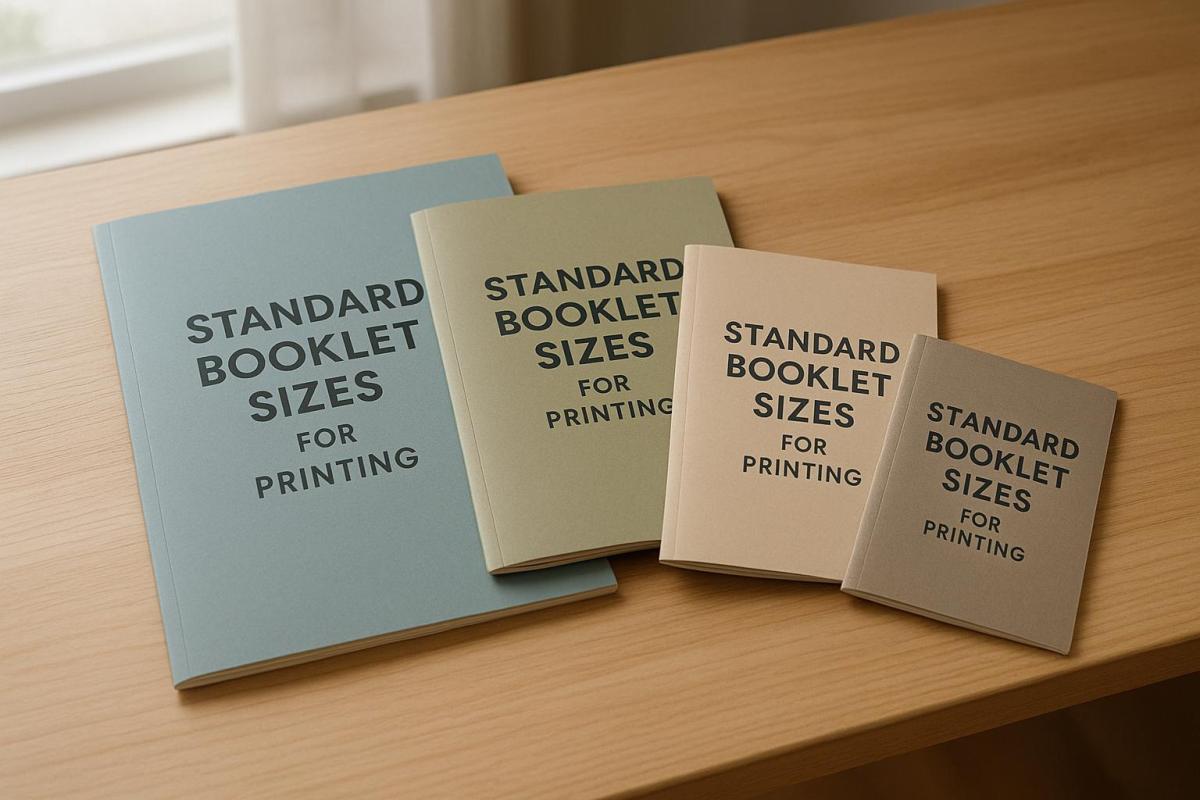
When printing booklets, choosing the right size impacts readability, cost, and usability. Common booklet sizes include:
- 5.5″ x 8.5″ (Half-Letter): Compact and portable, ideal for event programs, product catalogs, and promotional materials.
- 8.5″ x 11″ (Letter): Offers more space, suitable for reports, manuals, and detailed presentations.
- 6″ x 9″: A balanced option, often used for novels, training materials, and portfolios.
- A5 (5.83″ x 8.27″): Similar to half-letter, popular for international projects.
- A4 (8.27″ x 11.69″): Larger format, great for content-heavy designs and global audiences.
Smaller booklets are easier to carry and economical, while larger ones accommodate detailed visuals and text. Production and mailing costs vary by size, with standard formats like 5.5″ x 8.5″ and 8.5″ x 11″ being cost-effective in the U.S.
For custom sizes, consider your budget, audience, and content needs. Custom formats stand out but may increase production costs. Partnering with an experienced printer ensures high-quality results tailored to your project.
Designing Booklets: Choosing a Booklet Size
Standard Booklet Sizes
When it comes to printing booklets, certain dimensions have become widely used because they balance practicality, cost, and visual appeal. Here’s a breakdown of the most popular sizes and what they’re best suited for.
5.5″ x 8.5″ (Half-Letter)
This size, often referred to as half-letter or digest, is a favorite in the US. Its compact design makes it easy to carry while still offering enough space for visuals and text. That’s why it’s a go-to for product catalogs and promotional materials. It’s also a practical choice for event programs, as it fits conveniently into a purse or pocket. Many novels, memoirs, and non-fiction books also fall into this size category.
8.5″ x 11″ (Letter)
The letter size, 8.5″ x 11″, provides more room, making it ideal for content that requires clarity and detail. It’s commonly used for reports, manuals, handbooks, and technical documents, where clear text and diagrams are essential. This size is also perfect for professional business presentations and annual reports, offering a polished and organized look.
6″ x 9″ and Square Formats
The 6″ x 9″ size is a middle ground between the compact half-letter and the larger letter dimensions. It’s often chosen for portfolios, lookbooks, or marketing materials that need a sleek, sophisticated feel. Square formats, such as 6″ x 6″ or 8″ x 8″, stand out visually and are popular for art books, photography portfolios, and brand-focused designs.
A5 (5.83″ x 8.27″) and A4 (8.27″ x 11.69″)
International sizes like A5 and A4 are gaining traction in the US, especially among businesses with global audiences. A5, at 5.83″ x 8.27″, is similar to half-letter in its portable and personal feel. Meanwhile, A4 offers even more space than the standard letter size, making it ideal for detailed catalogs, comprehensive reports, and educational materials. A5 works well for projects needing a smaller, approachable format, while A4 is better for content-heavy designs.
The choice between US standard and international sizes depends on your audience and project goals. For US-focused projects, 5.5″ x 8.5″ and 8.5″ x 11″ are familiar and practical. On the other hand, international formats like A5 and A4 can add a global touch and ensure consistency for worldwide use. These dimensions provide a solid foundation for customizing your booklet to fit your needs and budget.
How to Choose the Right Size
Selecting the right booklet size is about finding the sweet spot between your content needs, how your audience will use it, and what your budget allows. The size you choose influences not only the design but also how practical and cost-effective the booklet will be.
Content and Layout Requirements
The type and amount of content you have should guide your size decision. If you’re working on detailed reports, technical manuals, or catalogs packed with charts and diagrams, a larger format like 8.5″ x 11″ is ideal. It ensures everything – from text to visuals – remains clear and easy to read. Larger sizes are also better for content with intricate visuals, as they preserve detail and impact.
For simpler materials such as event programs, product brochures, or promotional handouts, smaller formats like 5.5″ x 8.5″ are a better fit. This size encourages concise, focused messaging that’s quick for readers to digest.
If your project is heavy on visuals – like photography portfolios, art books, or architectural showcases – larger formats allow images to stand out. On the other hand, text-heavy booklets can work well in smaller sizes, as long as the content is well-organized and the font remains legible.
Purpose and Target Audience
Think about who will use your booklet and in what setting. For materials like trade show handouts, networking guides, or quick-reference booklets, portability is key. Smaller formats are easy to carry and more practical for these scenarios.
Larger formats, like 8.5″ x 11″, work best for professional settings such as boardroom presentations or client meetings. They make a strong impression and are ideal for discussing complex information like real estate brochures, corporate reports, or detailed product catalogs.
Educational materials and training manuals need a balance between portability and readability. A 6″ x 9″ size often works well, offering enough space for clear explanations and diagrams while still being easy to handle for students or employees.
Also, consider where your audience will encounter your booklet. Compact, visually appealing formats are perfect for busy trade shows, while larger, more detailed catalogs can be sent directly to prospects who are likely to spend more time reviewing them.
Budget and Mailing Costs
The size of your booklet has a direct impact on printing and shipping costs, so your budget plays a big role. Standard sizes like 5.5″ x 8.5″ and 8.5″ x 11″ are often more economical because they reduce production waste. Even small changes to these dimensions can lead to higher costs.
Mailing costs also increase with size and weight. For example, as of August 2024, USPS flat mail (large envelopes) starts at $1.50 for up to 1 ounce, with an additional $0.27 for every extra ounce. Standard letter-sized booklets are cheaper to mail than larger formats because of the way they’re processed. If your booklet can fold down to fit letter-size dimensions, you’ll save significantly on postage.
The size of your print run also affects costs. Ordering 25 booklets might cost $3–$5 per piece, but ordering 1,000 could drop the price to $0.40–$0.60 per booklet. Larger print runs make bigger formats more affordable, though rush orders will add extra charges.
"The size you select should resonate with your book’s purpose, content type, and target audience, so we’re often asked for guidance as a commercial printer on this small but crucial decision." – Thomas Group Printing
Booklet Size Comparison Chart
Choosing the right booklet size can make a big difference in your project’s impact and cost. Below is a side-by-side comparison of standard booklet sizes, highlighting their uses, advantages, and limitations to help you make an informed decision.
| Size | Best Uses | Advantages | Disadvantages | Cost Considerations |
|---|---|---|---|---|
| 5.5″ x 8.5″ | Event programs, promotional booklets, product catalogs, zines | Portable; fits standard envelopes; economical for printing and mailing | Limited space for content; requires concise design | Most affordable for printing and shipping |
| 8.5″ x 11″ | Reports, manuals, presentations, detailed catalogs | Offers maximum content space; professional look; great for visuals | Less portable; higher mailing and production costs | Expensive to print and ship |
| 6″ x 9″ | Novels, biographies, non-fiction books, training materials | Standard book size; good balance of readability and cost | Moderate space; average portability | Balanced printing and mailing costs |
| A5 (5.83″ x 8.27″) | International publications, technical manuals, academic materials | Compact and internationally recognized | Less common in the U.S.; may need custom setup | Slightly higher costs due to non-standard sizing in the U.S. |
| A4 (8.27″ x 11.69″) | International reports, technical documentation, academic papers | Larger international standard; great for detailed content | Rare in U.S.; higher costs and mailing challenges | Most expensive due to non-standard U.S. sizing |
Key Insights on Booklet Sizes
The 5.5″ x 8.5″ size stands out for its portability and cost efficiency. It’s perfect for projects like product catalogs or zines where compactness and affordability are priorities.
If your project requires more room for visuals and detailed text, the 8.5″ x 11″ format provides the space you need. This size is ideal for professional reports, technical manuals, and catalogs loaded with charts, diagrams, or extensive information.
For a balance between compactness and content space, the 6″ x 9″ format is a reliable choice. Widely recognized as the standard for novels and non-fiction books, it offers a good mix of readability and cost-effectiveness. It’s also a popular size for training materials and educational booklets.
Cost and Mailing Considerations
Printing costs can vary significantly between formats. For instance, a 6″ x 9″ booklet with 60 full-color pages and saddle-stitch binding costs about $5.50 per unit, while increasing the page count to 92 raises the cost to $11.88. On the other hand, 1,000 perfect-bound 5.5″ x 8.5″ booklets with 80 pages cost roughly $3.97 each, while printing just 250 units increases the cost to around $5.89 per booklet.
"The thicker the paper and the more color images (and ink) you use, the more it can cost." – Zoe Fisher, Marketing Assistant, PrintingCenterUSA
Mailing costs also depend on size. Smaller formats like 5.5″ x 8.5″ are generally cheaper to mail due to their lighter weight, which often qualifies them for lower postage rates. Larger sizes, such as 8.5″ x 11″, may incur higher shipping fees and could fall into more expensive postal rate categories.
A5 and A4 Formats for Global Use
If your project targets an international audience, A5 and A4 formats are worth considering. While these sizes align with global standards, they can increase costs in the U.S. due to custom setups and mailing challenges.
Final Thoughts on Choosing a Format
Smaller booklets are great for delivering focused, concise content, while larger formats are better suited for detailed information. The 6″ x 9″ size often strikes the best balance, offering enough space for content while keeping production and mailing costs reasonable. Use this guide to weigh the trade-offs and select the format that best fits your project’s needs and budget.
sbb-itb-ce53437
Custom Booklet Sizes
When you’re looking to make a statement with your printed materials, custom booklet sizes can provide the flexibility and creativity needed to leave a lasting impression. Moving beyond standard dimensions, custom sizes allow you to tailor your booklets to meet specific needs and stand out from the crowd.
Benefits of Custom Sizes
Choosing custom dimensions for your booklets comes with several perks:
- They offer unique shapes and sizes that align perfectly with specific design goals.
- Square booklets, being less common than rectangular ones, naturally draw attention and set your materials apart.
- Custom dimensions help reinforce your brand identity, making your booklet distinct and memorable.
- These sizes are ideal for matching your brand’s visual style or accommodating particular design elements.
Custom booklet sizes can be grouped into categories based on their purpose:
- Small Custom Booklets: Sizes like 9.5″ x 4.75″ or 8.0″ x 9.0″ are perfect for portable materials such as event programs, product brochures, or promotional handouts.
- Medium Custom Formats: Dimensions like 12.0″ x 9.0″ provide a flexible option for educational materials, retail catalogs, or company profiles.
- Large Custom Booklets: Larger sizes, such as 17.0″ x 11.0″ or 11.0″ x 17.0″, are excellent for impactful presentations, where large visuals and detailed information take center stage.
- Extra-Wide Formats: Unique dimensions like 22.0″ x 8.5″ or 18.0″ x 6.0″ are ideal for panoramic layouts or timelines, making them a standout choice for artistic displays or detailed marketing campaigns.
These options not only enhance the visual appeal of your materials but also ensure they serve their intended purpose effectively.
Custom Printing Considerations
Printing custom-sized booklets involves more than just picking dimensions. Here are some key factors to keep in mind:
- Cost implications: Custom sizes generally cost more than standard ones, so budget accordingly.
- Paper stock selection: Use thinner paper for internal pages and thicker, more durable stock for the cover.
- Binding methods: Leave enough space for binding to avoid cutting off important content. Saddle stitching is a budget-friendly option for booklets with fewer pages.
- File preparation: Ensure your files are formatted correctly, use high-resolution images, and work in CMYK color mode for accurate printing.
- Consult your printer early: Getting input from your printer during the design phase can help avoid costly mistakes.
- Order quantity: Printing larger quantities can significantly lower the cost per unit.
- Quality control: Always request a proof to check for errors. Images should have a resolution of at least 300 dpi for sharp, professional results.
Booklet Printing at Miro Printing & Graphics Inc.
Choosing the right booklet size is just one piece of the puzzle – what truly brings your vision to life is expert printing and finishing.
Since its founding in 1994 in Hackensack, NJ, Miro Printing & Graphics Inc. has been delivering professional-grade booklet printing for over 30 years. Their expertise spans both standard and custom projects, ensuring each booklet is produced to the highest standards.
"With meticulous attention to detail, our print shop has a customized approach that is unmatched by larger print providers."
Printing and Finishing Options
Miro Printing & Graphics Inc. offers a range of printing solutions, including digital and offset printing, to accommodate diverse project needs. Digital printing is perfect for short runs and tight deadlines, while offset printing provides consistent, cost-effective results for larger orders. What sets them apart is their fully in-house bindery, which keeps every step of production under one roof. This approach not only reduces delays but also ensures strict quality control.
Their post-press services cover a wide array of finishing options, including:
- Binding methods like perfect binding, plastic coil, and comb binding
- Collating, cutting, creasing, and die cutting
- Drilling, folding, micro-perforation, and numbering
- Padding and direct mailing services
These capabilities allow them to handle everything from economical production of standard formats to the intricate demands of custom designs. Whether it’s a simple saddle-stitched booklet or a catalog with unique finishes, they deliver professional results every time.
Custom Projects and Design Support
Miro Printing & Graphics Inc. goes beyond printing by offering layout and design support to create polished interiors and eye-catching covers. Their design team collaborates with clients throughout the process, from initial concept to final production, ensuring tailored solutions for even the most unique booklet projects.
"Let us know what type of project you are working on, and allow us to leverage our expertise."
For more complex projects, they provide proofs for review before moving to final production, giving clients the chance to ensure every detail is just right.
Customer testimonials highlight their dedication to quality and service. One client praised their exceptional customer service and attention to detail, while another shared how Miro completed a challenging job quickly and at a fair price – even going the extra mile to provide a video of a print sample for approval.
Conclusion
Selecting the right booklet size plays a key role in how well your content connects with readers, impacts your budget, and achieves the desired outcome. Standard formats each serve specific purposes, so your choice should reflect the type of content you’re presenting, the needs of your audience, and the resources you have available.
Smaller formats are ideal for portable, quick reads. Medium sizes shine in educational materials and profiles, while larger formats are perfect for bold, impactful presentations. Extra-wide layouts, on the other hand, are designed to showcase intricate visuals or artistic content.
For those looking to balance cost and efficiency, the 5.5″ x 8.5″ size is often the most economical for larger print runs, offering a good mix of affordability and printing ease. Careful planning and proper file preparation can also help you avoid unnecessary expenses, such as rush orders or reprints.
Beyond size, the quality of execution is equally important. Miro Printing & Graphics Inc., with over 30 years of experience, offers both digital and offset printing options, along with comprehensive finishing services. Their in-house bindery ensures consistent quality, while their design team provides layout assistance to help you make the most of your chosen format.
Once you’ve decided on the size, expert printing and attention to detail are essential for bringing your project to life. Whether it’s a small promotional booklet or a detailed product catalog, combining thoughtful size selection with professional printing ensures your booklet meets its purpose and delivers the impact you’re aiming for. This seamless approach – from choosing the right format to final production – ensures your vision becomes a reality.
FAQs
What should I consider when deciding between US standard and international booklet sizes?
When choosing between US standard and international booklet sizes, it’s important to consider your audience, the booklet’s purpose, and how it will be printed. In the United States, 8.5" x 11" is a popular size, commonly used for catalogs, instruction manuals, and business documents. Meanwhile, international sizes like A4 (8.27" x 11.7") are favored worldwide, especially for formal publications or materials targeting global audiences.
You’ll also want to think about the availability of printing services and materials for the size you select. Additionally, some design or layout requirements may naturally fit better with one format over the other. If you’re unsure, reaching out to a professional print shop, such as Miro Printing & Graphics Inc., can provide guidance tailored to your project’s needs.
How do custom booklet sizes affect production and mailing costs compared to standard sizes?
When opting for custom booklet sizes, be prepared for potentially higher production and mailing expenses compared to standard options. Why? Custom sizes often demand specialized printing setups, unique cutting processes, and adjustments to meet mailing requirements. All these extra steps can drive up both material and labor costs.
If you’re thinking about going the custom route, it’s worth balancing the appeal of a distinctive design against the likelihood of increased expenses. For those working within tighter budgets, sticking with standard booklet sizes is usually a more economical and efficient choice.
Why is the 6" x 9" booklet size a great choice for educational materials and training manuals?
The 6" x 9" booklet size is a favorite choice for educational materials and training manuals because it offers the ideal mix of ease of reading and portability. Its compact dimensions make it simple to carry around, while still providing enough room for detailed text, diagrams, and visuals.
This format is also widely recognized and convenient for readers, fitting easily into bags or sitting neatly on desks. Whether you’re creating step-by-step guides or reference materials, the 6" x 9" size delivers a polished, professional appearance without being cumbersome.
Related posts
- Paper Sizes for Commercial Printing Explained
- Offset vs. Digital: Paper Size Considerations
- Standard Print Sizes Explained
- Top 7 Layout Tips for Business Printing
https://app.seobotai.com/banner/banner.js?id=687c359f84572425aed90198
 BergenCountyPrintersBlogs