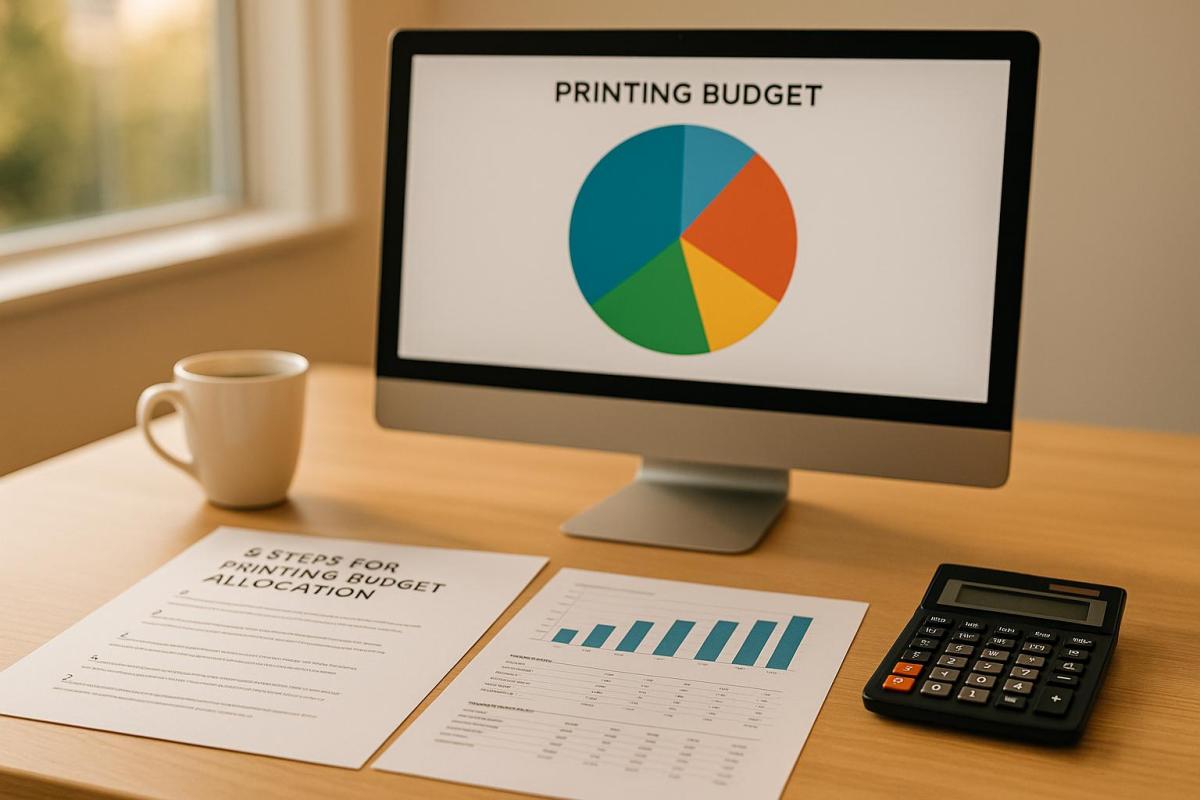
5 Steps for Printing Budget Allocation

Learn how to create an effective printing budget that aligns with your business goals, enhances ROI, and reduces unexpected costs.

Printing costs can account for up to 3% of annual revenue, making smart budgeting essential for businesses. Without proper planning, you risk overspending, inconsistent quality, and missed opportunities. This guide outlines five actionable steps to create a printing budget that aligns with your business goals and maximizes ROI:

  1. Review Your Printing Needs: List all required materials, assess current inventory, and plan for future demands. Group items by purpose (e.g., marketing, operational, event-specific) to focus spending effectively.
  2. Set Budget Limits: Define your maximum spend based on past expenses, ROI potential, and project priorities. Account for direct (e.g., paper, ink) and indirect costs (e.g., design, shipping).
  3. Distribute Funds by Priority: Rank items by their business impact – allocate more for high-value materials like sales brochures and less for internal documents. Balance quality and quantity to meet goals without overspending.
  4. Get Quotes and Update Your Plan: Request detailed, itemized quotes from providers. Compare options, negotiate where possible, and adjust your budget based on real prices.
  5. Track and Adjust: Monitor spending in real time using tools like spreadsheets or print management software. Conduct regular reviews to identify and correct discrepancies.

How To Create A Project Costing Application with Budget vs. Actual Costs In Excel [Free Download]

Step 1: Review Your Printing Needs

Building a meaningful printing budget begins with understanding exactly what your business needs to print. A clear and detailed list helps you avoid unnecessary purchases and ensures no essential items are overlooked. Once you’ve outlined your requirements, quantify them to set the stage for smart budgeting.

List Your Core Printing Items

Start by creating a detailed inventory of all the printed materials your business requires. The specifics will vary depending on your industry and objectives. For instance, retail businesses often focus on creating promotional flyers and bold banners for storefront displays. On the other hand, professional service firms may prioritize business cards and branded stationery for client interactions. Don’t underestimate the impact of paper costs – it can make up 20%–40% of your total print expenses. Knowing exactly what you need helps you focus your spending where it matters most.

Feedback from long-term customers of professional printing services highlights the importance of these essential items. As Julieth R., a satisfied customer, shared:

"I have been a customer of theirs for several years for my business cards, envelopes and posters and could not be happier." – Julieth R., Customer

When compiling your list, include details like material type, purpose, quantity, and how often you’ll need to reorder. This will help you make informed decisions about balancing quality and quantity.

Review Current and Future Requirements

Take stock of your current inventory and plan for future projects to avoid last-minute orders and take advantage of bulk discounts. Conduct an audit of your existing materials and review your calendar for the next 12 months. This will help you identify any shortages, surpluses, or upcoming needs. Looking at past usage and seasonal trends can also offer valuable insights to predict demand and avoid unexpected expenses.

For example, if you’re planning to attend multiple trade shows in the coming year, it’s wise to prepare banners, brochures, and business cards well in advance. Consolidating these orders can lead to better pricing. Additionally, consider whether digital alternatives – like email newsletters or online invitations – could replace some printed materials, allowing you to allocate more of your budget to high-impact items.

Group Items by Purpose and Use

Organizing your printing needs into categories simplifies budgeting and helps prioritize what’s most important. Many businesses divide their requirements into three main groups: marketing materials (flyers, brochures, banners), operational items (forms, invoices, letterhead), and event-specific materials (trade show signage, invitations). Once you’ve assessed demand, grouping similar items can help you take advantage of bulk discounts and reduce setup costs.

Using a spreadsheet to track these categories, along with quantities and estimated costs, can make the process even smoother. Partnering with a trusted print provider during this step can also uncover cost-saving opportunities.

"Let us know what type of project you are working on, and allow us to offer our expertise. During the process, Miro Printing & Graphics Inc. will work with a professional, personal approach to better understand your company’s needs." – Miro Printing & Graphics Inc.

Step 2: Set Your Budget Limits

Once you’ve outlined your printing needs, it’s time to set clear financial boundaries. Establishing a firm budget not only prevents overspending but also ensures your resources are allocated effectively. This step goes beyond just picking a number – it requires a careful review of priorities and a thorough understanding of potential costs.

Set Your Maximum Spending Amount

Your maximum budget should align with both your financial capacity and the importance of your printing projects. Start by reviewing past expenditures. For instance, if your annual report cost $2,500 last year, use that as a baseline, adjusting for any changes in scope or costs.

Think about the return on investment (ROI) when allocating funds. Materials that directly impact revenue, like marketing brochures or sales catalogs, may justify a larger budget compared to internal documents. Seasonal factors also play a role. Retail businesses might need to allocate more during the holidays, while B2B companies could see higher spending around trade shows.

The U.S. Government Publishing Office highlights that rush charges can inflate printing costs by 15–25%. Planning ahead can help you avoid these fees. Additionally, setting aside a contingency buffer can cover unexpected costs or price changes, keeping your budget intact. Finally, make sure to account for all direct and indirect expenses to create a comprehensive budget.

Include All Direct and Indirect Costs

To avoid surprises, break down your printing expenses into direct and indirect costs. Direct costs include essentials like paper, ink, printing labor, and basic finishing services. Indirect costs, often overlooked, can include design fees (ranging from $50–$200 per hour depending on complexity), shipping, storage, rush fees, and administrative overhead. Post-press services such as binding, laminating, or other specialized finishes can also add to your total.

For example, a New Jersey company cut brochure expenses by 18% by working with Miro Printing & Graphics Inc., which provided a complete pricing package that included design, finishing, and mailing services.

When requesting quotes, make sure to ask for itemized estimates that cover all potential services. Companies like Miro Printing & Graphics Inc. offer comprehensive solutions, including in-house bindery and mailing services, and provide free, detailed estimates that account for indirect costs. As they explain:

"The end result is a finished piece that exceeds your highest expectations but never your budget!"

Record and Share Your Budget Plan

A well-organized and shared budget plan is crucial for accountability and smooth collaboration. Tools like Microsoft Excel or Google Sheets are excellent for tracking expenses, offering real-time updates, version control, and easy sharing.

Use a spreadsheet to log expenses by item, quantity, cost, and approval status. This makes it simple for stakeholders to see where funds are going and monitor spending as projects move forward. According to Mimeo, businesses can save up to 30% on printing costs by consolidating orders and optimizing print runs.

Sharing your budget with your team helps prevent misunderstandings and ensures everyone is aware of financial constraints. Regularly reviewing the budget allows you to catch potential overruns early, making adjustments before costs spiral out of control. Cloud-based tools can be particularly helpful, enabling multiple team members to access and update budget data in real time, keeping everyone aligned and on track.

Step 3: Distribute Funds by Priority

Once you’ve set your budget limits, the next step is figuring out how to allocate your funds effectively. Not all printing materials carry the same weight when it comes to business impact. The key is to spend wisely – focusing your dollars on items that deliver the greatest results while avoiding unnecessary splurges on premium finishes where they aren’t needed. By prioritizing strategically, you ensure every dollar works toward boosting your business.

Rank Items by Business Impact

When it comes to allocating your print budget, start with the materials that directly influence your bottom line. Identify which items generate revenue, support marketing efforts, or meet critical regulatory needs.

You can divide print materials into three tiers based on their impact:

  • High-impact items: Think sales brochures, client proposals, and trade show banners – materials that directly drive sales or enhance your brand presence.
  • Medium-impact items: Includes business cards and internal presentations that support your team but don’t directly generate revenue.
  • Low-impact items: Internal forms, draft documents, or other materials with minimal outward-facing value.

To determine where to allocate funds, compare the cost of each item with its potential return. For instance, if a direct mail campaign has historically brought in $10,000 in new business from a 5% response rate, it deserves a larger budget slice than generic flyers with no measurable outcomes. Use past performance data to guide your decisions – if a product catalog pulled in 200 leads last quarter, it’s worth prioritizing in your budget.

Once you’ve ranked your items, create an itemized budget plan. This plan should include each print item, its priority level, allocated funds, and a brief explanation of why it deserves its spot. This transparency not only keeps your team aligned but also helps avoid last-minute debates over resource allocation.

Balance Quality and Quantity Needs

The trick to smart budgeting is matching the quality of materials to their purpose. Once you’ve ranked your priorities, align your spending with the level of quality each item requires.

For example, high-profile materials like client proposals, sales presentations, or marketing brochures often justify premium paper stocks and professional finishes. On the other hand, internal forms, draft copies, or administrative documents can get the job done with standard materials.

Here’s a practical breakdown: If you’re launching a new product, you might spend $1,000 on 200 premium brochures at $5 each for key prospects. At the same time, you could allocate $500 for 5,000 standard flyers at $0.10 each for broader distribution.

Bulk printing is another way to stretch your budget. Ordering larger quantities can reduce per-unit costs by as much as 30%. For items like sales brochures that your team uses regularly, consider ordering quarterly to take advantage of these discounts. Meanwhile, for specialty items with limited use, smaller print runs may be more economical.

Material choices also play a big role in cost management. Switching to more affordable paper stocks can save 10–20% without sacrificing professionalism. Partnering with your print provider can help identify cost-effective alternatives that still look polished.

For instance, working with a full-service provider like Miro Printing & Graphics Inc. can simplify the process. They offer in-house design and bindery services, helping you make smart choices on materials, printing methods, and bulk order discounts. Their expertise can prevent budget overruns and ensure your funds are directed toward the items that matter most.

Finally, make it a habit to review your spending regularly. Business priorities change, and your budget distribution should adapt accordingly. By staying flexible, you can adjust your allocations without throwing off your overall financial plan.

sbb-itb-ce53437

Step 4: Get Quotes and Update Your Plan

Turn your prioritized needs into detailed quotes to avoid unexpected costs and ensure your budget covers everything.

Request Complete Price Quotes

When reaching out to print providers, share comprehensive project details to receive accurate pricing. Be specific about the type of item (e.g., brochures, business cards, banners), quantities, materials, color preferences, finishing options like lamination or binding, deadlines, and any special instructions.

For instance, instead of asking for a quote on “marketing brochures,” specify: “500 tri-fold brochures, 8.5″ x 11″ folded to 8.5″ x 3.67″, full color on both sides, 100lb gloss text paper with an aqueous coating finish, delivered by March 15th.” This level of detail minimizes follow-up questions and ensures the quote aligns with your actual needs, helping you avoid unplanned expenses.

Using a full-service provider can simplify the process. Companies such as Miro Printing & Graphics Inc. offer services like digital and offset printing, large format printing, design, bindery, and mailing – all under one roof. This allows you to consolidate your project into a single quote instead of coordinating with multiple vendors.

"Let us know what type of project you are working on, and allow us to offer our expertise."
– Miro Printing & Graphics Inc.

When requesting quotes, always ask for an itemized breakdown. This should include costs for design, printing, materials, finishing, and delivery, so you can see exactly where your money is going.

Check What Services Are Included

Once you’ve gathered quotes, take a close look at each one to spot any hidden costs. These can sneak up on you and throw off your budget. Print quotes often include additional services like design, pre-press setup, digital proofing, bindery (e.g., folding or stapling), finishing (such as lamination or die-cutting), and delivery or mailing services.

For example, design services might cost $50 to $200 per hour depending on complexity, while bindery or mailing services could add $0.05 to $0.50 per piece. If a quote doesn’t clearly outline what’s included, don’t hesitate to ask for clarification.

Watch out for common hidden fees, such as rush charges for tight deadlines, setup fees for new projects, proofing fees, extra revision costs, special finishing charges, and delivery fees. Request itemized quotes and confirm whether any additional charges could come up during production.

The quality of service is just as important as the price. Look for providers that offer thorough proofing processes. Some companies even provide video proofs of print samples for approval before full production, ensuring accuracy and reducing the risk of costly reprints.

"Mike and his team completed a complex job in record time for a very reasonable price. I’d approached numerous printers about this job with no success, but these guys just made it work and were super easy to deal with. I even received a video of my print sample (a mini booklet) for approval before they proceeded with the rest. Best service I’ve ever received from a printer; couldn’t recommend Miro more highly."
– Julia I.

Update Your Budget Based on Real Prices

Once you’ve gathered quotes, revisit your budget and make adjustments as needed. Compare the quotes to your initial estimates and shift funds around to stay within your overall budget.

For example, if you budgeted $2,000 for brochures and $1,000 for business cards but received quotes of $2,500 and $800 respectively, you might reduce the brochure quantity, opt for less expensive materials, or reallocate $500 from the business card budget to cover the difference – keeping your total spend at $3,000.

Competitive quotes can also be a bargaining tool. Many print providers are open to matching or beating competitor pricing, especially for large orders or repeat customers. You might even negotiate perks like free upgrades to better paper, faster turnaround times, or bundled services.

Keep track of final prices and details in your budget spreadsheet for easy comparison and future planning. Save all quotes, emails, and updated budget spreadsheets. These records will help with future negotiations, improve forecasting, and make your budgeting process more efficient over time.

Step 5: Track and Adjust Your Budget

Keeping an eye on your budget in real time and making timely adjustments can make all the difference in your printing project. Active tracking allows you to spot issues early and make smarter decisions along the way.

Monitor Spending as It Happens

Use tools like Excel, Google Sheets, or print management software to log every expense as it occurs. For instance, if you set aside $1,500 for business cards and the actual quote comes in at $1,650, a tracking system can flag this $150 difference so you can decide how to address it. Many businesses rely on spreadsheets with built-in formulas to compare actual spending against their budgets.

Some print management platforms take this a step further by automatically recording expenses when linked to your print provider or internal devices. These systems provide up-to-date data on usage and costs, eliminating the need for manual entry and giving you instant insight into your spending patterns.

To avoid surprises, set up automated alerts that notify you when spending nears your budget limit. Many management platforms offer these notifications, helping you take action before overspending becomes an issue. This proactive approach ensures you’re always in control.

Schedule Regular Budget Reviews

Real-time tracking is only part of the equation – regular budget reviews are just as important. A 2022 industry report found that businesses conducting monthly reviews reduced printing cost overruns by an average of 18% compared to those reviewing quarterly.

During these reviews, compare your actual spending to your original budget and analyze any discrepancies. Are you consistently overspending on certain items? Are there areas where you’re spending less than expected and could reallocate funds? Identifying patterns helps you fine-tune your approach.

Signs that your budget might need adjustment include frequent overspending in specific categories, unexpected costs like rush orders, or changes in project scope. Address these issues as soon as they arise.

For example, one marketing agency adopted cloud-based print management and managed to cut unplanned printing costs by 22% over six months. Flexibility in your review process is key. Sometimes, external factors like rising postage rates or material shortages can impact your budget. One marketing team, faced with a sudden increase in postage costs, adjusted their plan mid-project by switching to lighter paper and reducing print quantities. These changes allowed them to stay within budget while still hitting their campaign goals.

Keep Records for Future Projects

Thorough record-keeping is essential for improving future projects. Save all invoices, quotes, and correspondence – whether digital or physical – for easy reference.

Create a post-project summary that includes cost breakdowns, unexpected expenses, and key takeaways. Document what worked and what didn’t, such as vendor performance, material choices, and timeline accuracy. This information will be invaluable for making better budgeting decisions in the future.

Records also make forecasting and vendor negotiations easier. Some print providers, like Miro Printing & Graphics Inc., offer templates or online portals to track order history and spending, simplifying the process.

Don’t overlook the small details. Even minor email threads about design changes or delivery schedules can provide crucial context later. Businesses using dedicated print management software report saving up to 25% annually on printing costs thanks to improved tracking and adjustments.

Lastly, set aside a contingency fund – typically 5–10% of your total budget – for unexpected expenses. Keep track of how this fund is used to determine if adjustments are needed for future projects. Careful documentation and a flexible approach can help you stay prepared for whatever comes your way.

Conclusion: Key Points for Printing Budget Success

Achieving a successful printing budget comes down to thoughtful planning, smart prioritization, and diligent tracking. These elements work together to ensure high-quality results without exceeding your financial limits.

To recap, effective budgeting begins with clear planning – identify your needs and set practical spending limits. From there, focus on strategic prioritization by directing funds toward items that directly impact business outcomes. Finally, keep a close eye on your expenses through real-time tracking, allowing you to make quick adjustments before small issues grow into bigger problems.

It’s essential to account for all costs in your plan. This includes direct expenses like paper, ink, and printing, as well as indirect expenses such as design, shipping, and storage. By doing so, you can avoid those unpleasant surprises that derail budgets.

Another key to success is partnering with a reliable print provider. Choosing a full-service expert like Miro Printing & Graphics Inc. can make a significant difference. Their expertise can guide you in selecting the right materials, streamlining production, and sidestepping costly errors.

"The end result is a finished piece that exceeds your highest expectations but never your budget!" – Miro Printing & Graphics Inc.

For long-term success, keep detailed records of your projects. These records will be invaluable for refining future budgets and improving outcomes over time. Also, stay adaptable – adjust specifications or designs to save costs without compromising quality. Sharing your budget constraints with your provider can lead to creative, cost-effective solutions.

FAQs

How do I find the right balance between quality and quantity for my printing materials?

Striking the right balance between quality and quantity in printing comes down to understanding your project’s purpose and sticking to your budget. Start by defining what you want to achieve. Are you looking to impress with sleek, high-end finishes? Or is your priority reaching a wider audience with a larger number of prints? For example, premium brochures might call for thicker paper and glossy finishes, while cost-effective bulk flyers can focus more on quantity.

Partnering with a professional print shop, like Miro Printing & Graphics Inc., can make this process much easier. They can guide you through material and finish options that fit your goals and budget, ensuring your printed materials deliver the impact you’re aiming for.

How can I track and adjust my printing budget effectively?

To keep your printing budget under control, start by pinpointing your top priorities and directing funds toward the most important projects. This approach ensures your resources are focused where they’ll have the greatest impact.

Keep a close eye on your expenses to make sure they stay within the limits of your budget. If unexpected costs pop up, tweak your plan as needed to prevent overspending. Opting for budget-friendly solutions, such as digital printing services from a reliable provider, can also help you save money without sacrificing quality.

How can I make sure I include all costs in my printing budget?

To get a clear picture of your printing budget, it’s important to factor in direct costs – like materials, printing techniques, and finishes – alongside indirect expenses such as design work, shipping, and post-press services. Partnering with a comprehensive provider like Miro Printing & Graphics Inc. can make this process much smoother. They handle everything from digital and offset printing to in-house bindery and mailing, ensuring no detail slips through the cracks.

Relying on a single, dependable partner for all your printing needs can help you streamline costs, steer clear of surprise charges, and create a budgeting plan that fits your project’s unique demands.

Related Blog Posts

https://app.seobotai.com/banner/banner.js?id=68f5c2491019c13c0b2f9d50

How NFC Labels Enhance Packaging

Explore how NFC labels revolutionize packaging, enhancing customer engagement, product authenticity, and supply chain efficiency.

NFC labels are transforming packaging by enabling smart, interactive features that improve customer engagement, product security, and supply chain efficiency. With around 85% of smartphones globally supporting NFC, businesses can use this technology to create touch-based experiences that go beyond traditional barcodes and QR codes. Here’s what makes NFC labels stand out:

  • Simple Interaction: Customers tap their smartphones on the label – no camera or alignment needed.
  • Secure Authentication: Encrypted codes make counterfeiting nearly impossible, especially for industries like pharmaceuticals and luxury goods.
  • Dynamic Data: Businesses can update label content remotely, offering tailored experiences and real-time insights.
  • Supply Chain Visibility: NFC labels provide detailed tracking, ensuring better inventory management and quality control.

Whether it’s verifying product authenticity, sharing multimedia content, or improving logistics, NFC labels are reshaping how brands connect with consumers and manage products.

Quick Comparison: NFC Labels vs. Barcodes/QR Codes

Feature NFC Labels Barcodes/QR Codes
Interaction Tap (no line-of-sight) Scan (requires line-of-sight)
Data Updates Dynamic Static
Security High (encrypted) Low (easily copied)
Consumer Engagement Interactive, multimedia Limited to static info
Communication Two-way One-way

Interactive Packages that Connect with NFC-enabled Smartphones

Benefits of NFC-Enabled Die-Cut Labels for Businesses

NFC-enabled labels transform packaging into interactive tools that enhance engagement, ensure product authenticity, and improve supply chain efficiency. These labels go beyond traditional packaging, offering businesses new ways to connect with customers while strengthening their overall brand presence.

Improving Customer Interaction

NFC labels turn packaging into a direct line of communication between brands and their customers. With just a tap of a smartphone, customers can instantly access digital content – no need for additional apps or scanning. Businesses can use these labels to share exclusive promotions, tutorials, warranty registration links, loyalty program sign-ups, and even personalized messages.

For example, a beverage company might include an NFC label that lets customers join a sweepstakes or discover cocktail recipes. Similarly, a cosmetics brand could use them to share how-to videos or detailed ingredient information. Beyond convenience, NFC labels also allow brands to gather valuable data, such as when and where customers interact with their products, providing insights into consumer behavior.

NFC packaging can also deliver information about product origins, environmental credentials, or even host interactive games and contests. These unique experiences create memorable interactions that strengthen customer loyalty and deepen engagement with the brand.

Better Product Authentication

Counterfeiting is a major issue across many industries, and NFC labels provide a powerful solution to combat it. Advanced NFC chips, like the NTAG 424 DNA, generate secure, encrypted codes with each scan. These codes are verified against a remote server and include features such as one-time codes, tamper detection, and encrypted authentication.

Industries particularly vulnerable to counterfeiting, like luxury goods, pharmaceuticals, and electronics, have embraced NFC technology. For instance, luxury brands use NFC labels to help customers verify the authenticity of handbags, watches, and premium spirits. Pharmaceutical companies use them to ensure the integrity of medication packaging, while electronics manufacturers rely on NFC to protect against counterfeit components.

With a simple tap, customers can confirm they’ve purchased an authentic product. This builds trust, protects brand reputation, and provides businesses with data on authentication activities.

Simplified Product Tracking and Supply Chain Visibility

NFC labels bring a new level of transparency to supply chain management by enabling real-time data collection at every stage of a product’s journey. Each scan updates a centralized database with critical information such as location, handling conditions, and timestamps. This level of detail helps businesses track inventory, optimize logistics, and quickly address any issues that arise.

By enabling precise product tracking, NFC systems improve inventory accuracy and help reduce losses. These labels are also lightweight and cost-effective, as they draw power from scanning devices instead of requiring their own energy source. Companies that use NFC-based tracking systems have reported better operational efficiency and fewer product losses.

Additionally, the detailed records provided by NFC tracking support quality assurance efforts. Businesses can monitor storage conditions, transit times, and handling practices, allowing them to refine packaging and shipping methods for better results. This level of visibility not only improves logistics but also ensures products meet high standards throughout their lifecycle.

Selecting and Implementing NFC Labels for Packaging

Integrating NFC labels into your packaging strategy takes thoughtful planning. This process sets the stage for effective label programming, quality assurance, and seamless functionality.

Choosing the Right NFC Labels

When selecting NFC labels, it’s important to match the label type to your specific needs. For example, anti-counterfeiting efforts call for chips like the NTAG® 213, which offer tamper-proof features and generate unique codes with every scan. These advanced features enhance both product authentication and customer interaction.

Memory capacity is another key factor. Labels with more memory can store additional information, such as detailed product descriptions, extended URLs, warranty details, or promotional offers. Assess how much data you need to include to determine the right memory size.

Durability is crucial, especially when considering your product’s journey through the supply chain. Labels for food packaging might need to endure refrigeration and handling, while pharmaceutical packaging may require labels capable of withstanding temperature fluctuations while monitoring sensitive medications in transit.

Customization is also essential for integrating NFC labels with your packaging design. Die-cut labels can be tailored to fit your brand’s aesthetic, printed in your brand colors, and placed strategically to ensure easy scanning without compromising NFC functionality.

Consideration Basic Applications Advanced Applications
Chip Type Standard NTAG chips NTAG® 213 with encryption
Memory Capacity Low (basic URLs) High (rich content, multiple data points)
Durability Standard materials Weather/temperature resistant
Security Features Basic data storage Encrypted authentication, tamper detection

Programming and Encoding NFC Labels

Once you’ve chosen the right labels, the next step is programming them. NFC chips can be encoded with URLs, product details, or encrypted authentication codes. For smaller projects, mobile apps can handle encoding, but for larger volumes, desktop solutions are more efficient. These tools allow you to batch program unique identifiers and encryption keys, saving time and ensuring consistency.

To strengthen security, prioritize encryption and one-time codes during encoding. Each label can be programmed with a unique encryption key and a one-time code that gets verified against a remote server when scanned. This setup prevents counterfeiting by ensuring each scan generates a unique, non-replicable code.

Quality Control and Scaling Up

Proper label placement is essential for durability and easy scanning. Position labels where they won’t be damaged or obstructed. Embedding labels within packaging layers during manufacturing can protect their functionality while maintaining their integrity. By focusing on quality control, you can unlock the full potential of NFC technology.

Testing is also critical. Use both automated systems and manual checks across various smartphone models to ensure consistent performance.

Scaling up your NFC implementation requires robust systems for batch programming, automated label application, and seamless integration with your supply chain processes. Partnering with experienced providers can simplify this transition. For instance, Miro Printing & Graphics Inc. offers services like custom die-cutting, high-volume production, and fulfillment to support businesses expanding their NFC usage.

As your scale increases, data management systems become indispensable. These systems help track label performance, monitor scan rates, and analyze customer engagement patterns. Insights from this data can refine your NFC strategy over time.

A great example of successful NFC adoption is Johnny Walker‘s Blue Label whisky. Their NFC-enabled labels allow customers to verify product authenticity while receiving personalized messages. This case highlights how careful planning and strong quality control can lead to effective large-scale NFC integration.

sbb-itb-ce53437

The fusion of technology and design in smart packaging is advancing at an impressive pace. With NFC technology becoming more accessible and sophisticated, the smart packaging industry is undergoing a transformation. This shift is opening up fresh opportunities for innovation and engagement across various sectors, creating new possibilities for interactive marketing strategies.

Interactive Marketing and Connected Packaging

NFC-enabled packaging is revolutionizing how brands connect with their customers. By incorporating multimedia experiences, exclusive offers, and personalized content directly into packaging, brands can engage consumers in ways that traditional methods, like QR codes, simply can’t match. In fact, NFC-enabled campaigns have demonstrated interaction rates up to 30% higher than QR codes. These campaigns also provide real-time analytics on consumer behavior, giving businesses valuable insights to fine-tune their marketing efforts.

To enhance these experiences further, many brands are combining NFC with other technologies like augmented reality and QR codes. The result? Immersive and interactive experiences that captivate consumers and strengthen brand loyalty.

New Developments in Die-Cut NFC Label Formats

The latest innovations in die-cut NFC labels are addressing both functionality and aesthetic appeal. These custom-shaped labels can now be seamlessly integrated into product designs, ensuring they align perfectly with a brand’s visual identity while maintaining reliable performance. Advances in material technology have allowed NFC chips to be embedded in flexible or paper-based packaging, enabling unique shapes and even tamper-evident features – an essential addition for luxury and high-value products.

Furthermore, the miniaturization of NFC tags, combined with decreasing production costs, is making it feasible for brands to implement smart packaging solutions across entire product lines. As these design innovations continue, brands must also focus on building consumer trust and complying with legal standards.

Regulatory and Compliance Requirements

With the growing adoption of NFC technology, meeting regulatory standards is becoming increasingly critical. In the United States, for example, brands must comply with data privacy laws such as the California Consumer Privacy Act (CCPA). This involves implementing encryption, secure authentication, and transparent data policies.

Environmental concerns are also shaping the industry. Efforts are underway to create recyclable and biodegradable NFC tags to address the growing issue of electronic waste. Staying compliant requires companies to keep a close eye on regulatory updates and continuously adapt their security measures and privacy practices to meet evolving standards.

Miro Printing & Graphics Inc.: Your Partner for NFC-Enabled Packaging

Looking to bring NFC technology to your packaging? Miro Printing & Graphics Inc., based in Hackensack, NJ, combines over 30 years of experience with a full suite of in-house services to deliver custom NFC label solutions for businesses across the U.S. Their expertise makes integrating NFC into your packaging a seamless process.

Comprehensive Printing and NFC Label Solutions

Miro Printing & Graphics Inc. offers everything you need for professional NFC label production under one roof. Whether it’s digital, offset, or large-format printing, they can handle projects ranging from short-run, variable data jobs to high-volume or oversized needs.

Their precision die-cutting services ensure NFC labels are custom-shaped to match your brand’s unique style while maintaining the exact tolerances needed for both aesthetic appeal and chip functionality. To protect NFC chips and improve durability throughout the supply chain, they also provide in-house bindery services like lamination and finishing.

Every NFC label undergoes rigorous testing to ensure chip functionality and material durability meet industry standards. This attention to detail ensures that the final product not only performs reliably but also aligns with your specific requirements.

Tailored Services for Any Industry

Miro Printing & Graphics Inc. understands that every industry has unique needs. They work closely with clients to create NFC labels that align with specific business goals, leveraging NFC’s ability to enhance security, improve inventory tracking, and boost consumer engagement.

Industries like beverages, cosmetics, and pharmaceuticals reap the benefits of custom NFC labels, which provide instant access to content, secure product authentication, and streamlined inventory management.

"During the process, Miro Printing & Graphics Inc. will work with a professional, personal approach to better understand your company’s needs. The end result is a finished piece that exceeds your highest expectations but never your budget!"

Their Computer Layout & Design services ensure NFC labels integrate effortlessly with existing packaging. This includes selecting the right NFC chip, determining the best placement for reliable scanning, and creating graphics that complement the NFC inlays.

End-to-End Support for NFC Labeling

From consultation to production, Miro Printing & Graphics Inc. offers full support for NFC label implementation. They guide clients through technical challenges, ensure regulatory compliance, and scale production to meet any demand.

Customer feedback highlights their dedication. Julia I. praised their speed and affordability, saying, "completed a complex job in record time for a very reasonable price". Mike B. added, "Great customer service that we didn’t get with our old online printer – attention to detail is what makes the difference!".

Their Mailing & Fulfillment Services streamline the entire process, allowing businesses to manage NFC packaging projects with one experienced partner instead of coordinating multiple vendors.

With 85% of smartphones globally equipped with NFC capabilities, smart packaging is becoming an essential investment. Miro Printing & Graphics Inc. pairs local expertise with competitive U.S. pricing to help brands maximize the potential of NFC technology in their packaging solutions.

Conclusion: Getting the Most from NFC Labels

NFC labels are reshaping how businesses and consumers interact with packaging, turning it into an interactive and dynamic touchpoint. They go beyond traditional labeling by offering a range of practical applications that enhance both engagement and efficiency.

Take healthcare as an example. Pharmaceutical companies are using NFC-enabled packaging to tackle counterfeiting and ensure patient safety. By embedding NFC labels, they can verify medication authenticity and share dosage instructions directly with users. This is no small feat, especially when the World Health Organization estimates that up to 10% of pharmaceutical products in some markets are counterfeit or illicit.

For businesses, NFC labels also pave the way for personalized customer experiences. They deliver tailored content, exclusive promotions, and real-time analytics that deepen consumer connections. On the operational side, these labels simplify supply chain processes with real-time tracking, inventory updates, and compliance monitoring. The result? A more efficient supply chain with fewer product losses.

However, achieving the full potential of NFC packaging relies on partnering with the right providers. Companies like Miro Printing & Graphics Inc. specialize in delivering integrated NFC label solutions that align with your goals.

Whether you’re aiming to boost customer engagement, enhance product authentication, or streamline your supply chain, NFC labels offer a modern solution that outperforms traditional packaging. Their versatility and measurable benefits make them a game-changer in the evolution of packaging.

FAQs

How do NFC labels boost customer engagement compared to barcodes and QR codes?

NFC (Near Field Communication) labels offer an easy, interactive way for customers to connect with products. Unlike barcodes or QR codes that require a scanning app or visible code, NFC labels let users access content instantly – just by tapping their smartphone on the packaging.

This simple tap opens up a world of possibilities: personalized content, loyalty rewards, or detailed product information delivered in real time. Brands can also use NFC labels to strengthen customer relationships by offering exclusive perks or immersive experiences like videos or augmented reality, all directly from the product packaging. It’s a modern way to blend convenience with engagement.

What should you consider when choosing NFC labels for your products?

When choosing NFC labels, you need to think about the product type and its packaging. The material of the packaging – whether it’s glass, plastic, or metal – can affect how well the label works. Other factors, like temperature, humidity, and where the label will be placed, also play a big role in its performance.

You’ll also want to consider the purpose of the label. Are you using it to share product details, boost customer interaction, or manage inventory? Knowing your goals will guide you in selecting the right label design and features.

Finally, make sure the NFC labels fit seamlessly into your production process and comply with any industry regulations. For expert guidance, a professional printing service like Miro Printing & Graphics Inc. can help you find a solution that works for your specific needs.

How do NFC labels help businesses protect product authenticity and enhance security?

NFC (Near Field Communication) labels are a game-changer for verifying product authenticity and boosting security. These labels contain unique digital identifiers that can be scanned with a smartphone or any NFC-enabled device. This makes it easy for businesses and customers to confirm a product’s origin and legitimacy in real time.

When integrated into packaging, NFC labels do more than just authenticate – they help businesses monitor products as they move through the supply chain. This added layer of tracking helps cut down on counterfeiting and prevents unauthorized tampering. On top of that, these labels can effortlessly share secure product details, like certifications or usage instructions, making the entire experience more trustworthy and transparent for customers.

Related Blog Posts

https://app.seobotai.com/banner/banner.js?id=68f42e201019c13c0b2f5692

Checklist for Packaging and Delivery Quality

Effective packaging and delivery quality are vital for customer satisfaction and business success. Learn essential steps to enhance your processes.

Packaging and delivery quality are critical for customer satisfaction and business success. Poor packaging can lead to damaged goods, high return rates, and negative reviews, while excellent packaging builds trust and loyalty. Here’s what you need to know:

  • 60% of consumers value packaging quality, and 40% share unique packaging on social media.
  • Poor packaging causes up to 30% of e-commerce returns in the U.S.
  • A retailer reduced returns by 15% in six months by using a quality checklist.

Key Steps for Better Packaging and Delivery:

  1. Inspect Materials and Print Quality: Check for damage, ensure branding accuracy, and verify design clarity.
  2. Count and Verify Products: Match items to orders and confirm specifications.
  3. Test Packaging Durability: Conduct drop and pressure tests to ensure secure transit.
  4. Prepare for Shipping: Use clear labels, proper documentation, and stable pallet stacking.
  5. Collect Customer Feedback: Use surveys or follow-ups to identify and address issues.

Results to Expect:

  • 30% fewer complaints about packaging and delivery.
  • 20–25% more repeat customers due to improved trust.
  • Better efficiency and cost savings from early issue detection.

Packaging Quality Control Checklist

Packaging Quality Control Checklist

Taking a methodical approach to packaging quality control after verifying materials and prints helps avoid expensive errors and safeguards your brand’s reputation. This checklist ensures every package meets high standards before it reaches your customers.

Check Packaging Materials and Print Quality

Begin by examining all packaging materials as soon as they arrive. Look for any visible damage, moisture exposure, or defects that could compromise the final product. Store these materials in a controlled environment to prevent issues like warping or ink absorption.

When it comes to print quality, focus on a few key areas. First, ensure color accuracy by comparing printed materials against approved color specifications – Pantone color matching is especially important for maintaining brand consistency. Next, confirm that logos, text, and graphics align with the approved design. Lastly, check for image clarity and sharpness, particularly in detailed graphics or small text.

Using digital proofs and samples is a great way to catch errors early. For instance, digital proofs or sample videos can highlight mistakes before full production begins. In one case, a customer spotted an error on a proof, allowing for a correction and a free reprint.

Always conduct test prints and sample checks before moving into full production. Once print quality is verified, move on to confirming item counts and specifications.

Count Items and Verify Products

Accurate item counting is essential to avoid one of the most common customer complaints. Count the units in each carton and compare them to the packing list. Discrepancies in item counts can lead to added costs for handling, restocking, and resolving customer service issues.

Set up a verification system to ensure products meet order specifications. Verify that each item matches the customer’s request in terms of size, color, quantity, and any customization. This step is especially critical for custom printing projects, where even minor variations can affect customer satisfaction.

For complex or high-value orders with multiple items, consider using a two-person verification process to reduce the chance of errors. Document any discrepancies immediately and follow a clear procedure to resolve them before shipping. Mistakes in counts or specifications can harm your brand and lead to costly returns.

Test Seals and Package Durability

Once materials and counts are confirmed, assess the physical strength of the packaging. Seal integrity testing is a must to ensure packages stay secure during transit. Check all adhesive seals, tape applications, and closures to confirm they are properly applied and firmly attached. Pay extra attention to corner seals and other stress points.

Conduct drop tests to evaluate how packages perform during shipping. Drop them from about 3 feet onto a hard surface, then inspect for seal failures, damage to corners, or product movement inside the package.

Use pressure testing to identify weak spots in the packaging. Apply moderate pressure to various areas of sealed packages to make sure they can handle the weight of other packages stacked on top during storage and transit.

Consistent quality control practices have been shown to reduce print and packaging defects by up to 50%, resulting in significant cost savings and happier customers. Randomly sampling packages from each batch can also help maintain consistent quality throughout production.

Maintain a quality log to document all inspections, any issues found, and the corrective actions taken. This record not only supports ongoing improvements but also provides traceability in case of post-delivery concerns. Regular staff training on these procedures reinforces the importance of each quality control step.

Delivery Preparation and Shipping Checklist

Once you’ve confirmed the packaging quality, the next step is all about ensuring secure and compliant delivery preparation. This involves paying close attention to shipping documentation, pallet stability, and carrier requirements to help packages arrive on time and in perfect condition.

Check Shipping Labels and Documents

Accurate shipping labels are essential for smooth delivery. Make sure labels are clear, properly placed, and verified with a barcode scanner. Double-check that all accompanying documents align with the customer order.

Barcode verification is a key step to avoid costly mistakes. Use a standard retail scanner to confirm that barcodes are readable and correctly linked to the right product details. Labels should be printed with high contrast, free of smudges, and placed away from edges or seams to prevent damage during handling.

For international shipments, customs declarations must include accurate product descriptions and values. Missing or incorrect paperwork can lead to delays at customs, so this step can’t be overlooked.

To catch errors early, use a standardized inspection checklist. This should cover details like order numbers, quantities, shipping addresses, and any special handling instructions. Once everything checks out, move on to securing the shipment for transit.

Secure Pallets and Prepare for Transit

Proper pallet stacking is critical to protect products during shipping. Stack cartons evenly, avoiding overhangs that can lead to damage. Place heavier items at the bottom to stabilize the load, and distribute weight evenly across the pallet surface.

Secure the load with strapping or shrink wrap, and consider using corner protectors or edge boards for added stability. These extra measures also help prevent strapping from damaging the packages.

Before loading, inspect each pallet for structural integrity. Conduct drop or tilt tests to ensure the load remains stable during normal handling conditions. Finish with a visual check to confirm everything is securely in place.

Meet Carrier Requirements

Different carriers have different rules, so it’s important to review their specific guidelines. These include labeling formats, weight and size limits, and required documentation like shipping manifests. Compliance with these standards helps avoid rejected shipments, extra fees, or delays.

Use carrier-specific checklists to verify shipments meet their requirements. This is especially important for businesses shipping custom-printed materials, where precision is critical to ensure smooth transit.

Training staff on carrier requirements is equally important. Regular updates on the latest guidelines ensure shipments are consistently prepared to meet current standards. Keep detailed records of shipping discrepancies or feedback from carriers to identify areas for improvement.

At Miro Printing & Graphics Inc., we follow these practices to ensure our shipments meet carrier standards, helping us deliver on time and keep our customers happy.

sbb-itb-ce53437

Customer-Focused Quality Control

Once the packaging and shipping processes are set, the final steps zero in on ensuring customer satisfaction. By thoroughly inspecting each package before it leaves the facility, businesses can build trust, reduce complaints, and minimize returns. These steps are all about delivering a seamless experience for the customer.

Final Package Inspection

Before dispatching, give each package a careful visual check. Look for any signs of damage, confirm the product matches approved samples, and ensure the seals are intact. Even minor physical flaws can impact a customer’s perception.

According to industry data, 70% of print defects are detected during the final inspection and packaging stage. Pay close attention to labels and barcodes, making sure they’re clear and correctly placed. Color accuracy is another critical factor – compare each batch to approved proofs to ensure consistency. Additionally, check that the physical substrate is free from any defects caused by improper handling or storage.

If any issues are identified during this stage, document them thoroughly. Tracking these patterns over time can highlight areas for improvement and help refine processes.

Maintain Order Consistency

Consistency is key to earning and keeping customer trust. Use standardized checklists for every shipment, regardless of the order size. Whether it’s a small batch or a large project, every order should receive the same level of care. Reference approved samples to ensure uniformity in color, size, and branding across all products.

Standardized quality control practices have been shown to reduce customer complaints by 30% and increase repeat business by 20%. To keep things on track, conduct regular audits, such as reviewing random samples of completed orders weekly. This ensures that all procedures are being followed and that standards remain high.

Staff Training and Oversight

The backbone of consistent quality lies in well-trained staff and effective oversight. Assign quality control tasks to team members who are well-versed in inspection procedures. Training should cover everything from using inspection tools to understanding relevant regulations and spotting defects. Clear accountability is also essential – introduce supervisor sign-offs and digital documentation systems to create a reliable chain of responsibility.

At Miro Printing & Graphics Inc., maintaining high standards through quality control is a top priority. They’ve implemented mentorship programs where seasoned staff guide newer team members, reinforcing best practices and ensuring that packaging and delivery meet the highest expectations. This kind of hands-on training helps sustain a culture of excellence.

Customer Feedback Collection and Implementation

Gathering customer feedback after delivery is where meaningful insights emerge. This stage of the quality process uses customer observations to fine-tune packaging and delivery standards. Even the most thorough quality checks can miss details that only surface after a product reaches the customer. A well-designed feedback loop helps catch these issues early and strengthens the overall customer experience.

Collect Post-Delivery Feedback

Act quickly to gather feedback. Add QR codes to package slips or send short email surveys within 24–48 hours of delivery. Focus on key areas like packaging condition, delivery timing, and order accuracy.

Keep surveys concise – 5 to 7 targeted questions work best. For example, ask questions like, “Was the packaging intact upon arrival?” or “Did your order contain all the correct items?” This approach ensures higher response rates and actionable insights.

For high-value orders, consider phone or SMS follow-ups to capture details that surveys might miss. The goal is to make the process simple and hassle-free for customers.

One company saw a boost in response rates and a drop in damage claims by implementing a similar program.

At Miro Printing & Graphics Inc., customer feedback plays a key role in maintaining quality. They share proofs and, in some cases, video samples of print jobs with customers before completing full orders. This proactive approach allows for early adjustments, resulting in consistently high satisfaction levels.

Once feedback is collected, the next step is to analyze the data and take action.

Review Feedback and Make Changes

After gathering responses, dive into the data to uncover trends and root causes. Organize feedback into categories like damaged packaging, delayed deliveries, labeling errors, or incorrect items. This makes it easier to spot patterns and prioritize fixes.

For example, if multiple customers report unclear shipping labels in a short period, it likely points to a larger issue rather than isolated incidents. Regularly reviewing feedback ensures both immediate problems and long-term improvements are addressed.

A 2022 McKinsey report revealed that companies using structured feedback systems reduced customer complaints by up to 30% within a year (McKinsey, 2022).

Root cause analysis is critical. For instance, if customers frequently report damaged products, dig deeper. Are packages mishandled during shipping? Is the packaging material insufficient? Or are items not securely packed? Asking "why" repeatedly helps uncover the real problem. Documenting every change ensures accountability and tracks whether the improvements are effective. For example, if barcode scanning issues persist, upgrading to better label printers and adding verification steps can resolve the problem.

Improve Processes Over Time

Use a PDCA (Plan-Do-Check-Act) cycle to turn feedback into meaningful improvements. Start by planning changes based on recurring feedback, test these changes on a smaller scale, monitor the results, and then standardize what works.

Update standard operating procedures and quality checklists to reflect customer input. For instance, if customers report packages arriving wet, adding moisture resistance testing to your checklist can address the issue. Similarly, if certain practices receive consistent praise, document them to ensure they’re applied universally.

Customer-driven feedback can also shape employee training. Instead of generic quality programs, focus on real issues customers face – like inconsistent packaging quality. Implement measures such as supervisor sign-offs or peer reviews during packing to address these concerns.

According to a 2023 survey by Qualtrics, 77% of consumers are more likely to recommend companies that actively seek and act on their feedback (Qualtrics XM Institute, 2023).

Track metrics like packaging complaints per 1,000 orders, customer satisfaction scores, and return rates to measure the impact of feedback-driven changes. These key performance indicators (KPIs) help determine whether adjustments are effective or if further tweaks are needed.

The best companies close the loop by letting customers know how their feedback has been used. Sending follow-up emails or including notes in future shipments that highlight improvements based on customer suggestions builds trust and encourages continued feedback. It’s a simple yet powerful way to strengthen relationships and show customers they’re truly heard.

Key Takeaways

Using a structured checklist for packaging and delivery quality can transform how orders are handled, leading to higher customer satisfaction. Companies that adopt detailed quality control processes report a 30% drop in customer complaints related to packaging and delivery errors. By catching issues before they reach customers, this approach prevents frustration and negative reviews that could harm a business’s reputation.

But it’s not just about avoiding problems – there are measurable benefits too. Strong quality control processes can lead to a 20–25% boost in repeat business thanks to happier customers. When orders arrive on time, in perfect condition, and exactly as promised, customers are more likely to return and recommend the business to others.

Consistency is one of the biggest advantages of using a checklist. Every order is held to the same high standards, from inspecting materials at the start to ensuring flawless delivery. This eliminates inconsistencies that could disappoint customers and builds trust over time.

The checklist approach also improves operational efficiency by identifying potential problems early. For example, inspecting materials as they arrive or testing sample packages before full production can save time and resources. Clear guidelines at each stage mean staff need less training and are better prepared to handle busy periods without compromising quality. Empowering employees to pause production when they spot issues helps prevent small problems from becoming larger ones.

Key Benefits

Benefit Impact
Reduced Complaints Up to 30% fewer delivery-related issues
Increased Repeat Business 20–25% improvement in customer retention
Consistent Quality Every order meets the same high standards
Operational Efficiency Early issue detection saves time and resources

Keeping detailed records throughout the process also supports continuous improvement. Quality logs can reveal patterns and trends that might otherwise go unnoticed, allowing businesses to address root causes instead of just short-term fixes. This evidence-based approach ensures that improvements are meaningful and targeted.

Incorporating customer feedback into the checklist process creates a powerful feedback loop. When customers share specific concerns, businesses can update their checklists to address these issues, showing customers that their input matters.

For example, Miro Printing & Graphics Inc. saw real results by implementing detailed packaging and delivery checklists. Over six months, their customer satisfaction scores increased by 20%, and return rates dropped by 15%. This demonstrates how structured quality control can directly impact business performance.

In today’s competitive market, where customer expectations are sky-high, maintaining consistent quality is a key factor in standing out. These measures not only strengthen your brand’s reputation but also foster customer loyalty, setting the stage for long-term success.

FAQs

What steps can a business take to ensure packaging quality and improve customer satisfaction?

To deliver top-notch packaging and enhance customer satisfaction, businesses should adopt a detailed quality control checklist. This means checking packaging materials for strength, confirming labels are correct, and ensuring seals are tight to avoid damage during shipping.

Equally important is the presentation. Neat, visually appealing packaging can create a memorable impression on customers. By prioritizing these aspects, you can minimize returns and complaints, while building a reputation for reliability and quality.

What are common packaging and delivery mistakes that increase return rates, and how can they be avoided?

Mistakes in packaging and delivery can quickly lead to unhappy customers and an increase in returns. Here are some common problems businesses face – and how to fix them:

  • Weak packaging: Using packaging that’s too flimsy or inappropriate for the product can mean items arrive damaged. Opt for durable materials and include proper padding, especially for delicate goods.
  • Labeling errors: Mislabeling or unclear shipping labels can cause delays or even deliveries to the wrong address. Take the time to double-check all shipping details, from addresses to barcodes, before the package goes out.
  • Poorly sealed packages: Packages that aren’t securely sealed are at risk of opening in transit. Use strong, reliable tape and make sure every seam is properly closed.
  • Skipping quality control: Overlooking a final inspection can result in sending out defective products or incomplete orders. Create a simple checklist to verify the contents and condition of each package before it ships.

Fixing these issues can help you keep your customers happy, reduce complaints, and cut down on costly returns. If managing this process feels overwhelming, partnering with a reliable provider like Miro Printing & Graphics Inc. can simplify your packaging and shipping operations.

Why is customer feedback important for improving packaging and delivery quality?

Customer feedback is key to improving how products are packaged and delivered. When you know what matters most to your audience – whether it’s sturdy packaging, on-time delivery, or clear updates – you can tackle specific problems and go above and beyond their expectations.

Listening and acting on feedback allows you to spot recurring issues, cut down on complaints, and earn your customers’ trust. Taking these steps doesn’t just improve the experience for your buyers; it also helps create stronger, long-term loyalty to your brand.

Related Blog Posts

https://app.seobotai.com/banner/banner.js?id=68f18c3d1019c13c0b2c8a71

Checklist for Choosing Sustainable Paper Suppliers

Learn how to choose sustainable paper suppliers by evaluating their environmental impact, certifications, and ethical practices for a greener business.

Choosing the right paper supplier can significantly reduce waste and emissions while boosting your brand’s credibility. Here’s a quick guide to help you make informed decisions:

  • Environmental Impact: Paper production uses vast resources – 2-3x its weight in trees and up to 13 liters of water per A4 sheet. Recycling saves 17 trees and 26,500 liters of water per ton.
  • Key Features: Look for recycled content, renewable fiber sourcing, chlorine-free bleaching, and biodegradable materials.
  • Certifications: Prioritize suppliers with FSC, SFI, PEFC, or Cradle to Cradle certifications.
  • Metrics to Assess: Evaluate carbon footprint, water and energy usage, and waste management practices.
  • Supplier Practices: Ask about energy sources, recycling programs, water conservation, and sustainable logistics.
  • Transparency: Request sustainability reports, chain-of-custody certificates, and compliance documentation.
  • Ethical Standards: Verify human rights compliance and labor practices.

How To Find Affordable Eco-friendly Office Printer Paper? – Office Supply Insider

Office Supply Insider

Understanding Eco-Friendly Paper Standards

When it comes to genuinely sustainable paper, clear standards and measurable criteria are essential. These benchmarks separate truly eco-friendly options from those that simply claim to be. Below, we’ll explore the key features, certifications, and metrics to look for when evaluating paper suppliers.

Key Features of Eco-Friendly Paper

Recycled Content
Eco-friendly paper often incorporates post-consumer and post-industrial recycled materials. This reduces the demand for virgin fibers, conserving natural resources.

Renewable Fiber Sourcing
Responsible sourcing of new wood fibers is another hallmark of sustainable paper. This means fibers are harvested from forests managed to protect biodiversity, maintain water quality, and ensure sustainable harvest rates. Suppliers should provide evidence of meeting these standards.

Chlorine-Free Bleaching
Chlorine-free paper treatments are a common practice in sustainable production. Totally Chlorine Free (TCF) paper avoids chlorine compounds entirely, while Elemental Chlorine Free (ECF) paper uses chlorine dioxide instead of elemental chlorine. Both methods aim to reduce harmful chemical discharges into water systems.

Biodegradable Materials
Sustainable papers avoid synthetic coatings and often use water-based inks, allowing the paper to decompose naturally. This is especially important for packaging and single-use items.

Certifications to Look For

Certifications play a crucial role in verifying that paper products meet established environmental standards. Some of the most respected certifications include:

Forest Stewardship Council (FSC)
FSC certification ensures that paper originates from forests managed under strict environmental, social, and economic guidelines.

Sustainable Forestry Initiative (SFI)
SFI focuses on sustainable fiber sourcing in North America, promoting biodiversity, responsible forest management, and community engagement.

Programme for the Endorsement of Forest Certification (PEFC)
PEFC works globally by endorsing national forest certification systems. It provides assurance that forests are managed sustainably, respecting both international standards and local conditions.

Cradle to Cradle Certified
This certification evaluates products across various impact areas, including renewable energy use, water stewardship, material health, and the potential for material reuse. It considers the entire lifecycle of a product.

When reviewing certifications, make sure they apply to the specific paper grades you’re considering, as some suppliers may only certify part of their inventory.

Green Metrics to Consider

To thoroughly evaluate a supplier’s commitment to sustainability, consider these key metrics:

Carbon Footprint
Request data on greenhouse gas emissions across the entire lifecycle of the paper, from forest management to production and transportation.

Water Usage
Recycled paper typically requires much less water than virgin fiber production. Ask for detailed water consumption data.

Energy Consumption
Seek out suppliers that rely on renewable energy sources like solar, wind, or biomass, and use energy-efficient production methods.

Waste Generation
Confirm that suppliers minimize waste by reusing residues and employing effective wastewater treatment systems.

Evaluating Supplier Practices

Taking a closer look at daily operations helps connect the dots between sustainable paper standards and how suppliers actually perform. Certifications and paper specifications are important, but they don’t tell the whole story. To truly gauge a supplier’s commitment to eco-friendly practices, you need to dig deeper into their manufacturing processes, energy use, and waste management. After all, what’s the point of “green” paper if the production process undermines environmental goals?

Key Questions to Ask Suppliers

Energy and Manufacturing Practices
Start by exploring their energy sources and production methods. Are they using renewable energy like solar or wind? What portion of their overall energy consumption comes from these sources? Also, check if they recover and reuse heat generated during production, which can significantly reduce energy waste.

Waste Management and Recycling Programs
Ask about their approach to waste reduction. How much of their production waste is recycled into new paper products? Do they recycle, compost, or repurpose manufacturing byproducts? Request specific data and documentation to verify their waste diversion efforts.

Water Conservation Measures
Water plays a big role in paper manufacturing, so it’s essential to understand their water usage. Do they use closed-loop recycling systems or advanced filtration technologies to treat and reuse water? Suppliers that have reduced water consumption per ton of paper often employ these methods.

Transportation and Logistics
Inquire about their distribution strategies. Do they optimize delivery routes to cut down on fuel use? Are they implementing carbon-neutral shipping or relying on regional distribution hubs to minimize emissions?

Supply Chain Partnerships
Take a closer look at their raw material sourcing. Do they work with certified forest managers? How do they ensure their supply chain adheres to sustainability standards? Verifiable partnerships with responsible suppliers are key.

Always ask for documentation to back up these claims. Transparency is a strong indicator of a supplier’s genuine commitment to sustainability.

Checking Transparency and Reporting

Sustainability Reports and Documentation
Request annual sustainability reports or environmental impact statements. These should include measurable data on energy use, water consumption, waste generation, and greenhouse gas emissions. Third-party verification of these reports adds an extra layer of credibility.

Chain-of-Custody Documentation
Ask for chain-of-custody certificates that trace materials from the forest to the final product. This ensures sustainable sourcing and supports certifications like FSC or SFI.

Environmental Management Systems
Find out if the supplier uses formal environmental management systems, such as ISO 14001. These systems require ongoing monitoring and improvement of environmental performance through structured processes and audits.

Public Commitments and Goals
Review the supplier’s publicly stated sustainability goals. Have they set measurable targets for reducing carbon emissions, water usage, or waste? Check if they publish progress updates to show accountability.

Customer References and Case Studies
Ask for references from other businesses focused on sustainability. Feedback from existing customers can give you a clearer picture of the supplier’s reliability. Some suppliers may also share case studies that highlight how they’ve helped other companies meet their environmental goals.

Suppliers who are genuinely committed to sustainability will be open to these questions and provide thorough, well-documented answers. On the other hand, vague or evasive responses could be a red flag, suggesting their practices might not live up to their marketing claims.

sbb-itb-ce53437

Comparing Eco-Friendly Paper Options

Once you’ve evaluated your suppliers, the next step is to compare their eco-friendly paper options to find the best fit for your needs. This involves looking beyond marketing claims and using measurable criteria to ensure the paper meets both your performance standards and environmental goals.

Requesting and Reviewing Samples

Start by requesting physical samples of the most sustainable paper options available. Look for papers with high recycled content, alternative fiber sources, or those carrying certifications like FSC, SFI, or PEFC.

When the samples arrive, take the time to inspect them under different lighting conditions and test them with your printing methods. Pay attention to key factors like paper weight, texture, and opacity to ensure they align with your project requirements. Compare recycled-content papers to those made from virgin fibers – you might be surprised that many recycled papers perform just as well as traditional ones.

Run test prints to see how the paper handles ink, how colors appear, and whether it feeds smoothly through your printers. This hands-on testing can help you avoid unexpected issues down the line when placing larger orders.

Document your findings, noting both performance and sustainability metrics. Some papers may excel in one area but fall short in another. Finding the right balance is key to making an informed choice.

Creating a Comparison Table

Organizing your findings in a comparison table can make the decision-making process much easier. Include essential criteria such as:

  • Certifications (e.g., FSC, SFI, PEFC)
  • Recycled content percentage
  • Pricing per unit
  • Minimum order quantities
  • Delivery timeframes

For a deeper analysis, consider adding sustainability metrics like carbon footprint per ton, water usage during production, energy sources used, and waste diversion rates. You could also include a column for a transparency score, reflecting how willing suppliers are to share documentation and answer your questions.

Don’t overlook practical details like manufacturing location, shipping costs, and customer service responsiveness. A supplier with excellent environmental credentials might still pose logistical challenges that could affect your operations.

Keep the table updated as you gather new information. This will serve as a valuable tool to guide your final decision.

Balancing Cost vs. Eco-Friendly Features

Eco-friendly paper options can sometimes come with a higher price tag, so it’s important to evaluate the total cost of ownership. Consider potential savings from reduced waste, improved brand reputation, and the goodwill earned by showcasing your commitment to sustainability.

Explore opportunities for volume discounts or flexible pricing tiers, especially for larger orders or long-term contracts. Sometimes, switching to a lighter-weight recycled paper can lower costs while still improving your environmental impact.

Weigh the added value of eco-friendly features against any premium pricing. For example, premium sustainable papers might be ideal for customer-facing materials, while more standard eco-friendly options could work well for internal documents.

Finally, choosing a supplier with strong sustainability practices can offer long-term benefits. These suppliers often provide more stable pricing and resilient supply chains, helping protect your business from market fluctuations and resource shortages.

Making sure your paper supplier operates ethically and follows legal requirements isn’t just a good practice – it’s essential for protecting your business from potential reputational damage and supply chain issues. A major part of this process involves examining how suppliers handle human rights and labor practices across their operations.

Verifying Compliance with Regulations

Start by confirming that suppliers use a reliable human rights due diligence (HRDD) framework to identify and address risks related to human rights within their supply chain.

"Human rights due diligence (HRDD) is the most practical and credible way for businesses to manage their human rights impacts on an ongoing basis. Done well, it helps businesses protect workers, safeguard reputations and strengthen supply chains."

Suppliers with structured HRDD processes are better equipped to meet the demands of mandatory HRDD legislation, which is becoming more detailed and now often extends across entire value chains. Ask for clear documentation of the supplier’s HRDD practices to evaluate how they monitor and report on their human rights performance. This transparency is a critical step in assessing their overall ethical compliance.

Checking Supplier Reputation

Beyond compliance, take a closer look at the supplier’s ethical standing by reviewing their public reporting on human rights and governance. Suppliers committed to strong HRDD practices often share details about their governance structures, risk management strategies, and efforts to maintain supply chain transparency.

"With growing momentum in this area, no responsible company can choose to ignore human rights due diligence."

Additionally, check if the supplier works with trade unions or civil society organizations. Such partnerships often signal a genuine effort to address complex human rights issues. Suppliers who participate in multi-stakeholder initiatives are typically more proactive in identifying and resolving ethical concerns, further demonstrating their commitment to responsible practices.

Conclusion: Making an Eco-Friendly Choice

When choosing suppliers, consider factors like eco-certifications, sustainable production methods, ethical labor practices, and transparency. These criteria help you make informed decisions that align with your environmental goals and strengthen your business reputation.

Working with local print shops is another smart step. It not only cuts down on transportation-related emissions but also supports your local economy. Plus, local partners often provide more personalized service tailored to your eco-conscious needs. For instance, partnering with a nearby printing business like Miro Printing & Graphics Inc. in Hackensack, NJ, can help you meet your printing needs while minimizing the environmental footprint of long-distance shipping.

Choosing eco-friendly suppliers brings more than just environmental benefits. They often offer dependable supply chains, uphold strong ethical values, and provide sustainable solutions that can elevate your brand’s image. Make thoughtful choices to create a positive impact both for the planet and your business.

FAQs

What certifications should I look for when choosing a sustainable paper supplier, and why do they matter?

When selecting a paper supplier with sustainability in mind, it’s essential to check for certifications like FSC (Forest Stewardship Council) and SFI (Sustainable Forestry Initiative). These certifications confirm that the paper comes from responsibly managed forests, helping to protect natural resources and combat deforestation.

Why do these certifications matter? They offer third-party assurance that sustainable practices are being followed. This not only helps businesses meet environmental standards but also strengthens their reputation and supports eco-conscious efforts. Partnering with certified suppliers is a step toward protecting the planet while meeting the rising consumer demand for greener practices.

What should I look for to evaluate a paper supplier’s environmental impact, especially regarding water and energy usage?

When assessing a paper supplier’s impact on natural resources, pay close attention to their water usage and energy management. The paper industry consumes a substantial amount of both, so understanding how suppliers handle these resources is critical.

Find out if the supplier actively monitors and works to lower their water consumption. Do they use energy-efficient technologies? Transparency is key – look for detailed reporting that shows progress over time or certifications that reflect responsible practices. These signs can reveal their dedication to reducing their environmental footprint.

How can I ensure a paper supplier follows ethical labor practices and respects human rights?

To make sure a supplier upholds ethical labor practices and respects human rights, begin by examining their policies on labor conditions, wages, and workplace safety. Ask for transparency by requesting detailed questionnaires and documentation that demonstrate their adherence to labor laws and ethical standards.

Regular audits or inspections are another effective way to verify their practices. Additionally, you might want to rely on third-party verification systems to confirm their dedication to human rights and social responsibility. Taking these steps can promote accountability and strengthen trust within your supply chain.

Related Blog Posts

https://app.seobotai.com/banner/banner.js?id=68c60a0e119e7220d7fa4361

FSC Certification: Standards Explained

Explore how FSC certification enhances sustainability in wood products, benefiting businesses and communities through responsible forest management.

FSC certification ensures that wood-based products come from responsibly managed forests. It’s globally recognized and guarantees strict environmental, social, and economic standards through its eco-labeling system. Businesses, including print shops, can benefit by aligning with consumer demand for ethical sourcing, meeting sustainability goals, and enhancing credibility.

Key Points:

  • Who Can Get Certified? Forest managers, manufacturers, and businesses handling FSC materials.
  • Certification Types: Forest Management, Chain of Custody, and Controlled Wood.
  • Core Principles: Cover compliance with laws, worker rights, community welfare, forest conservation, and economic viability.
  • Process Overview: Apply through an FSC-accredited body, undergo audits, and maintain compliance with annual reviews.
  • U.S. Costs: Start at $2,595 for small businesses; larger companies may pay $4,000–$5,000 annually.

FSC certification not only supports global forest conservation but also helps businesses meet customer expectations and improve market positioning.

What is FSC Certification? | Forest Management & Chain of Custody Explained | PQSmitra

Core Principles and Criteria of FSC Certification

FSC certification is built on 10 key principles that guide responsible forest management in environmental, social, and economic contexts. Each principle is paired with detailed criteria that forest managers and companies must meet to earn and maintain certification.

These principles are designed to work globally, while also being flexible enough to address local forest ecosystems and societal needs.

"As the pioneer of forest certification, the Forest Stewardship Council (FSC) sets the standard for responsible forest stewardship."

Forest Protection Standards

One of the standout principles, Principle 6, emphasizes conserving ecosystem services and reducing environmental harm. Studies highlight the impact of these standards: in the Douglas fir forests of western Oregon and Washington, FSC-certified practices remove and store at least 30% more carbon from the atmosphere compared to non-certified forests.

FSC standards often go beyond state regulations. For example, in western Oregon, FSC requires conservation buffers around salmon-bearing streams that are more than double the width typically mandated for private landowners. While Oregon law allows clear-cutting on areas up to 120 acres (48.6 hectares), FSC restricts such openings to an average of 40 acres (16.2 hectares).

The standards also impose strict limits on chemical use, banning hazardous substances like atrazine, which has been linked to birth defects in humans. Additionally, FSC-certified forests provide habitat protections for species such as the Cascade torrent salamander in western Oregon, even in cases where no legal protections exist.

Principle 9 focuses on preserving High Conservation Value areas. Organizations are required to use a precautionary approach to maintain and enhance these critical areas.

Worker Rights and Community Benefits

FSC certification prioritizes social responsibility by safeguarding workers and communities. Principle 2 ensures the social and economic well-being of workers. To obtain a Chain of Custody certificate, companies must comply with FSC Core Labor Requirements. Principle 3 protects the rights of Indigenous Peoples to own and manage their lands. Principle 4 emphasizes the importance of contributing to the social and economic well-being of local communities.

Companies pursuing certification must adopt policies that align with FSC labor requirements and demonstrate their implementation through self-assessments.

Economic Standards

Principle 5 is focused on maintaining long-term economic viability while delivering social and environmental benefits. Principle 7 requires organizations to have a management plan that aligns with their goals and considers the scale, intensity, and risks of their activities. Under Principle 8, organizations must monitor and assess their progress toward management objectives, allowing for adjustments as economic conditions evolve.

This economic framework benefits businesses across the supply chain. For example, print shops like Miro Printing & Graphics Inc. gain a competitive edge by showcasing their commitment to sustainability and meeting customer demands for responsibly sourced products.

Finally, Principle 10 ensures that all management activities adhere to FSC standards and organizational policies. This ensures that economic goals support, rather than conflict with, environmental and social responsibilities.

These principles provide the foundation for the certification process, which will be explored in the next section.

Types of FSC Certification

The Forest Stewardship Council (FSC) offers three main types of certification, each designed to promote responsible forest management and ensure traceability across the supply chain. Selecting the right certification depends on the nature of your operations.

Forest Management Certification

Forest Management (FM) Certification is aimed at forest owners and managers, ensuring they manage their lands in alignment with high environmental, social, and economic standards. This certification requires independent audits to verify compliance with FSC principles. The process involves assessing management plans, monitoring systems, adherence to local regulations, community engagement efforts, and worker safety protocols.

This certification focuses on the forests themselves, but companies handling certified materials later in the supply chain need a different system to maintain certification integrity during processing.

Chain of Custody Certification

Chain of Custody (CoC) Certification is essential for businesses that handle FSC-certified materials, such as manufacturers, processors, and retailers. It ensures that certified materials are tracked through every stage of the supply chain, from the forest to the final product.

"Chain of custody certification is how the Forest Stewardship Council (FSC) verifies that forest‐based materials produced according to our rigorous standards are credibly used along the product’s path from the forest to becoming finished goods."

This certification requires companies to maintain strict separation of FSC-certified materials from non-certified ones during production and distribution. Businesses must also implement management systems to document and track certified materials and comply with FSC’s core labor requirements, which include prohibiting child and forced labor, enforcing non-discrimination policies, and respecting workers’ rights to organize. Annual audits ensure ongoing compliance.

Types of FSC CoC Certificates Description
Single site For businesses operating a single facility
Multi-site Certification For companies managing multiple facilities under one certificate, coordinated by a "Central Office"
Group Certification Allows small, independent businesses to join under one certificate with a "Group Manager" overseeing compliance
Project Certification Designed for specific projects, such as new construction, renovations, or unique product production

Controlled Wood Certification

Controlled Wood Certification is designed to manage the use of non-certified wood while ensuring it meets strict criteria. This certification helps prevent the inclusion of wood from illegal or unethical sources. Controlled Wood can be mixed with FSC-certified wood to create FSC Mix products, but companies must first hold Chain of Custody certification to sell or use Controlled Wood.

Unlike full FSC certification, Controlled Wood producers cannot use FSC trademarks to promote their operations. This certification allows manufacturers flexibility when fully certified materials are unavailable while ensuring wood does not come from unacceptable sources, such as:

  • Illegally harvested wood
  • Wood harvested in violation of traditional and civil rights
  • Wood from forests where high conservation values are at risk
  • Wood from forests converted to plantations or non-forest uses
  • Wood from genetically modified trees

Together, these certification types form the backbone of FSC’s approach to sustainable forest management and maintaining integrity throughout the supply chain.

Key Standards and Certification Process

This section breaks down the standards and steps involved in achieving FSC certification, ensuring operations meet responsible and sustainable forest management practices. Knowing these standards and the certification process is crucial for businesses aiming to align with FSC requirements and verify their supply chains.

Required Standards for Certification

FSC certification is built on ten core principles designed to ensure forests provide environmental, social, and economic benefits while promoting responsible management practices. These principles and criteria apply to all forest types within a management unit seeking certification and are designed to work globally across different ecosystems and governance systems.

Here’s a summary of the ten principles:

FSC Principle Requirement
Principle 1: Compliance with Laws Organizations must adhere to all applicable laws, regulations, and internationally ratified treaties, conventions, and agreements.
Principle 2: Workers’ Rights and Employment Conditions Safeguard and improve the social and economic well-being of workers.
Principle 3: Indigenous Peoples’ Rights Recognize and uphold the legal and customary rights of Indigenous Peoples regarding land, territories, and resources impacted by management activities.
Principle 4: Community Relations Support and enhance the social and economic well-being of local communities.
Principle 5: Benefits from the Forest Manage forest products and services efficiently to ensure long-term economic and social benefits.
Principle 6: Environmental Values and Impacts Protect, conserve, and restore ecosystem services and environmental values while minimizing negative impacts.
Principle 7: Management Planning Develop a management plan that aligns with objectives and is proportionate to the scale and risks of activities.
Principle 8: Monitoring and Assessment Regularly monitor and evaluate progress, impacts, and conditions to adapt management practices as needed.
Principle 9: High Conservation Values Protect and enhance areas with high conservation value using a precautionary approach.
Principle 10: Implementation of Management Activities Ensure all activities align with economic, environmental, and social policies and comply with the principles collectively.

These principles serve as the foundation for FSC certification, guiding every aspect of the process. Globally, FSC has certified 228 million hectares of forests using these standards. While the principles maintain global consistency, they are adapted locally to address regional needs and realities.

How to Get Certified: Step-by-Step Process

FSC certification is administered by independent, FSC-accredited bodies that verify compliance with FSC standards; the FSC itself does not issue the certificates. The process typically involves the following steps:

Step Action Required
1 Select an FSC-accredited certification body.
2 Submit an application for certification.
3 Undergo an evaluation of operations and systems.
4 Complete the final FSC verification process.
5 Receive certification upon meeting all requirements.
6 Participate in annual audits to maintain certification.

The costs, timeline, and guidance vary depending on a business’s size and complexity. Certification bodies ensure evaluations are credible, adhering to FSC standards for forest management and supply chain operations. In the United States, this process is customized to align with regional guidelines and economic considerations.

FSC Certification Requirements in the United States

For U.S. businesses, the FSC US National Standard (v1.0) serves as the framework for forest management certification. There are eleven FSC-accredited certification bodies operating across the country, providing services tailored to different regions and business needs.

The cost of certification depends on company size. For businesses with annual sales between $5 million and $100 million, certification typically costs between $4,000 and $5,000. Smaller businesses – those with less than $10 million in annual revenue or fewer than 25 full-time employees – can opt for Group Certification, which starts at $2,595, about half the cost of individual certification.

In 2024, FSC updated its requirements to align with the European Deforestation Regulation (EUDR). These updates impact Forest Management, Chain of Custody, and Controlled Forest Management Certification, reflecting FSC’s commitment to meeting evolving international regulations.

Small businesses in the U.S. can also join existing group certificates by contacting a Group Manager for either Forest Management or Chain of Custody certifications. This approach offers a cost-effective and less complex path to FSC certification, making it more accessible for smaller operations.

sbb-itb-ce53437

Benefits of FSC Certification for Print Shops

FSC certification enables print shops to address the growing consumer demand for environmentally responsible practices while fostering stronger relationships with their clients.

Business and Market Advantages

For print shops, FSC certification is more than just a label – it’s a way to stand out in a crowded market. It demonstrates a commitment to sustainable forest management, giving businesses a noticeable edge. According to an IBM study, nearly 60% of consumers are willing to adjust their buying habits to minimize their environmental impact.

"FSC certification provides a competitive advantage by demonstrating a commitment to sustainability right to the source of your supply chain." – Uniprint Global

This certification not only boosts brand reputation but also opens doors to eco-conscious customers and markets that prioritize or mandate FSC-certified products. U.S. print shops, for example, have successfully enhanced their sustainability profiles by adopting FSC-certified practices, appealing to clients who value responsible sourcing.

On top of that, FSC certification promotes fair labor practices and respect for indigenous communities, aligning print shops with broader social responsibility goals. These ethical standards resonate with today’s consumers, who expect businesses to act responsibly at every level.

What FSC Certification Means for Your Clients

FSC certification doesn’t just benefit print shops – it builds trust and credibility with clients in ways that traditional marketing often can’t. Globally recognized, the FSC label inspires confidence, with 77% of consumers expressing moderate to high trust in FSC’s ability to protect forests. This trust translates into action: 62% of consumers familiar with FSC say they would choose FSC-certified products, and 80% are more likely to trust brands that offer them.

"Consumers place more trust in independent certification than Businesses and Governments" – FSC Global Consumer Recognition Study

For print shops, this trust strengthens client relationships. When clients see the FSC label on printed materials, it reassures them that their projects contribute to responsible forest management. Additionally, FSC certification helps clients avoid risks tied to illegally sourced materials by providing verified proof of responsible sourcing. Consumer preferences back this up: 78% are inclined to favor FSC-certified products, and 73% view brands displaying the FSC label more positively.

These benefits not only build loyalty but also position print shops as reliable partners for eco-conscious clients.

How Print Shops Can Get FSC Certified

Print shops, like Miro Printing & Graphics Inc., can achieve FSC Chain of Custody certification by following a structured process. This involves applying to an accredited certification body, undergoing an audit to verify responsible sourcing and record-keeping practices, and maintaining compliance through regular reviews.

"FSC certification is not just paperwork, but a real benefit – both for the printer and the planet."

The process requires careful segregation of FSC-certified materials from non-certified ones and detailed tracking of the supply chain. Whether a shop specializes in digital, offset, or large-format printing, FSC certification covers all production methods and post-press operations like binding, cutting, and finishing.

Beyond certification, adopting eco-friendly practices can further enhance a print shop’s appeal. Initiatives such as recycling paper, ink cartridges, and other consumables, or switching to environmentally friendly inks and low-VOC solvents, can significantly reduce environmental impact. Consumer data supports this approach, with 73% of people worldwide stating they would adjust their purchasing habits to reduce their ecological footprint.

Maintaining FSC certification requires ongoing adherence to established standards and regular audits. By responsibly managing materials and keeping thorough records, print shops can ensure their certification remains a valuable asset, helping them attract eco-conscious clients and stand out in a competitive industry.

Conclusion

FSC certification stands out as a benchmark for responsible forest management, shaping how print shops operate while fostering stronger client connections. By adhering to these standards, businesses can align their practices with growing demands for environmentally conscious products and services.

The business advantages are clear. Many FSC-certified companies report improved profitability, driven by the rising market demand for sustainable products. This ties directly to enhanced customer trust and a stronger reputation, as clients increasingly value eco-friendly practices.

For print shops, implementing chain of custody standards is key. This ensures that every printed item is responsibly sourced, actively supporting efforts to combat illegal logging. These standards can be seamlessly integrated into various production processes, reinforcing a commitment to sustainability at every step.

Beyond the environmental impact, FSC certification boosts a company’s public image and opens doors to partnerships with organizations that share similar values. It offers a structured way for businesses to assess and improve their environmental practices while showcasing their dedication to corporate social responsibility. In a competitive landscape, this certification helps print shops build loyalty and long-term relationships with their clients.

Choosing FSC certification is more than just a commitment to the environment – it’s a smart business move. Print shops that embrace these standards not only set themselves apart but also contribute to forest conservation, biodiversity, and community well-being on a global scale. At Miro Printing & Graphics Inc., we ensure that every project reflects our dedication to these principles and our role in promoting sustainability.

FAQs

What are the main advantages of FSC certification for print shops in building trust and improving market position?

FSC certification gives print shops a clear edge by highlighting their dedication to responsible forestry and environmentally friendly practices. It resonates with customers who care about the planet and helps establish trust and credibility in the industry.

By adhering to strict sustainability standards, FSC-certified businesses stand out from competitors, meet regulatory requirements, and appeal to clients who value green initiatives. This certification strengthens customer loyalty and positions the business as a forward-thinking leader in eco-conscious efforts.

What is FSC certification, and how does it ensure wood products are responsibly sourced?

What Is FSC Certification?

FSC certification guarantees that wood products originate from forests managed responsibly, adhering to strict environmental, social, and economic standards. This certification helps protect biodiversity, ensures sustainable practices, and safeguards the rights of workers and local communities.

To earn FSC certification, businesses need to follow these steps:

  • Request an evaluation: Reach out to an FSC-accredited certification body to begin the process.
  • Review current practices: Assess existing operations to identify any gaps based on FSC standards.
  • Create a forest management plan: Develop a plan to address shortcomings and align with sustainability goals.
  • Undergo an on-site assessment: Certification bodies conduct thorough inspections to verify compliance with FSC criteria.

This comprehensive process ensures accountability and traceability across the supply chain, giving consumers confidence that certified products contribute to responsible forest management.

How do FSC certification standards promote environmental protection and social responsibility beyond state regulations?

FSC Certification Standards: A Closer Look

FSC certification goes beyond what most state regulations require by prioritizing responsible forest management. It aims to protect ecosystems, support biodiversity, and uphold the rights of Indigenous communities. To achieve this, certified forests must meet strict criteria, such as safeguarding areas with high conservation value, maintaining essential ecosystem services, and actively preventing deforestation.

But it’s not just about the environment – social responsibility plays a key role too. FSC-certified businesses are expected to treat workers fairly, engage with local communities, and follow strict ethical standards. Transparency is non-negotiable, with companies required to adopt clear management practices and undergo regular audits. This ensures they remain accountable and committed to responsible forest stewardship over the long term.

Related posts

https://app.seobotai.com/banner/banner.js?id=688966ed0e97e74a2fabe94b

Ultimate Guide to USPS Bulk Mailing Discounts

Learn how to save on postage costs with USPS bulk mailing discounts, requirements, and best practices for effective campaigns.

Want to save on your mailings? USPS bulk mail offers discounted rates for businesses sending large volumes of mail. Here’s what you need to know:

  • Who qualifies? Businesses sending at least 200 pieces or 50 pounds of Marketing Mail, 500 pieces of First-Class Mail, or 50 copies of Periodicals.
  • Why use bulk mail? It’s cheaper per piece, offers predictable delivery times, better tracking, and a professional look.
  • How to get started? Apply for a bulk mail permit (Form 3615, $265 fee) and prepare mail according to USPS standards (sorting, address formatting, and size requirements).
  • Additional savings: Use presort services, automation-ready mail, or drop shipping to cut costs further.

Bulk mailing is ideal for marketing campaigns and business communications. Partnering with a mailing service provider can simplify the process and ensure compliance with USPS rules.

Top 10 Ways to Optimize your USPS Permit Accounts

USPS

USPS Bulk Mail Requirements

Following USPS bulk mail requirements can help you save money and ensure your mailings are processed efficiently. These guidelines are designed to maintain consistent quality and reliable delivery.

Volume & Physical Requirements

To qualify for bulk mail rates, your mailings need to meet specific volume and preparation standards:

  • Minimum Quantities:
    • First-Class Mail: At least 500 pieces
    • USPS Marketing Mail: At least 200 pieces or 50 pounds
    • Periodicals: At least 50 copies

Physical Standards:

  • Size: Letters must be between 3.5" × 5" and 6.125" × 11.5"
  • Thickness: From 0.007" to 0.75" for automation-compatible mail
  • Weight: Maximum of 3.5 ounces for letter-size pieces using letter rates
  • Aspect Ratio: Length divided by height must fall between 1.3 and 2.5

Additional Requirements:

  • A valid bulk mail permit
  • An active postal account with sufficient funds
  • Properly formatted addresses
  • Pre-sorted mail by ZIP Code
  • Standardized mailpiece design

Once you meet these requirements, you can select the mail class that suits your needs.

Mail Classes and Options

Pick the right mail class based on your budget and delivery goals:

Mail Class Delivery Time Key Features
First-Class Mail 1-3 business days Priority handling, includes free forwarding
USPS Marketing Mail 3-10 business days Affordable, great for promotional materials
Periodicals 3-9 business days Discounted rates for approved publications
Bound Printed Matter 2-8 business days Ideal for catalogs and similar items

Additional Features:

  • Discounts for automation-ready mail
  • Drop Shipping: Save by delivering mail closer to its final destination
  • Presort Services: Options for both automated and manual sorting
  • Extra Services: Tracking, insurance, and delivery confirmation

Consider working with mailing service providers like Miro Printing & Graphics Inc. to ensure compliance and make the most of these cost-saving opportunities.

Getting Started with Bulk Mail

Bulk Mail Permit Application

To send USPS bulk mail, you’ll need to get a bulk mail permit. Here’s how:

  1. Fill out Form 3615 with your business details, the type of mailing you plan to send, your expected volume, and your payment preference.
  2. Pay the required fees:
    • $265 for the permit fee
    • $265 for the presort fee (if needed)
    • $65 setup fee
  3. Choose a payment method:
    • Permit Imprint Account: Prepay your mailings.
    • Postage Meter: Use an approved postage meter.
    • Precanceled Stamps: Buy special stamps for bulk mail.

Once your permit is approved and your payment method is set, you can start preparing your mail according to USPS guidelines.

Mail Preparation Rules

Follow these rules to ensure your mail meets USPS standards.

Address Format Requirements:

  • Use CASS-certified software to verify addresses.
  • Include ZIP+4® codes for accuracy.
  • Leave at least 0.5 inches of clear space around the address.
  • Print addresses in black ink on a white or light-colored background.

Physical Preparation:

  • Align all mail pieces in the same direction.
  • Bundle mail securely using rubber bands or straps.
  • Use USPS-approved trays or sacks for transport.
  • Properly label and tag the trays with USPS-approved tags.

Sorting Requirements:

Sorting your mail helps you qualify for discounts. Here’s a breakdown:

Sort Level Piece Minimum Savings
5-Digit 150 pieces Highest savings
3-Digit 150 pieces Medium savings
AADC 150 pieces Basic savings
Mixed AADC No minimum Minimal savings

Documentation Required:

Make sure to include the following:

  • A completed Postage Statement (Form 3600 series).
  • Proof of CASS/PAVE certification.
  • Documents showing your sorting levels.
  • Optional endorsement line specifications, if applicable.

If this process feels overwhelming, professional mailing services can help. Companies like Miro Printing & Graphics Inc. specialize in handling permit applications and ensuring USPS compliance, making bulk mailing easier for businesses.

sbb-itb-ce53437

Bulk Mail Cost Savings

Current Bulk Mail Prices

Sending bulk mail can significantly lower postage costs for large mailings across different classes. The exact amount you save depends on factors like the type of mail, presorting rules, and how much you’re sending. For the most accurate information, check the latest USPS guidelines or speak with a mailing professional.

Presort and Automation Benefits

Once you’re familiar with the rates, you can cut costs further by preparing your mail to meet USPS standards. This includes using barcodes, machine-readable fonts, clear processing zones, and standardized sizes. Meeting these requirements can make your mail eligible for additional discounts through proper presorting.

USPS Discount Programs

USPS also runs special promotions that can reduce rates even more for certain types of mailings. To take full advantage of these offers, consider partnering with a full-service mailing provider like Miro Printing & Graphics Inc. Their expertise can help ensure your mail meets all USPS guidelines and qualifies for the best discounts.

Best Practices for Bulk Mailing

Building on USPS discount strategies, these tips can help improve the effectiveness of your bulk mailing campaigns.

Keep Your Mailing List Accurate

A clean and precise mailing list is key to getting the most out of your efforts. Here’s how to keep your list in top shape:

  • Regularly update your list with NCOA (National Change of Address) processing.
  • Eliminate duplicate entries using matching tools.
  • Use USPS address validation tools to confirm deliverability.
  • Remove inactive addresses if there’s been no response over a long period.

Track and Measure Results

Monitoring performance metrics allows you to fine-tune your campaigns. Use the following metrics to evaluate success:

Metric What It Measures Ideal Range
Delivery Rate Percentage of mail delivered 98–99%
Response Rate Percentage of recipients who respond 1–5%
Return Mail Rate Percentage of undeliverable mail Under 1%
Cost per Response Cost divided by the number of responses $1–5

Using Intelligent Mail barcodes (IMb) can give you detailed insights into delivery performance and timing. These metrics help identify areas for improvement and guide future campaign strategies.

Partner with Mailing Experts

Consider working with professionals like Miro Printing & Graphics Inc. in Hackensack, NJ. They provide full-service mailing and fulfillment solutions, ensuring your mailings are error-free and meet USPS standards. Their in-house bindery and design teams also ensure your materials are polished and professional.

For better delivery rates and responses, aim to schedule mailings mid-week and avoid sending them around major holidays.

Conclusion

Key Points Review

Here’s a quick recap of the main ideas we covered:

  • Meeting presort requirements can lead to big savings on postage costs.
  • Using Intelligent Mail barcodes improves tracking accuracy, making delivery more reliable.
  • A polished, professional presentation helps strengthen your brand image.
  • Flexible mailing options make it possible to handle both small and large-scale mailing needs with ease.

These points can help you take the first steps toward saving money with bulk mailing.

Steps to Get Started with USPS Bulk Mailing Discounts

If you’re ready to take advantage of USPS bulk mailing discounts, here’s what to do:

  1. Assess Your Mailing Needs
    Look at how often and how much you send mail. This will help you decide if bulk mailing is the right fit for your business.
  2. Obtain the Necessary Permits
    Apply for a USPS bulk mail permit either online or at your local post office. Be sure to check the latest fees and requirements.
  3. Work with Experts
    Partner with a mailing service provider like Miro Printing & Graphics Inc. in Hackensack, NJ. They offer full-service mailing solutions to simplify the process and ensure everything meets USPS standards.

Related Blog Posts

https://app.seobotai.com/banner/banner.js?id=67da0dd431389773b3fef1c4

What Are Mailing and Fulfillment Services?

Explore the benefits of mailing and fulfillment services, including cost savings, time efficiency, and enhanced customer experiences for businesses.

Mailing and fulfillment services help businesses manage the delivery of materials and products efficiently. Here’s what you need to know:

  • Mailing Services: Focus on preparing and sending mail, including printing, packaging, addressing, and tracking.
  • Fulfillment Services: Handle broader logistics like inventory management, order processing, shipping coordination, and returns.

Key Benefits:

  • Cost Savings: Reduce expenses on infrastructure, labor, and bulk processing.
  • Time Efficiency: Streamline logistics, letting businesses focus on growth.
  • Better Customer Experience: Faster deliveries, fewer errors, and real-time tracking.

Whether you’re running an e-commerce business or a direct mail campaign, outsourcing these tasks ensures smoother operations and happier customers.

Warehousing and Fulfillment Services Overview

Understanding Mailing and Fulfillment Services

Mailing and fulfillment services help businesses handle distribution processes efficiently, covering everything from sending promotional materials to delivering products using specialized tools and expertise.

What Mailing Services Include

Mailing services focus on preparing and sending materials like direct mail campaigns or bulk mailings. The main tasks include managing data, printing, folding, inserting, and addressing items for delivery [4].

These services also take care of technical details, such as:

  • Verifying and correcting addresses
  • Organizing postal codes for better efficiency
  • Preparing bulk mail
  • Tracking deliveries

Additionally, they help businesses save on postage costs and ensure compliance with postal regulations. While mailing services primarily handle preparation and delivery, fulfillment services cover a broader range of logistical tasks.

What Fulfillment Services Include

Fulfillment services are responsible for managing inventory, processing orders, and handling returns [1]. Here’s a breakdown of their main functions:

Fulfillment Component Key Functions
Inventory Management Monitoring stock, organizing storage, sending reorder alerts
Order Fulfillment Checking orders, packaging, performing quality checks
Shipping Coordination Choosing carriers, optimizing rates, scheduling deliveries
Returns Management Handling returns, updating inventory, assisting customers

These services often use advanced tools for real-time tracking, helping businesses maintain accuracy and meet customer expectations. By leveraging technology, fulfillment services ensure smooth operations and provide businesses with actionable insights [3].

Benefits of Mailing and Fulfillment Services for Businesses

Reducing Costs

Outsourcing mailing and fulfillment services can cut operational expenses by as much as 30% for mid-sized and large businesses in retail and e-commerce sectors [1][3]. These savings come from several areas:

Cost Area Savings Example
Infrastructure No need for warehouse space or specialized equipment
Labor Lower staffing costs for packaging and shipping tasks
Bulk Processing Access to discounts on shipping and materials
Operational Efficiency Streamlined workflows and better resource use

In addition to saving money, outsourcing these operations allows businesses to focus on strategic growth, rather than day-to-day logistics.

Saving Time

Partnering with specialized providers takes logistical challenges off a business’s plate, giving teams more time to focus on their core activities. This is especially beneficial for companies looking to scale quickly and efficiently.

Key time-saving advantages include:

  • Handling of data management and materials processing
  • Coordination with shipping carriers
  • Management of returns and customer service

According to the National Retail Federation, 75% of consumers prioritize delivery speed when making purchasing decisions [2]. By outsourcing to experts, businesses can maintain fast delivery times, keeping customers happy while focusing on growth. Efficient logistics not only save time but also strengthen customer satisfaction with reliable service.

Improving Customer Experience

Reliable fulfillment services enhance customer satisfaction by ensuring faster deliveries, minimizing errors, and providing clear communication. Advanced tools and systems support this by offering:

  • Optimized shipping routes and streamlined processing
  • Regular quality checks to reduce mistakes
  • Real-time tracking and updates for customers
sbb-itb-ce53437

Key Elements of a Successful Mailing and Fulfillment Plan

High-Quality Printing Options

Selecting the best printing method is crucial for making your materials stand out and achieving your campaign objectives. Digital printing works well for smaller quantities, offset printing is ideal for larger runs, and large format printing is perfect for displays. Beyond the printing itself, ensuring your materials are delivered accurately and on time is just as important for a smooth campaign.

Streamlined Fulfillment Processes

A well-organized fulfillment process depends on precise data management, strict quality checks, and a structured inventory system. These elements ensure orders are delivered on time and without errors. By incorporating advanced tools, businesses can simplify operations, improve accuracy, and keep customers satisfied throughout the process.

Technology That Improves Efficiency

Adopting tools like automated inventory systems and real-time tracking can make fulfillment operations smoother and more transparent. These technologies not only keep things running efficiently but also provide customers with updates when they need them [3]. Combining inventory management with tracking systems helps businesses refine their strategies and consistently meet customer expectations.

Choosing the Right Mailing and Fulfillment Provider

Evaluating Experience and Reputation

Look for providers with a proven history of success and a strong reputation. Providers with case studies and strong partnerships with carriers are often more reliable. Certifications, such as MFSA membership, indicate adherence to high industry standards. For example, companies like Miro Printing & Graphics Inc. demonstrate their expertise by offering integrated printing and fulfillment services.

Finding Tailored Solutions

The best providers should align closely with your business requirements. Offering customized solutions can lead to better cost management, improved efficiency, and enhanced customer satisfaction. Some key capabilities to look for include:

  • Flexibility to handle varying order volumes, rush requests, and unique packaging needs
  • Storage and inventory systems that can adjust to your business model
  • Options for personalized reporting to match your data needs
  • Scalable operations to manage seasonal spikes in demand

Assessing Technology and Tools

When evaluating providers, focus on their technological capabilities. These tools can make a big difference in efficiency and accuracy:

Technology Component Function Benefit
Inventory Management Systems Automates stock tracking Prevents stockouts and reduces waste
Address Verification Software Fixes shipping address errors Minimizes returns and delivery issues
Real-Time Tracking Tools Monitors shipment status Improves transparency and customer trust
Data Security Systems Safeguards sensitive information Ensures compliance and builds trust

Effective technology should integrate seamlessly, offering real-time updates. Features like online portals allow you to monitor inventory, track shipments, and analyze campaign performance. Providers who regularly update their systems can deliver efficient and scalable services.

Miro Printing & Graphics Inc. stands out in this area, offering customized solutions supported by advanced technology to meet diverse business needs.

Example: Miro Printing & Graphics Inc.

Miro Printing & Graphics Inc. is a great example of how businesses can make the most of integrated mailing and fulfillment services. Let’s take a closer look at how they operate and the services they provide.

About Miro Printing & Graphics Inc.

Based in Hackensack, NJ, Miro Printing & Graphics Inc. serves businesses in Bergen County while also offering nationwide shipping. They combine traditional printing expertise with advanced fulfillment services, making operations smoother and more efficient for their clients.

Services Offered by Miro Printing

Miro Printing provides a range of services designed to meet various business needs:

Service Category Features Offered
Integrated Print Solutions Digital, Offset, and Large Format Printing
In-house Support Services Bindery and Professional Design
Fulfillment Operations Mailing, Inventory Management, Distribution

Why Businesses Choose Miro Printing

Miro Printing shows how businesses can save time, cut costs, and improve customer satisfaction through integrated services. Their all-in-one approach delivers key benefits, including:

  • Simplified Project Management: In-house bindery reduces the need for outsourcing, speeding up timelines.
  • Expert Design Services: Professional design enhances the impact of marketing materials.
  • Consistent Quality Control: Direct oversight ensures high standards from production to distribution.
  • Tailored Solutions: Services customized to meet the unique needs of each business.

Miro Printing’s all-encompassing approach demonstrates how the right provider can make a big difference when it comes to mailing and fulfillment services.

Conclusion: Why Mailing and Fulfillment Services Matter

Selecting a mailing and fulfillment provider is just the beginning. These services play a crucial role in optimizing business operations by boosting efficiency, cutting costs, and improving customer satisfaction. A reliable provider not only manages logistics but also aligns with your business goals, offering tailored solutions and advanced tools.

Cutting Costs and Boosting Efficiency
Outsourcing mailing and fulfillment removes the need for in-house facilities, staff, and equipment. This allows businesses to focus their resources on core activities while ensuring cost-effective, high-quality delivery.

Leveraging Advanced Technology
Modern fulfillment services rely on tools for data validation, inventory management, and real-time tracking. These technologies ensure accurate, secure, and efficient delivery, helping businesses stay competitive and improve overall performance [3].

Driving Business Growth
Working with experienced providers like Miro Printing & Graphics Inc. offers access to integrated solutions that combine printing expertise with efficient distribution systems. This approach enables businesses to scale effectively while maintaining consistent quality and service.

Balancing quality, efficiency, and customer satisfaction is key to business success. Mailing and fulfillment services provide the tools needed to streamline operations, enhance customer experiences, and support long-term growth. With the right partner, businesses can deliver outstanding service and scale confidently.

Related Blog Posts

https://app.seobotai.com/banner/banner.js?id=6761db5fba109895705bcda5