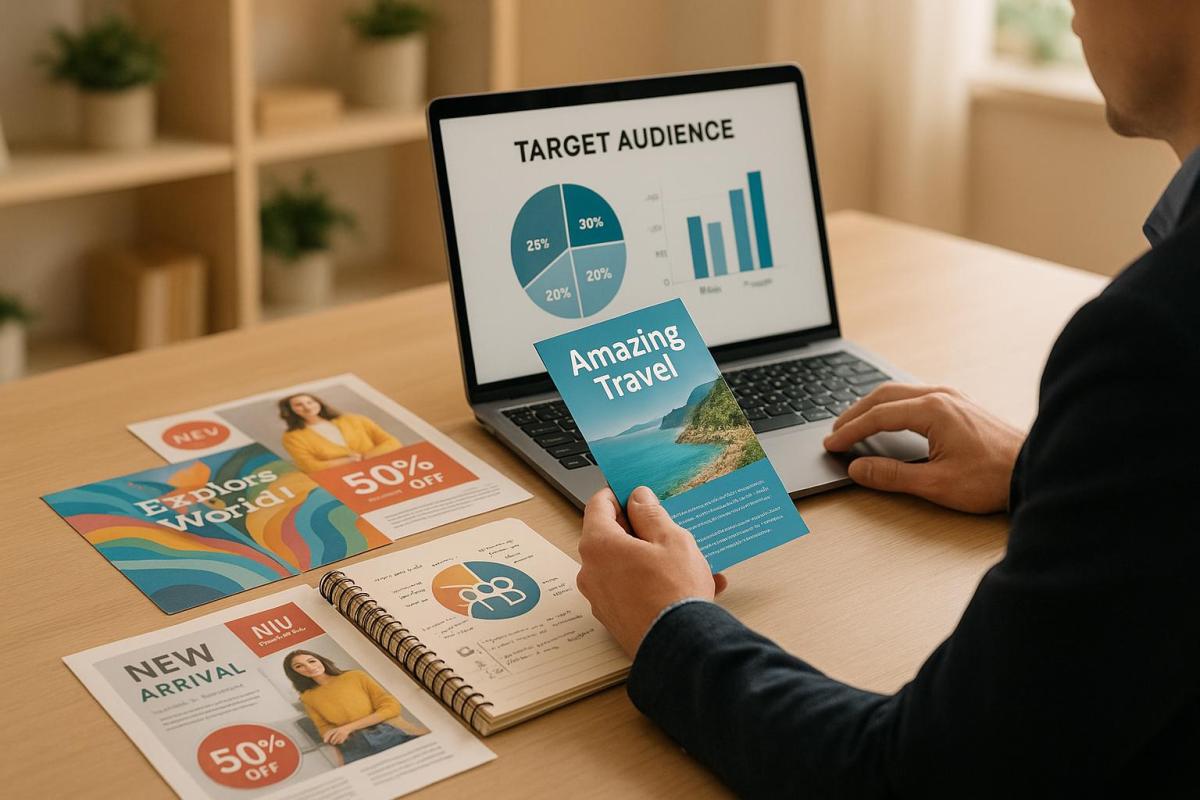
Defining your target audience is the key to a successful print campaign. Without it, your efforts risk missing the mark and wasting your budget. Here’s a quick breakdown of the 5 steps you need to follow:
- Understand Your Product: Identify its features, benefits, and the problems it solves.
- Analyze Current Customers: Use data like demographics, buying habits, and surveys to learn who already engages with your brand.
- Research Competitors and Market: Study competitors’ campaigns and look for gaps in the market.
- Segment and Create Personas: Group your audience into segments and build detailed profiles to guide your campaign.
- Test and Refine: Rank your target segments and test your campaign ideas with focus groups or surveys.
How Effective Is Print Advertising As A Channel? – BusinessGuide360.com
Step 1: Know Your Product or Service
Before diving into creating print materials, it’s crucial to have a deep understanding of your product or service – what it offers, how it helps, and the problems it addresses. By clearly identifying your product’s features, benefits, and the challenges it solves, you can craft messages that resonate with the right audience.
List Features and Benefits
Start by breaking down your product into two key components: features and benefits. Features are the tangible elements – things like specifications, materials, design, or capabilities. Benefits, on the other hand, focus on the outcomes your customers experience, both practical and emotional, when using your product.
Take FIGS, for example, a brand known for its medical scrubs. They highlight features like durability, comfort, and reliability in their fabric and construction. But they don’t stop there – they connect these features to benefits by showing emergency medical providers in action, such as at a motorsport racing track. The durable fabric (feature) ensures freedom of movement in high-pressure, life-or-death situations (benefit).
When listing your product’s features and benefits, aim to be specific. For instance:
- Instead of saying “high quality,” explain what makes it high quality (e.g., “crafted from 100% organic cotton for lasting softness”).
- Instead of saying “saves time,” quantify it (e.g., “reduces prep time by 30 minutes for busy professionals”).
Another example is Cozy Earth, a brand that markets fabric quality, fit, and versatility. Their ads emphasize benefits like “maximum style, minimal effort,” appealing directly to busy women who want to look polished without spending hours on their appearance.
Features might include aspects like:
- Comfort
- Style
- Durability
- Size options
- Color choices
- Technical specifications
Benefits, in contrast, focus on results, such as:
- Saving time
- Improving efficiency
- Enhancing appearance
- Solving a specific problem
- Providing enjoyment or convenience
Find the Problems Your Product Solves
Once you’ve nailed down the features and benefits, the next step is to identify the specific problems your product addresses. This is where you connect with your audience by solving their pain points.
Daniel Russell puts it perfectly:
"The best Marketing Strategies start with the customer first… if you can answer these questions you are halfway to a decent strategy: Who is your customer? What is their pain point? What problem am I solving for them?"
Think about the frustrations or unmet needs your customers face before discovering your product. These pain points should guide your messaging. For example, Wellnessliving, a software company for gyms and studios, targets yoga studio owners with Instagram Story ads. Their headline, “Grow your yoga studio revenue by 57%,” directly addresses a common problem – struggling to increase revenue – and offers their software as the solution.
When creating your print materials, focus on how your product solves specific problems while emphasizing the benefits it delivers. This customer-first approach ensures your message addresses what your audience cares about most, making your print campaigns more impactful.
Step 2: Review Your Current Customer Data
Once you’ve nailed down your product’s features and the problems it solves, it’s time to put your existing customer data to work. By analyzing who already engages with your brand, you can uncover the best prospects for your print campaign.
Check Demographics and Buying Patterns
Start by diving into the basics: age, gender, location, income, and occupation. These demographic details are key to understanding who values your product or service. Pair this with behavioral data, like purchase history, order frequency, and average order value, to build a clearer picture of your audience.
Next, look at purchasing trends. Are there seasonal spikes in sales? What’s the average order value? When do customers typically make purchases? Geographic data is especially helpful for print campaigns, as it allows you to target specific neighborhoods or zip codes where your ideal customers live or work.
These insights provide a strong starting point, which can be further enriched with tools like CRM systems and surveys.
Use CRM Systems and Surveys for More Data
Once you’ve identified demographic and behavioral trends, take it a step further with CRM systems and surveys. Customer Relationship Management (CRM) tools pull together data from across your customer interactions, offering a more complete view of their habits and preferences. This includes tracking website visits, email engagement, customer service interactions, and responses to past campaigns. Such information helps you pinpoint your most engaged customers and tailor messages to different segments.
For instance, Spotify used Mailchimp‘s CRM tools to reduce email bounce rates, ultimately boosting revenue by $2.3 million [Source: Mailchimp Case Studies, 2023].
Surveys and reviews add another layer by capturing customer opinions directly. CRM tools can even personalize surveys by pre-filling customer details based on past interactions. Research shows that 67% of customers are willing to share their data for perks like discounts, and 86% are open to paying more for a better experience. These insights are a goldmine for fine-tuning your print campaign strategy.
Step 3: Research Your Market and Competitors
Now that you’ve gathered customer data, it’s time to dig into your market and competitors. Understanding the competitive landscape and market trends helps you spot opportunities others might miss and ensures you’re not just following the crowd.
Study Local and National Competitors
Start by identifying both direct and indirect competitors. These include businesses offering similar products or services and those vying for the same customers’ dollars. For print campaigns, this means looking at companies using similar print advertising strategies, both locally and nationally.
Dive into their advertising strategies – study their messaging, channels, and tactics. Pay close attention to their print campaigns, examining ad designs, placements, and frequency. Use online tools to track their social media presence and website traffic, and complement this with offline methods like attending industry events, conducting surveys, or simply reviewing their print ads. Competitive tracking isn’t a one-and-done task; it’s an ongoing process that helps you stay agile and responsive to market shifts. By keeping tabs on competitors, you’ll uncover valuable insights to refine your own strategy.
A Chief Marketing Officer from a beverage brand shared this insight:
"By analyzing our competitors’ social media strategies, we pinpointed areas where we could innovate. This allowed us to take the lead in our category."
Look at their strengths, weaknesses, and areas where they’re falling short. For example, examine their SEO efforts – what keywords are they targeting? How does their content perform in search rankings? Are their audiences engaging with their content? This type of analysis reveals where you can stand out.
Find Market Gaps and Opportunities
The next step is to identify underserved segments and untapped opportunities where a print campaign could shine.
Tools like Google Trends, Social Mention, SEMrush, and Ahrefs can help you uncover emerging market trends and unmet needs. These tools offer insights into your audience, potential customers, and areas where competitors might be falling short.
Print advertising has unique advantages that can help you carve out a niche. Did you know that 56% of consumers trust print more than any other type of advertising? Plus, print marketing is 70–80% more memorable than digital ads. If competitors are pouring their budgets into digital channels, a well-executed print campaign could set you apart.
As one Marketing Director from an e-commerce company explained:
"Competitor analysis helped us uncover an underutilized channel that was perfect for our audience. We turned this into a key differentiator in our advertising strategy."
Look for areas where competitors aren’t active – this could be geographic regions, demographic groups, or even messaging approaches they’ve overlooked. For instance, in 2023, Airbnb adjusted its messaging after analyzing competitor campaigns, which significantly boosted its brand awareness.
By identifying these gaps, you can craft a print campaign that reaches untapped audiences with a message that truly resonates. This analysis will directly inform how you segment and target your audience in the next step, ensuring your campaign connects with the right people.
Pair your market research with high-quality print materials for maximum impact. If you’re looking for expert help in transforming your insights into standout print campaigns, check out the services offered by Miro Printing & Graphics Inc..
sbb-itb-ce53437
Step 4: Create Audience Segments and Profiles
Now that your market research is done, it’s time to turn all that data into actionable audience segments and customer personas. Think of this step as shaping raw information into clear, detailed profiles that will guide every part of your print campaign – from the design to the messaging.
Combine Demographics, Location, and Behavior Data
Don’t rely on just one type of data. Instead, blend demographics, geographic information, psychographics, and behavior data for a more complete picture of your audience.
Start by ensuring your segments meet these five key criteria: measurable, accessible, substantial, differentiable, and actionable. In other words, your segments should be large enough to justify the investment, reachable through cost-effective channels, and distinct enough to respond differently to your messaging.
| Segmentation Type | Definition | Examples | Difficulty |
|---|---|---|---|
| Demographic (B2C) | Based on individual attributes | Geography, Gender, Education Level, Income Level | Simpler |
| Firmographic (B2B) | Based on company attributes | Industry, Location, Number of Employees, Revenue | Simpler |
| Psychographic | Based on lifestyle and values | Personality Traits, Values, Opinions, Lifestyle | More advanced |
| Behavioral | Based on purchase behaviors | Purchase History, Usage Patterns, Brand Loyalty | More advanced |
Here’s a real-world example: MX Player combines geographic data with language preferences and viewing habits to personalize content. Urban viewers see original-language Hollywood action films, while regional audiences enjoy dubbed romantic dramas in their native language. This strategy led to a 39% increase in viewership and a 70% boost in click-through rates.
Geographic segmentation can go beyond zip codes. Consider factors like climate, local culture, and regional habits. For instance, Whole Foods adjusts its product selection based on these insights. Stores in environmentally-conscious Boulder stock different items than those in suburban family-oriented areas, even when income levels in both locations are similar.
By integrating behavioral data – such as purchase frequency, campaign response rates, and engagement across touchpoints – you can pinpoint your most active prospects. Companies using automation tools to leverage segmentation insights report an 80% increase in leads.
The impact of segmentation is hard to ignore: 81% of executives consider it essential for profit growth, and businesses with effective segmentation strategies see 10% higher profits over five years compared to those that don’t invest in it.
Create Customer Personas
Once you’ve identified your segments, the next step is to build detailed customer personas. These fictional profiles represent the real people within your audience segments, helping you better understand their needs, preferences, and decision-making processes.
To create these personas, gather demographic data (like age, gender, income, education, and occupation) and behavioral insights (such as purchase habits, website activity, and responses to previous campaigns). Look for patterns and correlations between these data points.
Nike provides a great example here. The brand uses psychographic insights into urban running culture combined with demographic data like local income levels and age groups to influence inventory decisions, store layouts, and community events in its neighborhood-specific stores.
Make your personas detailed and relatable. Give them names, outline their challenges, and include specifics like their media habits, shopping preferences, and motivations for buying. For instance, what channels do they prefer? What’s their decision-making timeline? What pain points does your product or service address? Since 81% of customers expect a personalized experience, the more precise your personas, the stronger your print campaign will be.
Aim to create 3–5 primary personas that represent your most valuable segments. These personas will directly shape your messaging strategy, design choices, and media placements. When you can clearly picture who you’re speaking to, it becomes much easier to create print materials that resonate.
This detailed work on segmentation and persona-building lays the foundation for testing and refining your campaign strategy.
Step 5: Choose and Test Your Target Segments
With detailed personas ready, it’s time to prioritize your target segments and test your campaign strategy. This step can make the difference between a well-executed print campaign and a costly mistake.
Rank Your Target Segments
Not every segment is created equal, and budgets are always limited. Start by defining your campaign goals – are you looking to increase brand awareness, generate leads, or drive direct sales?. Then, evaluate each segment based on factors like size, potential value, and how well they align with your goals. Consider metrics such as growth rate, market share, competition, and profitability. Sometimes, a smaller but highly engaged segment can outperform a larger, less responsive one.
Create a ranking system tailored to your goals. For example, if you’re introducing a new product or service, focus on segments that value innovation and have the budget to invest. For brand awareness campaigns, larger groups with widespread reach might take priority.
"Advertisers who prioritize ad placements over audience targeting are likely to see weaker campaign results compared to those who know that targeting the right people is crucial." – SnapMe Creative Agency
To refine your rankings, calculate the cost per impression for each segment. Include print production, distribution costs, and expected response rates. Sometimes, a mid-tier segment with lower costs and steady engagement can generate a better return on investment than a pricier option.
Once you’ve ranked your segments, the next step is to test and confirm their responsiveness.
Test Your Campaign Ideas with Focus Groups
After ranking your segments, validate your decisions through targeted testing. Concept testing can help identify what resonates with your audience while minimizing wasted resources.
"Testing creative concepts helps identify the best way to meet campaign objectives. Understanding what works – or does not work – saves time and money." – The Compass for SBC
Focus groups are a powerful way to test print campaign ideas. Bring together 6–12 participants from your target segments to review and discuss your creative mockups. These sessions encourage open conversations, giving you insights into both the strengths and weaknesses of your campaign.
If budget is a concern, smaller focus groups can still provide valuable feedback. Building on the personas you developed in Step 4, these discussions ensure your campaign remains sharply targeted.
During these sessions, focus on key factors like attention, comprehension, motivation, personal relevance, and cultural fit. Use pre-designed questions to systematically gauge responses, and look for any confusing elements or styles that don’t connect with the audience.
For sensitive topics or audiences spread across a large area, consider in-depth interviews or self-administered surveys. These methods can capture individual reactions without the influence of group dynamics.
"Concept testing is used to understand if ideas have enough potential for further investment and growth." – Halsted Strategy Group
Analyze the feedback by categorizing responses into themes that can guide your creative adjustments. Document these insights carefully – they’ll not only improve this campaign but also inform future print marketing strategies.
Once you’ve gathered feedback, refine your concepts and apply the lessons learned to other elements of your campaign. Sometimes, testing reveals that a secondary segment is more enthusiastic than your primary target. Stay flexible and let the data lead your adjustments.
This thorough approach to segment selection and testing ensures your print campaign connects with the right audience before moving into full production. At Miro Printing & Graphics Inc., we use these strategies to create tailored, impactful print solutions.
Conclusion: Summary and Next Steps
Main Points from the 5-Step Process
Understanding your target audience is the cornerstone of successful print marketing. The five-step process outlined earlier helps you pinpoint, analyze, and connect with the right people.
It all begins with knowing your product or service – understanding the problems it solves and identifying who benefits most. Reviewing your current customer data uncovers patterns in demographics and behaviors that guide your targeting efforts. Researching your market and competitors highlights gaps and opportunities to explore. Creating audience segments and personas turns raw data into actionable insights, shaping your creative strategies. Lastly, choosing and testing your target segments ensures you’re focusing on the right groups before committing significant resources.
"When focusing on your target audience, be specific. And make sure your marketing materials are fulfilling the goals of your customers." – Metzgers
The power of print marketing is backed by impressive stats. Print and direct mail marketing achieve a 9% customer response rate, far outpacing digital channels, which average around 1%. Additionally, 80% of consumers act on direct print mail ads, compared to 45% for digital ads.
"Audience definition is an ongoing process, and regularly reassessing and refining your targeting efforts will lead to continuous improvements in your print media campaigns." – Commerce Press Inc.
Armed with this knowledge, you’re ready to bring your campaign to life.
How to Launch Your Campaign
To get started, craft a clear message and a strong call-to-action that speaks directly to your defined audience segments. Use the insights from your audience profiles to shape your messaging, design, and distribution strategies. Focus on customer-centric language, emphasizing how your product or service solves their problems.
Select materials that align with your brand image – considering paper quality, finishes, and budget. Keep your visual identity consistent across all materials, using your brand colors, fonts, and style to reinforce recognition. Research shows that over 90% of consumers find print ads easier to read than digital, and physical print ads require 21% less cognitive effort to process and remember.
Your distribution strategy should match the insights you’ve gathered about your audience. Think about timing, channels, and geographic targeting based on the personas you’ve created. For example, letter-sized direct mail achieves a 15.1% response rate, making it an effective format for lead generation.
Track your campaign’s performance and refine it as needed. Use tools like promo codes, QR codes, unique URLs, and dedicated phone numbers to measure success. Gather feedback from your audience to identify what resonated and what needs improvement, then apply these lessons to future efforts.
Combining print and digital strategies can increase campaign effectiveness by up to 400%. Integrate QR codes or personalized URLs into your print materials to connect them with digital platforms, enabling you to track engagement and gain deeper insights into your audience’s behavior.
At Miro Printing & Graphics Inc., we know that a successful print campaign begins with understanding your audience. Our end-to-end printing and design services ensure your message is delivered with precision and impact. From concept to distribution, we’re here to help you connect with your audience in the most effective way possible.
FAQs
How can I figure out the problems my product solves to better connect with my target audience?
To figure out the problems your product addresses, start by diving into customer interviews and conducting market research. These methods can help you uncover recurring pain points your audience experiences. Keep an ear out for phrases like "I wish" or "if only" during conversations – these often reveal unmet needs or frustrations.
You can also gather direct insights using surveys and feedback forms. Another smart move? Take a close look at your competitors. By analyzing their offerings, you might spot gaps in the market where your product can step in and make a difference. The key is to truly understand what’s bothering your customers and how your product can solve those issues in a meaningful way.
What are the best ways to collect customer data for effective audience segmentation?
To collect detailed customer data for audience segmentation, leverage tools like analytics platforms (such as Google Analytics), customer surveys, and feedback forms. You can also use website tracking tools and customer relationship management (CRM) software to gain deeper insights into customer behavior and preferences.
By combining these approaches, you can ensure you gather precise and useful data to clearly define your target audience for print marketing campaigns.
How can I make my print campaign stand out in a world dominated by digital advertising?
To make your print campaign stand out in today’s digital-focused world, aim to create a memorable, hands-on experience. Choose high-quality materials that showcase your brand’s style and professionalism. Pair these with striking visuals and a clear, persuasive message that communicates what sets your business apart.
You can also bridge the gap between print and digital by including interactive features like QR codes or augmented reality (AR). These elements not only boost engagement but also allow you to track responses effectively. By blending creative design with smart messaging, your print campaign can feel both fresh and relevant.
Related posts
- How Typography Impacts Print Design Success
- 8 Metrics to Track Direct Mail Success
- Top 7 Layout Tips for Business Printing
- How to Align Print and Digital Marketing
https://app.seobotai.com/banner/banner.js?id=68881441ce3048a7f63a5ff2
 BergenCountyPrintersBlogs