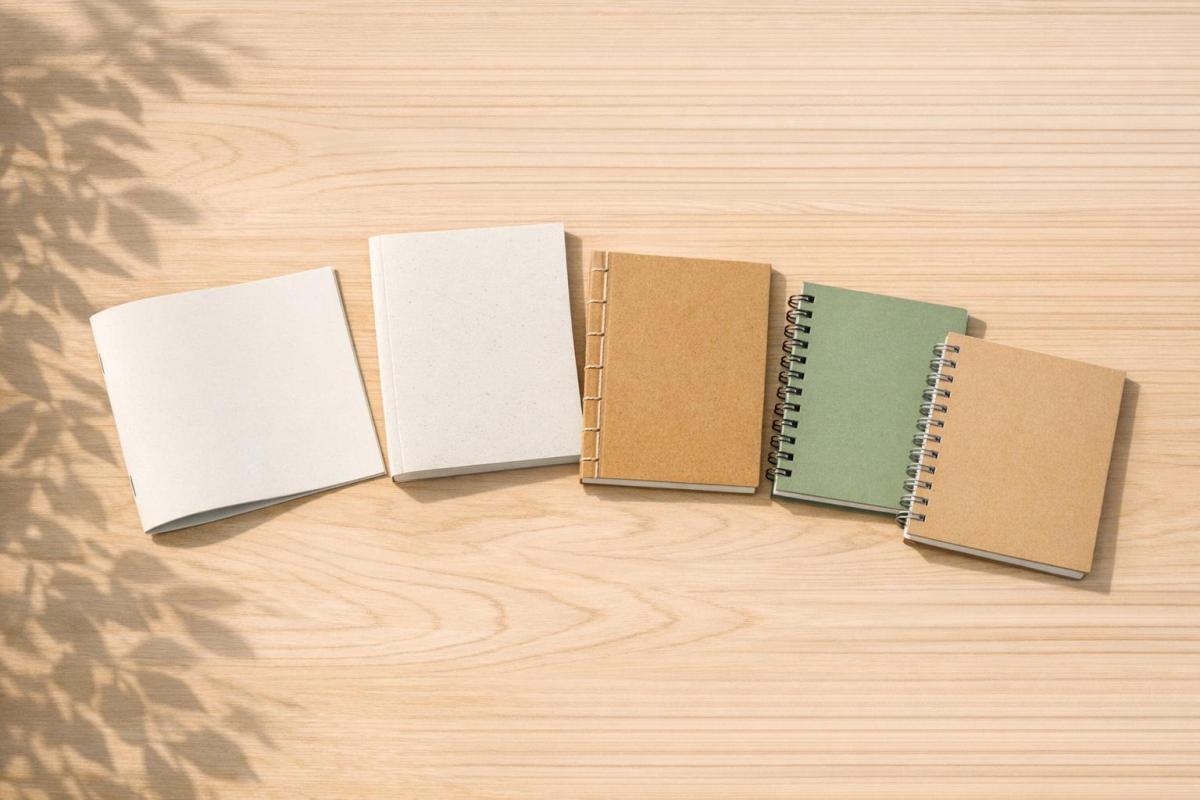
Eco-friendly binding methods prioritize materials and processes that reduce waste, improve recyclability, and lower resource usage. Common techniques include using recycled or biodegradable materials, energy-efficient adhesives, and plastic-free options like metal wires or cotton threads. Here’s what you need to know:
- Recyclable Materials: Options like FSC-certified paper, recycled plastic spirals, and magnetic steel wire simplify the recycling process.
- Low-Impact Adhesives: PUR binding uses 70% less glue than traditional EVA adhesives and operates at lower temperatures, saving energy.
- Plastic-Free Options: Singer-sewn and thread-sewn bindings eliminate adhesives entirely, relying on biodegradable threads.
- Mechanical Bindings: Spiral and Wire-O bindings avoid adhesives, using recyclable metal coils for durability and ease of recycling.
Each method suits different projects. Saddle stitching works for lightweight booklets, while PUR binding handles thicker publications. For premium finishes, thread-sewn binding offers durability and biodegradability. Mechanical options like spiral and Wire-O are ideal for larger documents needing flexibility and strength. Choosing the right method depends on page count, durability needs, and recycling goals.
Environmentally Friendly Book
sbb-itb-ce53437
Eco-Friendly Binding for Small to Medium Prints
When it comes to smaller print projects like booklets, brochures, catalogs, or training manuals, choosing an eco-friendly binding method can make a big difference. These options aim to combine durability, cost-effectiveness, and environmental responsibility. The trick is to select the binding type that best suits your page count and how the final product will be used.
Saddle Stitch and Loop Stitch
Saddle stitching is a simple yet effective method that uses steel wire staples to hold folded pages together along the spine. Since it doesn’t rely on adhesives, it minimizes material use and simplifies recycling. The metal staples are magnetic, so they can be easily removed during the recycling process.
"Saddle-stitching is… the most sustainable binding option. It uses no glue – and the metal fastenings which attach the pages together can be easily removed by a magnet during recycling." – Park Communications Ltd
Loop stitching works similarly but forms wire loops along the spine, allowing the booklet to fit into a 3-ring binder without the need for punched holes. Both methods are budget-friendly and offer quick production times, making them excellent for short deadlines. If you need something more durable, you might want to consider PUR binding.
PUR Binding for Durability
For thicker materials like catalogs or booklets with a square spine, PUR (Polyurethane Reactive) binding is a solid choice. Unlike standard EVA glues, PUR uses less adhesive and operates at lower temperatures, reducing waste and energy use during production. It’s also about 50% stronger than traditional perfect binding adhesives, making it ideal for publications that will see frequent handling.
Another advantage of PUR is its thermosetting property. Unlike thermoplastic glues, it doesn’t remelt during recycling. Instead, it can be filtered out as a solid and used for carbon-neutral power generation. Its flexibility also allows books to open flat without damaging the spine. For a fully biodegradable alternative, you might want to look into singer-sewn or thread-sewn binding.
Singer Sewn and Thread-Sewn Binding
Thread-sewn binding methods take sustainability a step further by using textile threads, often made from biodegradable cotton, to stitch pages together. Singer-sewn binding eliminates adhesives entirely, relying on extra stitching for added strength. This approach creates a 100% biodegradable product, making it ideal for premium brochures, art catalogs, and other high-end materials.
Thread-sewn binding also provides excellent lay-flat functionality, allowing the pages to open fully without stressing the spine. While these options tend to be more expensive and may require specialized equipment, they deliver unmatched quality and environmental benefits for small to medium print runs.
Eco-Friendly Binding for Large Prints
When dealing with oversized books, thick reports, or large-format documents, it’s essential to pick binding methods that meet both physical durability and eco-conscious standards. Mechanical bindings like spiral and Wire‑O stand out because they don’t rely on heated adhesives, making them more energy-efficient compared to glue-based options. These methods strike a balance between sturdiness and environmentally friendly practices.
Spiral Binding with Recycled Coils
Spiral binding uses a continuous coil threaded through pre-punched holes, allowing pages to rotate a full 360° and lay completely flat. This makes it perfect for large manuals, cookbooks, or reports that need to stay open while in use. It’s also highly versatile, accommodating documents up to 2 3/4 inches thick, which is more than most binding methods can handle.
Opting for metal coils instead of PVC plastic significantly enhances recyclability. Metal spiral coils can be easily separated using magnets, and recycled steel options further help in reducing environmental impact.
Wire‑O Binding for Professional Results
Wire‑O binding, on the other hand, delivers a sleek, professional appearance. It uses a double-loop metal wire, completely avoiding plastic and adhesives, which simplifies the recycling process.
"Metal-based binding (Wire‑O mechanical binding and wire saddle stitching) use no glues and are entirely plastic free unlike plastic coil mechanical binding." – Kase Printing
While Wire‑O binding can handle stacks up to 1 1/4 inches thick – less than spiral binding – it’s more than adequate for most professional presentations and reports. Its durability ensures documents last longer, reducing the need for reprints and saving resources over time. Just keep in mind that designs should include a binding margin to maintain a clean, professional look.
How to Choose the Right Eco-Friendly Binding
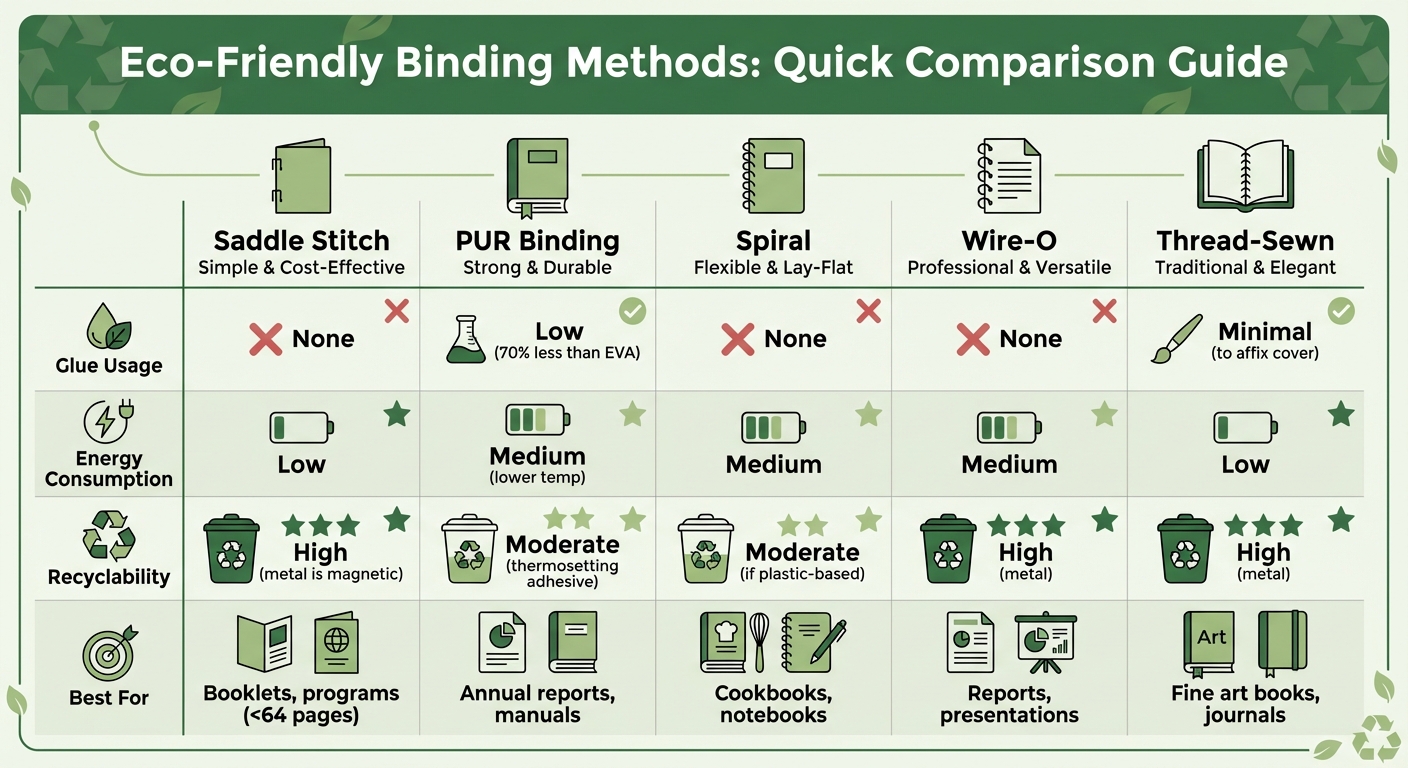
Eco-Friendly Binding Methods Comparison: Features, Recyclability & Best Uses
Factors to Consider
When picking a binding method, think about what works best for your project’s specific needs. For instance, saddle stitching is ideal for documents with fewer than 64 pages, while PUR binding is better suited for thicker publications starting at 40 pages.
If your project involves materials that will be handled frequently, like training manuals, PUR binding offers about 50% more strength compared to traditional methods, all while using less adhesive. It also operates at lower temperatures than EVA glue, which helps cut down on energy use. For those aiming to avoid plastic-based adhesives altogether, Singer-sewn bindings with biodegradable cotton threads provide a durable, eco-conscious option.
Recyclability is another crucial factor. Metal-based bindings, like Wire-O, can be easily separated from paper during recycling. While PUR glue is a type of plastic, its thermosetting properties simplify the recycling process because it doesn’t remelt. For books that need to lay flat, such as cookbooks or art books, bindings like thread-sewn, spiral, or Wire-O are practical and also make recycling easier.
Finally, keep your budget in mind. Saddle stitching is the most cost-effective choice for simple booklets or newsletters. While PUR binding is pricier than standard perfect binding, its durability can save money over time by reducing the need for reprints. On the other hand, Singer-sewn bindings are generally more expensive due to their specialized production but are perfect for artisan projects that emphasize a plastic-free finish.
Comparison of Binding Methods
| Binding Method | Glue Usage | Energy Consumption | Recyclability | Best For |
|---|---|---|---|---|
| Saddle Stitch | None | Low | High (metal is magnetic) | Booklets, programs (<64 pages) |
| PUR Binding | Low (70% less than EVA) | Medium (lower temp) | Moderate (thermosetting adhesive) | Annual reports, manuals |
| Spiral | None | Medium | Moderate (if plastic-based) | Cookbooks, notebooks |
| Wire-O | None | Medium | High (metal) | Reports, presentations |
| Thread-Sewn | Minimal (to affix cover) | Low | High | Fine art books, journals |
Eco-Friendly Binding Services at Miro Printing & Graphics Inc.
Binding Solutions That Reduce Environmental Impact
Miro Printing & Graphics Inc., based in Hackensack, NJ, offers binding and print solutions designed with sustainability in mind. Their digital printing process is a standout feature, providing an environmentally conscious option for short to mid-sized print runs, which helps minimize waste.
For smaller projects like booklets, catalogs, and newsletters, they provide eco-conscious binding options such as coil binding made from recycled materials, perfect binding, comb binding, and booklet-making techniques like saddle stitching. Their advanced in-house bindery ensures tight quality control, allowing them to maintain high production standards throughout the process.
When it comes to larger projects, Miro Printing produces vinyl banners, poster prints, and signs using sustainable materials. Their team works closely with clients, offering guidance on eco-friendly material choices to help reduce environmental impact. This hands-on approach ensures that every project aligns with both professional standards and environmental goals.
Custom Eco Projects for Local Clients
In addition to their standard services, Miro Printing takes on custom projects with a focus on sustainability. Located at 831 Main St in Hackensack, they cater to businesses and individuals across New Jersey, New York, and Connecticut, offering tailored solutions that meet unique eco-friendly needs. One satisfied customer, Julia I., shared her experience:
"Mike and his team completed a complex job in record time at a reasonable price… I even received a video of my print sample (a mini booklet) for approval before they proceeded."
Equipped with a full in-house bindery and compatibility with top design tools like Adobe Creative Suite and Microsoft Office, Miro Printing ensures seamless project customization. Their team is available Monday through Friday, from 9:00 am to 5:00 pm, to discuss specific environmental objectives and provide print samples before moving forward with production. By partnering with clients to achieve eco-friendly goals, Miro Printing underscores its dedication to sustainability in every aspect of its work.
Conclusion
Eco-friendly binding isn’t just about reducing environmental impact – it also ensures a professional finish and responsible production practices. Techniques like saddle-stitching and Wire-O binding prove that sustainability and durability can go hand in hand. As Sarah Lee, Author at Number Analytics, highlights:
"Binding plays a vital role in print production as it determines the final product’s quality and usability".
The binding method you choose does more than meet practical requirements – it also reflects your brand’s values, showcasing a commitment to both quality and sustainability.
For businesses and individuals in New Jersey, New York, and Connecticut, Miro Printing & Graphics Inc. offers expert guidance. Located at 831 Main St in Hackensack, their team provides personalized consultations to help you find the right sustainable binding solution for your project.
Ultimately, binding is more than just a finishing touch; it’s an opportunity to minimize waste while delivering a polished, professional product. By considering factors like page count, usage, and distribution, you can select a binding method that aligns with both your needs and your environmental goals.
FAQs
Which eco-friendly binding is best for my page count?
When choosing an eco-friendly binding method, it’s essential to consider both the page count and how durable you need the project to be. For smaller projects with 8–64 pages, saddle stitch binding is a reliable option. If you’re working on larger or sturdier projects, perfect binding or post binding might be better suited. To minimize environmental impact, you can explore sustainable options like PUR adhesives or glue-free bindings.
Can bound documents be recycled without removing the binding?
When it comes to recycling bound documents, the binding itself plays a big role. If the binding is made from recyclable materials like paper or metal, you can often recycle the entire document without any extra steps.
However, bindings made from plastic, such as PUR or perfect binding, might need special attention. In these cases, you may need to remove the binding or handle it separately to ensure it’s recycled properly.
Always make sure to check your local recycling guidelines for the most accurate instructions. Different areas may have specific requirements for handling these materials.
What’s the most plastic-free binding option for a premium finish?
The binding option that minimizes plastic use while offering a premium finish utilizes biodegradable materials like FSC® Certified dyed-through Kraft paper. This paper comes with a 100% organic, plastic-free coating, combining excellent performance with a refined, sophisticated look.
Related Blog Posts
- Top 6 Binding Methods for Professional Documents
- Ultimate Guide to Custom Binding Options
- How Binding Choices Impact Print Durability
- Perfect Binding Glue Types: What to Know
https://app.seobotai.com/banner/banner.js?id=69c0cc891b352ff267cbac32
 BergenCountyPrintersBlogs