If I need a simple answer, here it is: bulk print jobs often move on time only when I plan for more than press time. For many U.S. orders, production may take 2–15 business days after proof approval, but the full schedule can stretch much longer once I add file fixes, approvals, finishing, shipping, and USPS handling.
Here’s what matters most:
- Turnaround time = production only
- Lead time = quoting, proofs, revisions, printing, finishing, and delivery
- File problems can add 1–2 business days
- Each proof round can add 0.5–2 business days
- Finishing can add 1–5 business days, and at times more for binding or die cutting
- Special stocks can add 2–5+ days
- Direct mail often needs 5–10 business days for print and mail prep, plus 3–5 more days in USPS transit
In other words: a “10-day turnaround” does not mean I’ll have the job in hand in 10 days.
If I’m planning a bulk order, I need to watch six things first:
- file readiness
- approval speed
- print method
- finishing steps
- stock availability
- shipping or mailing time
A simple flat piece may be done in 3–5 business days after approval. A folded brochure may need 3–7 days. A saddle-stitched booklet often takes 5–10 days. Perfect-bound work can land around 10–15 business days or more.
| Job Type | Common Time After Approval | What Usually Adds Days |
|---|---|---|
| Flat prints | 3–5 business days | file issues, coatings, volume |
| Folded pieces | 3–7 business days | scoring, folding, finishing |
| Booklets/catalogs | 5–15 business days | page count, binding, paper |
| Direct mail | 5–10 business days + USPS transit | list work, addressing, postal entry |
My main takeaway: the slowest step is often not the press run. It’s usually approvals, bindery, or delivery. So if I want to hit a firm in-hand date, I should build the schedule backward and leave 5–10 extra business days for surprises.
That’s the point of this guide: to help me set a print schedule that matches the job before the deadline starts to slip.
How to Backward Schedule Your Printed Products | Offset Printing Turnaround Times
sbb-itb-ce53437
What Affects Bulk Printing Turnaround the Most
The main factors are pretty simple: file readiness, approval speed, print method, finishing, materials, and shop capacity. Where do jobs usually get stuck? Most often in pre-production, setup, finishing, and delivery.
That matters because a bulk print schedule can look fine on paper, then slip fast once one early step slows down. If you know what tends to add time, you can set a schedule that matches the job before the deadline starts to drift.
File Readiness, Proofing, and Approval Delays
File problems are one of the biggest causes of delay. Common issues include missing bleeds, low-resolution images, unembedded fonts, RGB files sent into a CMYK workflow, and incorrect variable data setup. When that happens, the job often goes back to prepress, which can add 1 to 2 business days.
Proofing and approval can slow things down just as much. Each proof round can add 0.5 to 2 business days, based on how fast feedback comes in. If several people need to weigh in, that delay can grow fast.
A simple way to keep things moving is to:
- assign one approver
- set a 24- to 48-hour proof review deadline
Miro Printing & Graphics Inc. also offers in-house design and prepress support, which can help catch problems before they push the schedule off track.
Print Method, Quantity, and Finishing Requirements
The print method has a direct effect on timing. Digital printing skips plate-making, so production can often begin soon after files are approved. It’s usually a good fit for runs in the hundreds to a few thousand pieces, with a normal turnaround of 1 to 3 business days after approval.
Offset printing takes more setup. Plates need to be made, the press has to be set up, and registration work adds time up front. For larger runs, offset is often the better choice, but production usually takes 3 to 7 business days, plus 12 to 24 hours of drying time on coated stocks before finishing can start.
Then there’s finishing, which is where a lot of hidden time shows up. Folding and trimming are often simple. But perfect binding, die cutting, UV coating, and lamination add extra steps and labor. Perfect binding needs glue curing. Custom die cuts may need dies made or pulled from inventory. Coatings and lamination often need separate equipment runs.
Across these steps, finishing can add 1 to 5 business days to a bulk order. And if the job uses specialty papers or substrates, sourcing those materials can add 2 to 5 days or more before the job is even scheduled.
Put all that together, and it becomes clear why one job can be easy to turn around while another with the same deadline feels tight from day one.
Comparison Table: Which Factors Add the Most Time
The table below shows which variables usually add the most time.
| Factor | How It Affects Time | Typical Impact on Bulk Orders |
|---|---|---|
| File readiness | Errors send files back to prepress before production | Major if files have issues; minimal if press-ready |
| Approval speed | Each revision cycle adds 0.5–2 business days | Major with multiple stakeholders; moderate with one approver |
| Print method | Offset adds setup and drying time compared with digital | Moderate for standard runs; major for large offset jobs |
| Quantity | Larger runs require more press and finishing time | Moderate for typical volumes; major for very large runs |
| Finishing complexity | Binding, die cutting, and coatings add production steps | Major for multi-step bindery; minimal for simple trim and fold |
| Stock availability | Special-order materials must be sourced before scheduling | Minimal with house stocks; major with specialty substrates |
| Shop capacity | Peak seasons or heavy job loads can push scheduling out | Moderate in normal periods; major during high-demand seasons |
Typical Turnaround Ranges for Common High-Volume Print Jobs
Use these ranges to spot schedule risk early. They reflect typical U.S. commercial print timelines and begin after final proof approval. In plain English, this is the window after the file is signed off, not the full project timeline. Setup, proofing, finishing, and mailing can still add time before a job is fully out the door.
The main pattern is simple: the more moving parts a job has, the more time it needs. Clean files move faster. Folding, bindery, coatings, list work, and mailing can stretch the schedule fast.
Marketing Collateral, Direct Mail, and Business Essentials
Flat items usually move the fastest. Once mailing enters the picture, the timeline takes its first big jump.
Flat single-sheet products often turn in 2–5 business days after proof approval. Business cards usually land in the 3–5 business day range, and specialty finishes can add 1–2 days. If the run goes above 2,500 pieces, timing can stretch to 4–8 business days.
Folded brochures – like trifolds, gatefolds, and similar formats – normally need at least one extra day for scoring and folding. That pushes them into the 3–7 business day range. Non-mailed postcards usually follow the same pattern as other flat products.
Direct mail works differently. The printing itself for postcards may take only 3–5 business days, but once you add addressing, variable data, sorting, and USPS induction, the full timeline from approval through mail prep often lands around 5–10 business days. After the mail is handed off, USPS transit can add another 3–5 business days, depending on destination.
Catalogs, Booklets, Labels, and Long-Run Projects
Once a job adds pages, bindery, or specialty materials, turnaround tends to stretch fast.
Short- to mid-run saddle-stitched booklets in the 8–32 page range usually take 5–10 business days on standard stocks. As page counts climb or stock needs get tighter, that range often shifts toward 10–15 business days for larger catalog work. Perfect-bound books and magazines sit near the top end of most commercial schedules: 10–15 business days for standard domestic runs, and 15–20+ business days when premium finishes or high page counts are involved.
Labels and stickers can look simple, but specs matter a lot. Standard shapes on common paper or vinyl stocks usually turn in 3–7 business days. Clear or metallic substrates, removable adhesives, or custom die cuts can push timing to 7–12+ business days, especially if dies must be ordered or substrate tests are needed before production starts.
Summary Table: Bulk Print Turnaround by Product Type
Use the table below to match product type to a planning window.
All ranges begin after final proof approval and do not include shipping or USPS transit.
| Product Type | Typical Quantity Range | Standard Turnaround | Extended Turnaround (Complex Specs) |
|---|---|---|---|
| Business cards | 500–5,000 | 3–5 business days | 5–10 business days (specialty finishes, higher volume) |
| Flyers / flat sell sheets | 1,000–20,000 | 3–5 business days | 7–10 business days (folding, scoring, specialty finishing) |
| Brochures (folded) | 1,000–20,000 | 3–7 business days | 7–12 business days (complex folds, coatings) |
| Postcards (non-mailed) | 1,000–50,000 | 3–5 business days | 7–10 business days (variable data, specialty stocks) |
| Direct mail campaigns | 5,000–100,000+ pieces | 5–10 business days (print + mail prep) | 10–15+ business days (complex list work, multiple drops) |
| Booklets / catalogs (saddle-stitched) | 1,000–20,000 copies | 5–10 business days | 10–15+ business days (high page counts, custom papers) |
| Magazines / perfect-bound books | 1,000–50,000 copies | 10–15 business days | 15–20+ business days (premium finishes, complex schedules) |
| Labels / stickers (standard) | 1,000–50,000 units | 3–7 business days | 7–12+ business days (specialty substrates, custom dies) |
How to Plan a Bulk Print Order and Meet Your Deadline
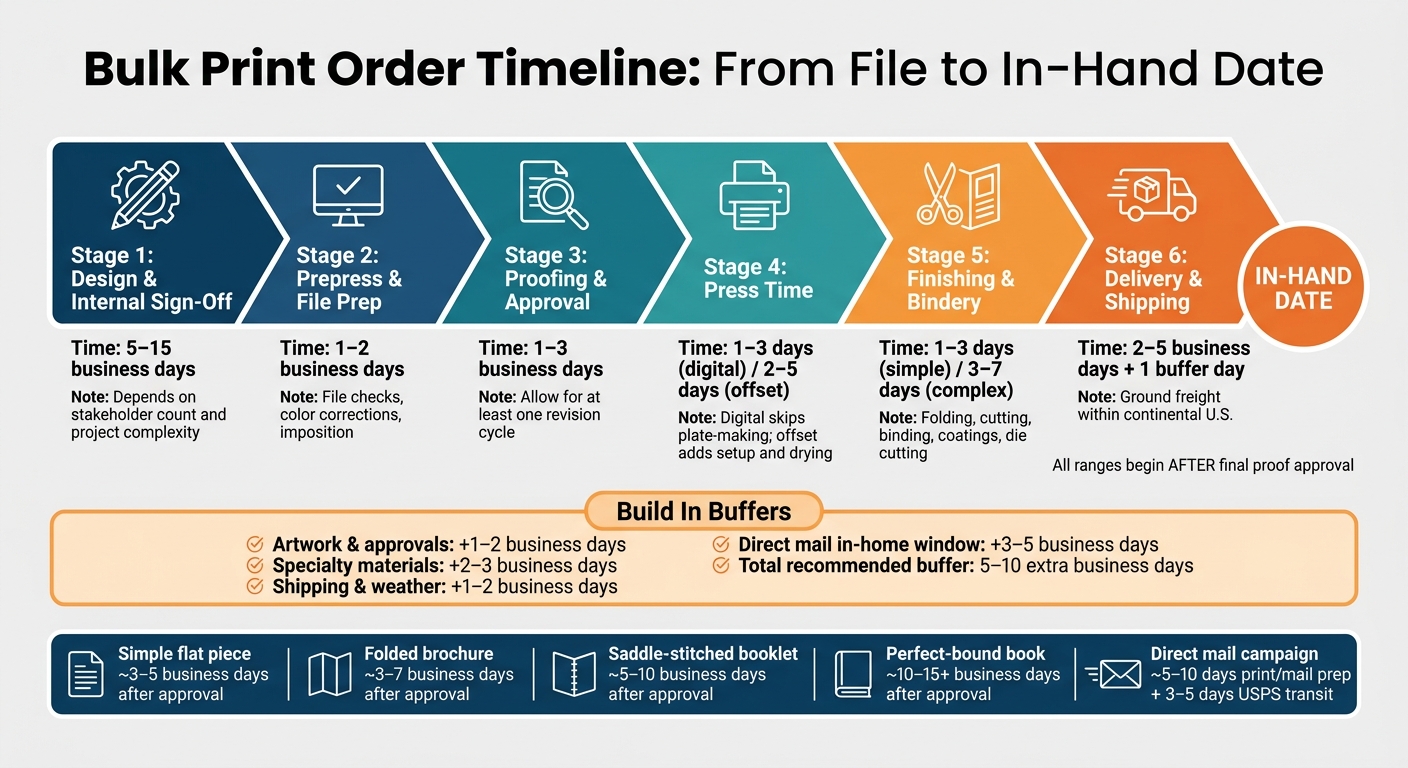
Bulk Print Order Timeline: From File to In-Hand Date
Use the turnaround windows above to build a backward schedule that lands on your in-hand date. Start with those ranges as your baseline, then subtract each production step in reverse.
Work Backward From the In-Hand Date
Start with the exact date and time the materials must be physically available. Not the ship date. Not the date printing wraps up. The in-hand date is when the pieces must be at your trade show booth, in your store, or delivered to the mail house.
Then work backward through each stage:
- Delivery/shipping: 2–5 business days for ground freight within the continental U.S., plus 1 buffer day.
- Finishing/bindery: 1–3 business days for standard work like cutting, folding, or saddle-stitching; 3–7 business days for more involved bindery such as perfect binding or custom die-cutting.
- Press time: 1–3 business days for digital; 2–5 business days for offset bulk runs.
- Proofing and approval: 1–3 business days, assuming at least one revision cycle.
- Prepress and file prep: 1–2 business days for file checks, color corrections, and imposition.
- Design and internal sign-off: 5–15 business days depending on stakeholder count and project complexity.
For example, if you need brochures in hand by October 7, a standard bulk job may mean design needs to wrap by mid-September, proof approval happens by late September, and press plus finishing are done by early October.
Trade show, product launch, and direct mail jobs need more room. Venue deadlines, compliance review, and in-home delivery windows can quietly add extra days.
Once the timeline is mapped out, lock materials and press capacity.
Confirm Materials, Capacity, and Specs Early
Finalize paper, finishes, and size before design is locked. Specialty stocks, coatings, and custom sizes each come with their own lead times, and those lead times keep moving while your design team is still working.
Check these points with your printer before design is locked:
- Paper stock and availability: Non-standard weights, textured stocks, or recycled substrates may need to be ordered from a mill or distributor, which can add several business days.
- Coatings and finishes: UV coating, soft-touch lamination, foil stamping, and embossing need specialized equipment and extra drying or curing time.
- Quantity and press capacity: Lock quantities early so the job can get into the production queue.
- Bindery and mailing: If the job needs saddle-stitching, perfect binding, or USPS entry, confirm whether those services are handled in-house. A full-service shop like Miro Printing & Graphics Inc. can coordinate printing, bindery, and mailing on one schedule, which helps cut handoff delays.
Specialty choices can add 3–10 business days to a bulk project. Make those calls early, or you may end up squeezing the production window at exactly the wrong time.
With the specs set, add some breathing room before production starts.
Build Buffers Into the Schedule
Print schedules almost never go exactly as planned. A copy change, a second proof cycle, a paper swap, a carrier delay – any one of those can eat up a day or two. Stack a few together, and you can lose a week fast.
Here are practical buffer guidelines for U.S. business-day planning:
- Artwork and approvals: Add 1–2 extra business days for unplanned copy edits or brand review comments; add more if several departments need to sign off.
- Supply chain: Add 2–3 business days if specialty paper or imported materials are involved, to cover late deliveries or substitutions.
- Shipping and weather: Add at least 1–2 buffer days, especially during winter storm season or when shipping cross-country by ground freight.
- Direct mail windows: Add 3–5 business days beyond the USPS delivery range to protect the in-home date.
Taken together, these buffers can add 5–10 business days to a high-stakes timeline. Add that cushion early. Rush fees can wipe out any savings.
Coordinating Printing, Finishing, Delivery, and Mailing
With buffers in place, the next thing that can still push your finish date is everything that happens after printing. This is why finishing and mailing need to be locked into the schedule now. The press run usually isn’t the part that drags. More often, the delay shows up once the sheets come off press.
How Bindery and Finishing Add Time
Every finishing step adds its own setup time, queue time, and quality check. And the more steps you add, the more handoffs you create. That’s where schedules start to slip.
Simple work like cutting and scoring usually adds 1–3 business days. More involved jobs – perfect binding, die cutting, coil binding, or multi-step booklet binding – can add 5–10 business days, especially when the finishing queue is packed. A perfect-bound catalog takes longer than folded brochures because it also needs curing and inspection time.
Once finishing is set, mailing becomes the next part that can hold up the schedule.
Mailing and Fulfillment Steps That Extend the Timeline
Mailing isn’t something you tack on at the end. It’s part of the production plan from the start. Address processing, variable data, inserting, tabbing, presorting, and USPS entry all take time, and each one affects the calendar.
After printing and finishing, mail prep usually adds 1–3 business days. Coordinated print-plus-mail campaigns often take 7–14 business days from approved artwork and a clean list. USPS Marketing Mail runs on a 4–7 day end-to-end service standard in the contiguous U.S., while First-Class Mail usually lands in 1–5 days.
Key Takeaways and Coordination Table
In bulk printing, the total turnaround usually follows the slowest step, and that’s often finishing or mailing, not printing itself. The table below shows where extra time comes from once you move beyond a simple press run.
| Order Type | Included Steps | Added Time to Plan For | Best Use Case |
|---|---|---|---|
| Print only | Press run, trimming, shipping | 2–5 business days after proof approval | Flyers, posters, simple handouts |
| Print + finish | Press run, folding/binding/die cutting, trimming, shipping | 1–3 days (simple finishing); 5–10 days (complex bindery) | Brochures, booklets, catalogs, coil-bound reports |
| Print, finish, mail | Press run, finishing, address processing, presort, USPS induction, delivery | 7–14 business days from approved artwork and clean list; full campaigns 3–6 weeks or more | Direct mail campaigns, personalized mailers, EDDM drops |
FAQs
What’s the difference between turnaround time and lead time?
Turnaround time is the period between placing your print order with Miro Printing & Graphics Inc. and the point when your finished piece is ready for pickup or delivery.
Lead time is a broader window. It covers the whole process, including planning, proofing, production, shipping, and any extra cushion needed to help hit your deadline.
How far in advance should I place a bulk print order?
Place your bulk print order well ahead of your deadline. That gives enough time for production and post-press work without turning the whole job into a last-minute scramble.
Digital printing often takes 1 to 4 business days. Larger offset jobs usually need 5 to 15 business days, including setup and binding.
If your project includes custom finishing, like embossing or die-cutting, expect 1 to 5 extra business days. It’s smart to talk through your specs and due date early with Miro Printing & Graphics Inc. so you can help avoid rush fees.
What delays bulk printing jobs the most?
Bulk printing delays usually come down to three things: long offset press setup, time-heavy finishing work, and special materials.
Finishing steps like embossing, die-cutting, or complex assembly can add 1 to 5 days to a job. That extra time stacks up fast, especially when several finishing steps are involved.
Delays also show up during peak demand, when files arrive late or aren’t print-ready, and when design changes happen in the middle of a run and new offset plates have to be made. Miro Printing & Graphics Inc. helps cut down on these slowdowns with end-to-end local production.
Related Blog Posts
- Printing Turnaround Times Explained
- Print Project Timeline: Steps to Stay on Track
- Deadline Management for Custom Print Projects
- Ultimate Guide to Magazine Printing Services
https://app.seobotai.com/banner/banner.js?id=6a7d0b87dc1e9c396e6c3b35

