
Lamination in print shops is shaped by two main forces: industry standards that ensure product quality and durability, and U.S. environmental laws that regulate emissions, chemical usage, and waste. Striking a balance between these frameworks is critical for businesses to deliver reliable products while staying compliant with regulations.
Key Points:
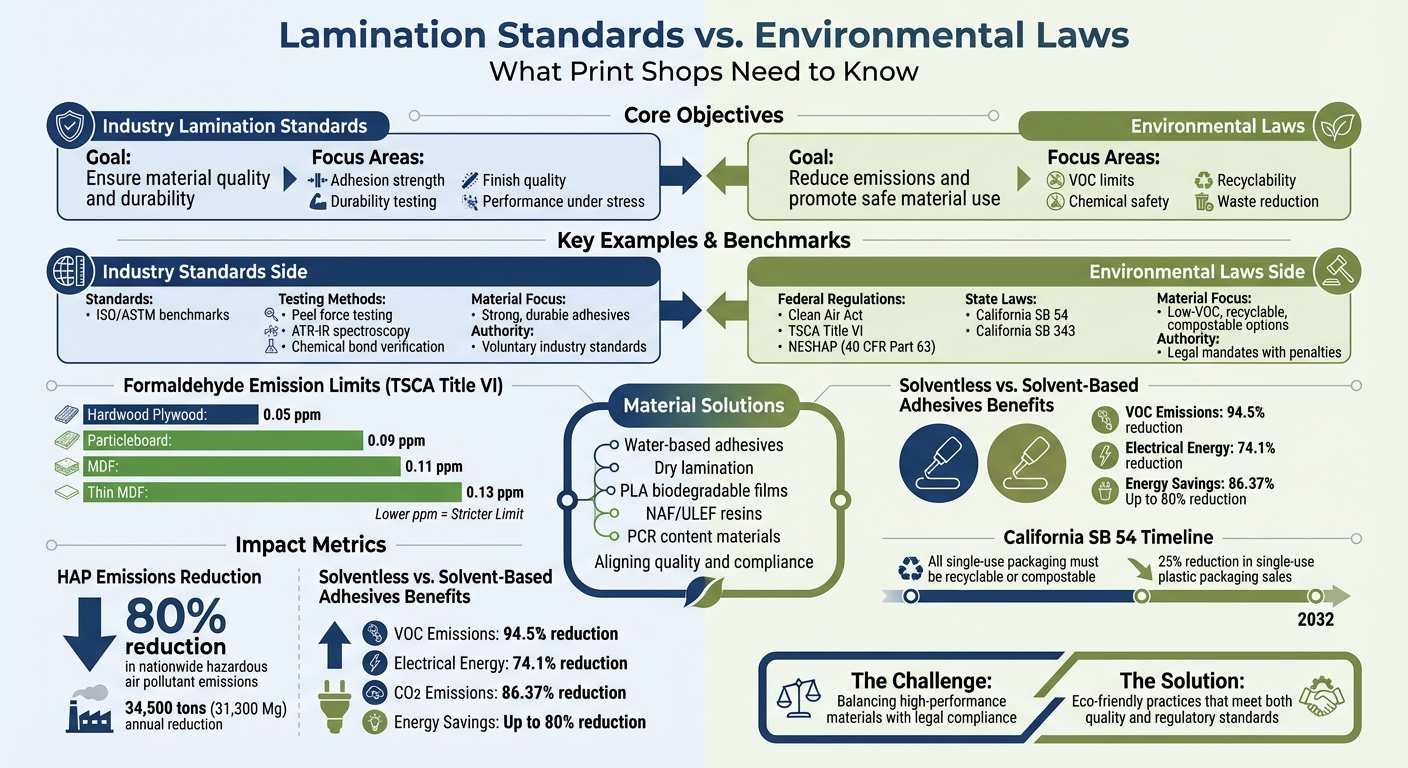
- Lamination Standards: Focus on material durability, adhesion strength, and performance. Standards like peel force testing and chemical bond verification ensure consistent results.
- Environmental Laws: Federal rules, such as the Clean Air Act and TSCA, aim to reduce emissions (e.g., VOCs, formaldehyde) and manage hazardous waste. State laws like California’s SB 54 and SB 343 push for recyclability and reduced plastic use.
- Challenges for Print Shops: Balancing high-performance materials with legal requirements. Solvent-based adhesives offer strong bonds but emit VOCs, while water-based options are safer but may impact curing times.
- Solutions: Eco-friendly practices, such as water-based adhesives, dry lamination, and biodegradable films like PLA, can help meet both quality and legal standards.
Quick Comparison:
| Aspect | Lamination Standards | Environmental Laws |
|---|---|---|
| Goal | Ensure material quality and durability | Reduce emissions and promote safe material use |
| Focus | Adhesion strength, durability, finish quality | VOC limits, chemical safety, recyclability |
| Examples | ISO/ASTM benchmarks, peel force testing | Clean Air Act, TSCA Title VI, SB 54, SB 343 |
| Impact on Materials | Requires strong, durable adhesives | Pushes for low-VOC, recyclable, or compostable options |
Understanding these frameworks helps print shops navigate complex decisions, ensuring compliance without compromising product reliability.
Lamination Standards vs Environmental Laws: Key Differences for Print Shops
Lam’On: On a Mission to Make the Printing Industry More Eco-Friendly
sbb-itb-ce53437
Industry Lamination Standards for Print Finishing
Industry lamination standards lay out the technical guidelines that ensure laminated products perform consistently across different uses. Below, we’ll dive into the material and performance criteria that are essential for print finishing.
Material Requirements
Standards dictate the use of 1-component, 2-component, or thermal adhesives, depending on the type of substrate and ink. For example, adhesives must work seamlessly with "duct-fresh" offset inks to avoid delayed delamination issues.
One key measure of bond strength is peel force, which evaluates how well the film adheres to the substrate. Research from Fogra highlights that peel force tends to increase over five months after production. Interestingly, while thermal lamination often achieves higher peel forces compared to 1-component and 2-component dispersion laminations, this doesn’t always mean better performance under stress. Thermal laminations, despite their stronger initial peel forces, are more prone to delamination in certain conditions.
Ink coverage also plays a major role. High ink coverage can lower peel force in dispersion lamination but may enhance it in thermal lamination. For 2-component adhesives, standards emphasize proper dosing of curing agents. Techniques like ATR-IR spectroscopy are used to verify the chemical bonds formed, ensuring durability over time. These material specifications will later be compared with environmental criteria to explore areas of overlap and potential conflict.
Performance and Safety Requirements
Performance standards focus on how laminated materials handle real-world stresses. Laminates must endure mechanical creasing, folding, sealing, and exposure to thermal stress. As Fogra notes:
The trend towards duct-fresh offset printing inks, single-component laminating adhesives and short production times repeatedly gives rise to quality problems in film lamination – especially when the film lamination is subjected to mechanical or thermal process stresses.
Mechanical deformation is a key factor in performance:
The occurrence of delamination was dependent on the geometry of the mechanical deformation.
To address these challenges, advanced testing methods go beyond basic tape tests. Laboratory-scale devices, like flexographic and gravure proofing machines, replicate production-level lamination and stress scenarios to better evaluate performance.
On the safety side, TSCA Title VI enforces strict limits on formaldehyde emissions for composite wood cores and adhesives used in laminated products. The permissible levels are as follows:
- 0.05 ppm for hardwood plywood
- 0.09 ppm for particleboard
- 0.11 ppm for medium-density fiberboard (MDF)
- 0.13 ppm for thin MDF
Furthermore, process parameters like temperature and pressure must be fine-tuned for each adhesive and substrate pairing. This ensures proper bonding without damaging materials, while also meeting emission and safety standards. These technical requirements provide a solid foundation for comparing current practices with evolving environmental regulations.
Environmental Laws Affecting Lamination
In the U.S., environmental laws play a crucial role in shaping how lamination materials and processes are chosen and used. While technical standards focus on performance, these regulations aim to reduce health risks and environmental harm. They directly impact the adhesives, films, and substrates print shops can use, often requiring significant changes to production methods.
VOC Regulations
The Environmental Protection Agency (EPA) enforces strict limits on volatile organic compounds (VOCs) in printing and lamination adhesives. To comply, manufacturers often need to switch to water-based or low-VOC adhesives, which help reduce air pollution. For print shops, this means carefully reviewing adhesive suppliers and potentially transitioning to formulations that meet both federal and state VOC limits. However, these changes can affect drying times and bonding performance, requiring adjustments to maintain product quality. Beyond VOCs, the Toxic Substances Control Act (TSCA) introduces additional guidelines on chemical emissions.
TSCA Requirements
The Toxic Substances Control Act (TSCA) Title VI focuses on reducing formaldehyde emissions in composite wood products used in lamination. Materials like hardwood plywood, MDF, or particleboard cores must meet stringent emission standards. This has led to the increased use of No-Added Formaldehyde-Based (NAF) and Ultra Low-Emitting Formaldehyde (ULEF) resins. Recent proposals, such as incorporating ISO 12460-2:2024 as a testing standard, further align U.S. practices with international protocols. Print shops working with laminated materials must ensure their core components comply with these regulations. Meanwhile, emerging laws targeting plastic waste and recycling are pushing the industry to rethink how laminated products are disposed of at the end of their lifecycle.
Plastic Waste and Recycling Laws
Unlike material performance standards, these laws prioritize the recyclability and environmental impact of laminated products. For example, California’s SB 54 mandates that by 2032, all single-use packaging must be either recyclable or compostable, with a 25% reduction in single-use plastic packaging sales. This marks a significant departure from traditional lamination practices, which often overlook recyclability. Additionally, states like California, Washington, and New Jersey now require specific percentages of Post-Consumer Recycled (PCR) content in plastic products.
California’s SB 343 further tightens regulations by restricting the use of recycling symbols. Under this law, the familiar "chasing arrows" symbol can only appear on materials that meet strict state-defined recyclability standards. While a legal challenge was filed in March 2026 against SB 343, citing First Amendment concerns, these laws are already steering the industry toward recyclable films and away from multi-layer plastics that are difficult to process. This shift underscores the growing emphasis on sustainability in material selection for lamination.
Lamination Standards vs. Environmental Laws: Side-by-Side Comparison
Comparison Table
When it comes to lamination, industry standards and environmental laws have distinct priorities. Standards center on performance – ensuring materials are durable, bond effectively, and meet customer needs. On the other hand, environmental laws focus on public health, aiming to reduce toxic emissions and promote safe recycling practices. Here’s a breakdown of these differences:
| Feature | U.S. Environmental Laws (NESHAP/CAA) | Industry Lamination Standards |
|---|---|---|
| Primary Objective | Minimize hazardous emissions and protect public health. | Guarantee material durability, bond strength, and safety. |
| Material Requirements | Restrictions on HAPs like Toluene and Formaldehyde. | Specifications for film thickness, clarity, and adhesion. |
| Compliance Metric | 80% reduction in nationwide HAP emissions. | Meeting performance benchmarks (e.g., ISO/ASTM). |
| Legal Authority | Clean Air Act; 40 CFR Part 63 Subpart JJJJ. | Voluntary industry standards or customer requirements. |
The EPA’s NESHAP regulations specifically target harmful chemicals such as toluene, methanol, xylenes, phenol, formaldehyde, and ethyl benzene. These rules apply to facilities producing industrial laminates, flexible packaging, and pressure-sensitive tapes. According to the EPA, "The final standards will eliminate approximately 80 percent of nationwide HAP emissions from facilities that coat paper and other web substrates". This translates to an annual reduction of about 34,500 tons (31,300 Mg) of hazardous air pollutants.
This comparison highlights the trade-offs manufacturers face when choosing adhesives and materials.
How They Affect Material Choices
The differences between these standards and regulations push print shops to rethink adhesive formulations to balance high performance with strict environmental rules. Solvent-based lamination, while meeting performance criteria, comes with high VOC emissions and energy-intensive drying processes. On the flip side, solventless and water-based adhesives offer significant environmental benefits – they reduce VOC emissions by over 94.5%, cut electrical energy use by 74.1%, and lower CO2 emissions by 86.37% compared to traditional methods.
That said, the switch isn’t always simple. Water-based adhesives, for example, may require longer curing times or fail to achieve the immediate peel strength of solvent-based options. Print shops must juggle these challenges, ensuring they meet both regulatory requirements and quality standards. The key lies in finding a balance that maintains product integrity while staying compliant with environmental laws.
Where Standards and Laws Align or Conflict
Building on earlier comparisons, this section dives into how standards and laws either work together or clash when applied in practice. For print shops, understanding these dynamics is key to balancing product quality with compliance responsibilities.
Where They Align
Lamination standards and environmental laws are increasingly aligning around the principles of a circular economy. Both industry groups and regulators emphasize recyclability and the use of post-consumer recycled (PCR) content in packaging. For example, EU regulations require all plastic packaging to be designed for recycling and to meet specific recycled content quotas by 2030.
Another area of alignment is the shared goal of eliminating harmful substances. Environmental laws and safety standards often work hand-in-hand to restrict or ban additives like per- and polyfluoroalkyl substances (PFAS), polystyrene, polyvinyl chloride (PVC), and primary aromatic amines (PAA). Organizations such as RecyClass and CosPaTox are stepping in to provide guidelines that help print shops meet recyclability requirements without compromising product safety or performance. As Dr. Axel Weiss, Director Marketing Adhesives at BASF, explains:
With our solutions, you can avoid harmful substances like PAA that are created during the recycling process. Our adhesives enable debonding PET/PE, fully compostable packaging and much more.
While these areas of convergence are promising, print shops still face significant challenges where standards and laws diverge.
Where They Conflict
Conflicts between standards and laws often force print shops into tough decisions about materials and processes. Traditional laminates like PE or PET are valued for their moisture barriers, grease resistance, and glossy finishes, all of which meet industry expectations. However, these same materials make paperboard non-recyclable in standard recycling streams. This creates a dilemma: prioritize performance or recyclability?
Labeling regulations add another layer of complexity. Industry standards commonly use "chasing arrows" to signal recyclability, but laws like California’s SB 343 restrict these symbols unless the material is actively recycled by programs serving at least 60% of the population. A laminate might meet technical recyclability standards but still fail to qualify for such labeling under state law.
Reusability mandates further complicate the picture. The EU’s Packaging and Packaging Waste Regulation (PPWR) requires 40% of transport packaging to be reusable within a reuse system by 2030. However, repeated cleaning and sanitation cycles can weaken laminated materials, potentially causing them to fall short of durability standards. Adding to the uncertainty, the European Commission plans to release a report on Substances of Concern (SoC) by 2026, which is expected to introduce new restrictions that could further limit material options.
What This Means for Print Shops
Print shops face the challenge of balancing operational efficiency with meeting environmental regulations. These demands influence everything from the materials they use to how workflows are structured. As Gary Jones, a respected voice in the industry, explains:
The challenge is understanding the specific requirements as they apply to your operation and taking specific steps to ensure compliance.
To tackle these hurdles, print shops can implement eco-conscious practices and maintain strict compliance protocols.
Adopting Eco-Friendly Practices
One way to reduce environmental impact is by switching to water-based or solvent-free adhesives, which lower VOC emissions without sacrificing bond strength. These adhesives match the performance of traditional solvent-based options while creating a safer work environment and simplifying compliance. For shops using specialty finishes like embossing or foil stamping, adhesives must also endure high pressures and temperatures (usually between 140°F and 176°F) to avoid issues like delamination.
Another innovative option is pre-coated (dry) lamination, where adhesives are applied and dried during film production rather than on-site. This method minimizes solvent emissions and streamlines operations. For those aiming to eliminate plastic lamination altogether, Polylactic Acid (PLA) films offer a biodegradable solution. Made from renewable resources like corn starch, PLA films provide excellent transparency and meet food safety standards, rivaling traditional PET films. Matt Hazel, Senior Director of Supply Chain Management at The Bernard Group, highlights the growing interest in sustainable options:
We’ve seen customer demand grow as we educate people on the fact that there are green alternatives to just about every non-sustainable material.
While adopting greener practices can improve sustainability, staying compliant with regulations is equally critical.
Staying Compliant
Print shops must carefully monitor their waste output and emissions. Using Safety Data Sheets (SDSs) helps track these metrics, ensuring proper classification of hazardous waste and compliance with EPA standards. Shops are categorized as Very Small, Small, or Large Quantity Generators based on their monthly hazardous waste output, such as cleaning solvents. This classification determines the specific rules they must follow. For example, the reporting threshold for Persistent Bioaccumulative and Toxic chemicals, like lead, can be as low as 100 pounds.
While federal EPA guidelines set a baseline, state and local regulations often impose stricter limits. With growing concerns around air quality, emission thresholds have tightened, requiring even smaller shops to secure air permits.
Benefits of In-House Services
Managing lamination and other processes in-house provides print shops with greater control over compliance and quality. For instance, Miro Printing & Graphics Inc. in Hackensack, NJ, demonstrates how in-house operations allow for direct oversight of material certifications and emissions tracking. In-house bindery services also enable precise management of steps like powder removal, preventing issues such as air bubbles or weak adhesion.
Additionally, in-house workflows support "instant lamination" processes, where adhesive application, drying, and pressing happen in one seamless step. This not only boosts efficiency but also ensures compliance with standards like TSCA Title VI for composite wood cores. By keeping these processes under their own roof, print shops can adapt more quickly to regulatory changes and meet growing customer demands for sustainable materials.
Conclusion: Meeting Standards While Protecting the Environment
Print shops can maintain high-quality output while being mindful of environmental responsibilities by aligning industry practices with environmental regulations. As John Hammel, Senior Director of Hardwood and Laminate at Mannington, explains:
Laminates are inherently eco-friendly, largely composed of natural, renewable, and sustainably harvested materials.
The key lies in choosing materials that meet both performance benchmarks and legal requirements. For instance, TSCA Title VI–certified products – such as hardwood plywood (0.05 ppm), particleboard (0.09 ppm), and MDF (0.11 ppm) – often come with third-party certifications like Greenguard Gold or FloorScore, ensuring compliance and quality .
Key Takeaways
Adopting eco-conscious practices, such as solvent-less lamination, can significantly cut energy use – by as much as 80% – while enabling advanced machinery to produce 20–25% of their own energy. Doug Jackson, CEO of Cali, highlights the health advantages of these innovations:
Today’s laminates are safer from a health standpoint thanks to eco-friendly adhesives yielding a low-VOC product.
FAQs
Which lamination choice is easiest to keep compliant in the U.S.?
To ensure compliance in the U.S., select laminates that align with recognized industry standards and meet environmental regulations. Focus on laminates certified by NALFA (North American Laminate Flooring Association) for performance and durability. Additionally, choose products that comply with CARB (California Air Resources Board) or EPA TSCA Title VI requirements, which regulate formaldehyde emissions. These certifications help you meet safety and environmental standards across all states.
How do I verify an adhesive or laminate meets VOC and TSCA limits?
To ensure compliance, use approved test methods – such as ASTM standards – to measure the VOC content of your product. Compare the results against the limits set by local regulations, like those outlined by SCAQMD (South Coast Air Quality Management District).
For TSCA compliance, carefully review the product’s chemical composition alongside the documentation provided by the manufacturer. This will help verify that it meets the requirements of the Toxic Substances Control Act.
By following these steps, you can confirm that your adhesive or laminate aligns with both VOC and TSCA standards.
Can laminated paper products be recyclable or compostable?
Laminated paper products can occasionally be recycled or composted, but it largely depends on the type of lamination used. For example, single-sided coatings might still allow for recycling, whereas double-sided laminations typically make recycling impossible. When it comes to composting, most laminated products containing plastic are not suitable. Plastics don’t decompose in composting environments and can contaminate the compost. While certain laminated papers might work for recycling, those with plastic laminations are usually unsuitable for either recycling or composting.
Related Blog Posts
- UV Printing vs. Lamination: Which Protects Better?
- Guide to Eco-Friendly Printing Substrates
- Substrate Selection for Print Quality
- Industry Standards for Heat Testing
https://app.seobotai.com/banner/banner.js?id=69dd6fe409e6c77f4f7ae12b

