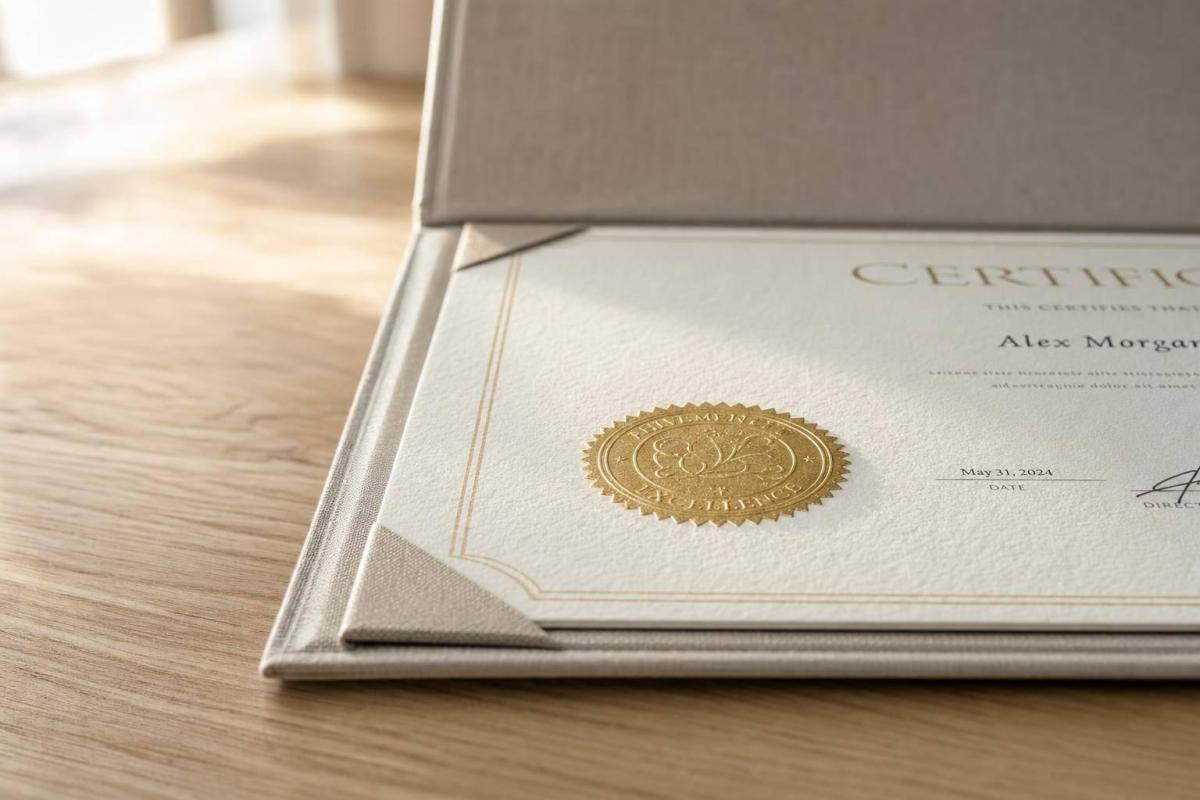
If you want a certificate to last, paper weight and paper chemistry matter more than most people think. Standard office paper is usually 20–24 lb bond (about 75–90 gsm), while certificate stock often starts at 32 lb bond (about 120 gsm) and can go up to 65–110 lb cover (about 175–300 gsm). That jump helps cut down on creases, torn corners, curling, and yellowing.
Here’s the short version:
- I’d use 28–32 lb text (105–120 gsm) for most everyday certificates
- I’d use 65–100 lb cover (175–270 gsm) for framed awards, diplomas, and mailed certificates
- I’d look for acid-free, buffered, or ANSI/ISO archival-grade paper for long-term storage
- I’d pick cotton paper when the certificate is meant to last for decades
- I’d also check finish, grain direction, scoring, and storage humidity (about 40%–50%)
Thin office paper may look fine at first. But over time, it can wrinkle, split at folds, ripple in frames, and turn yellow as acids break down the fibers. Heavier stock does a better job because it is stiffer, thicker, and harder to damage in handling and mailing.
In other words: heavier certificate paper lasts longer because it handles both physical wear and long-term aging better.
| Paper type | Typical weight | Main use | How it holds up |
|---|---|---|---|
| Standard office paper | 20–24 lb bond | Drafts, internal prints | More likely to crease, curl, and yellow |
| Heavier text stock | 28–32 lb text | General certificates | Better stiffness and cleaner display |
| Cover stock | 65–110 lb cover | Diplomas, awards, mailing | Better against bends, tears, and corner damage |
| Acid-free / buffered / cotton | Varies | Long-term certificates | Slows yellowing and brittleness |
If I were choosing certificate paper, I wouldn’t look at weight alone. I’d match the stock to how the certificate will be handled, framed, mailed, and stored.
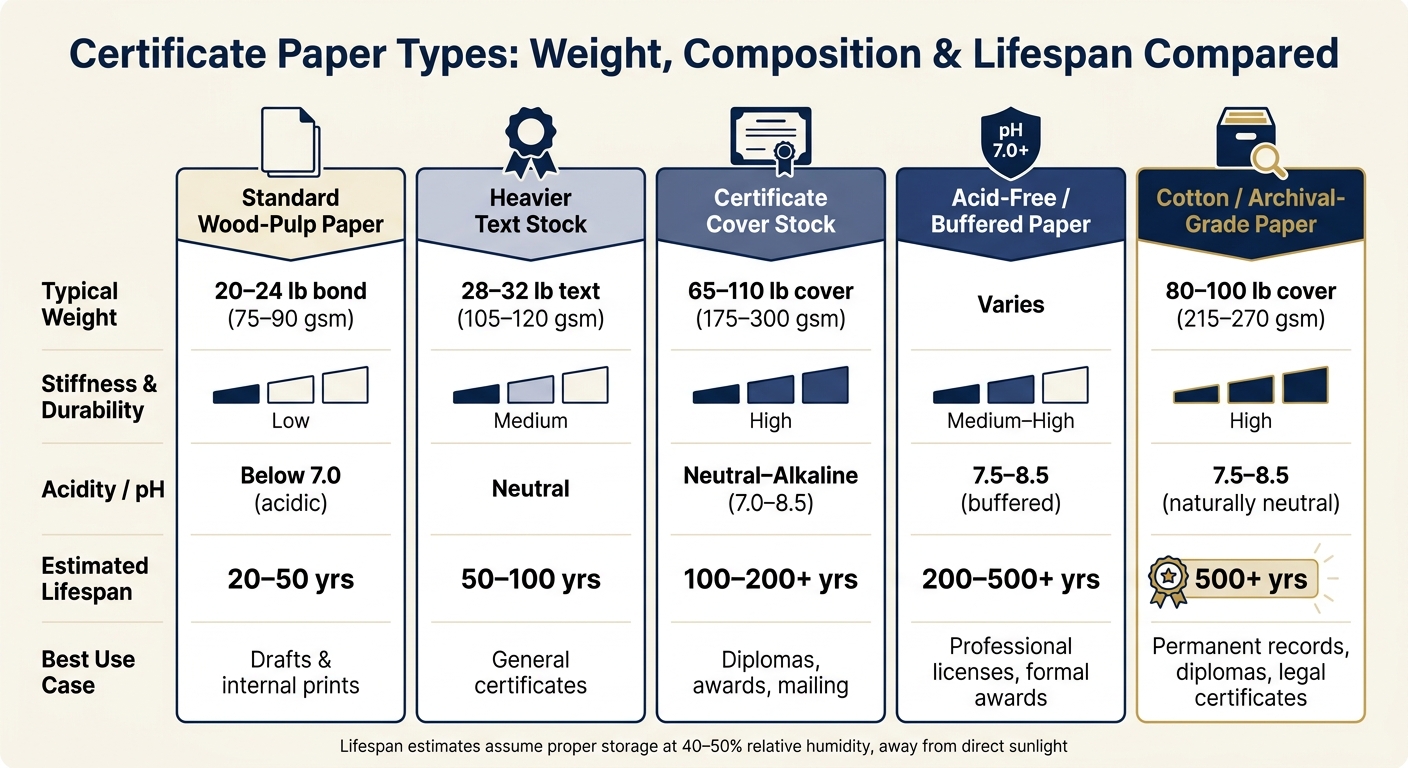
Certificate Paper Types: Weight, Composition & Lifespan Compared
✅ CHOOSING THE RIGHT PAPER TYPE FOR PRINT
sbb-itb-ce53437
How heavyweight paper holds up better under physical stress
When standard paper gets passed around, stacked, mailed, or stored, it tends to show wear fast. Heavyweight paper lasts longer because it stands up better to that kind of stress. A thicker sheet is harder to bend, less likely to crease, and tougher to tear.
Weight, thickness, and tear resistance explained
Basis weight, GSM, and caliper each describe a different part of the sheet – weight, density, and thickness. For durability, caliper matters most because even a small bump in caliper can lead to a much bigger jump in stiffness. Standard copy paper is usually about 4 pt thick, while certificate cover stocks often fall between 8–14 pt, depending on the grade.
That difference shows up in everyday use. A stiffer sheet stays flat in a frame, makes it through the mail with less damage, and handles repeated use much better. That’s a big deal for certificates, which often get passed from hand to hand before they end up on display.
Heavier stocks also do a better job protecting corners. If a sheet catches on a binder clip or frame edge, you’re more likely to see a small scuff or dent instead of a full tear.
For certificate printing, the best weight depends on how the document will be used:
- Use 28–32 lb text (≈105–120 gsm) for most certificates.
- Use 65–110 lb cover (≈175–300 gsm) for framed diplomas, formal awards, and mailed certificates that need to arrive without bends or creases.
Comparison table: standard office paper vs. certificate stock
| Paper Type | Typical Weight | Stiffness | Crease Resistance | Tear Resistance | Best Use |
|---|---|---|---|---|---|
| Standard office paper | 20 lb bond (≈75–80 gsm) | Low | Low | Low–Medium | Internal prints, drafts, temporary use |
| Heavier text stock | 28–32 lb text (≈105–120 gsm) | Medium | Medium–High | Medium–High | General certificates, in-house printing, mailing |
| Certificate cover stock | 65–110 lb cover (≈175–300 gsm) | High | High | High | Formal awards, diplomas, long-term framed display |
Cover stock handles storage better, too. It resists crushed corners, stays flatter behind glass, and holds up in rigid mailers in a way lighter sheets just don’t.
Thickness matters, but it isn’t the whole story. The makeup of the paper also plays a big part in how well a certificate holds up over years of light exposure and storage.
Why paper composition matters for long-term durability
Thickness helps a certificate feel solid in your hands. But if you’re thinking years down the road, chemistry does a lot of the heavy lifting. In plain English: durability comes from both the sheet’s thickness and what it’s made of.
The big issue is acidity. Standard wood-pulp paper can contain lignin and acids left over from manufacturing. As time passes, those acids attack the cellulose fibers in the sheet. That’s what leads to yellowing, brittleness, and that dry, fragile feel old paper gets. Acid-free papers use a neutral to slightly alkaline pH, which slows that process down. Acidic paper may last about 20–50 years, while properly buffered, acid-free sheets can stay usable for 500+ years when stored in good conditions.
Acid-free, cotton, and archival-grade certificate papers
Acid-free paper is a solid starting point. But for certificates meant to last, the better options are also lignin-free and often include a calcium carbonate buffer. That buffer helps neutralize acids the paper may absorb from the air or from storage materials over time.
Cotton papers take things a step further. Cotton fibers are longer and stronger, so the sheet stands up better to tearing, repeat handling, and fold cracks. Cotton papers are also naturally lignin-free. A 25–100% cotton rag certificate stock in the 80–100 lb cover range can last more than 100 years for diplomas and lifetime awards.
True archival-grade papers meet known standards such as ANSI/NISO Z39.48 or ISO 9706. That’s an important line in the sand. Not every acid-free sheet meets those standards, so it’s worth checking for certification when you’re printing diplomas, licenses, and other permanent certificates.
Here’s how the main certificate paper types compare.
Comparison table: certificate paper types and lifespan factors
| Paper Type | Composition | pH Level | Estimated Lifespan | Best Use |
|---|---|---|---|---|
| Standard wood-pulp paper | Lignin-present, acidic | Below 7.0 | 20–50 years | Short-term, internal use |
| Acid-free paper | Lignin-free, neutral pH | 7.0–8.5 | 100–200+ years | General certificates, awards |
| Buffered acid-free paper | Lignin-free, calcium carbonate buffer | 7.5–8.5 | 200–500+ years | Professional licenses, formal awards |
| Cotton/rag paper | 25–100% cotton, naturally lignin-free | 7.5–8.5 | 100–500+ years | Diplomas, lifetime awards, archival certificates |
| Archival-grade (ANSI/ISO certified) | Acid-free, buffered, certified low lignin | 7.5–8.5 | 500+ years | Permanent records, diplomas, legal certificates |
The next step is matching the stock to the certificate’s purpose.
How to choose the right heavyweight paper for your certificates
Now that thickness and paper makeup are on the table, the next step is simple: match the stock to how the certificate will actually be used. A framed certificate has one job. A certificate that gets passed around at events, mailed, or stored for years has a very different one.
Paper weights and finishes for common certificate uses
For basic framed certificates, 28–32 lb text (about 105–120 gsm) is a good place to start. The frame does some of the work, but the paper still needs enough stiffness to stay flat and look clean over time.
For frequently handled awards – employee recognition certificates, training completions, or student honors that get passed around and transported – it makes sense to move up to 65–80 lb cover (about 175–215 gsm). That extra heft helps the sheet resist curling, creasing, and those beat-up corners that can show up after a bit of travel.
For premium presentation pieces – executive awards, professional credentials, and diplomas meant to be kept for decades – go with 80–100 lb cover (about 215–270 gsm). This stock feels substantial in the hand, stands up better on an easel or tabletop stand without a frame, and works well with foil stamping and embossed seals.
Finish matters too. A simple match-up looks like this:
- Use linen or laid for formal awards
- Use parchment for academic-style certificates
- Use smooth matte when signatures, stamps, or fine detail need to come through cleanly
The next thing to check is durability in practice: can the stock print, stamp, and finish without problems?
What to check before you print
Start with the spec sheet. Check both the basis weight in lb and the gsm. Bond and cover weights are not interchangeable, so a number that sounds heavy in one class can be thinner than expected in another. For example, 28 lb bond and 80 lb cover are nowhere close to the same thickness.
If the certificate needs to stay presentable for more than a few years, look for paper marked acid-free, buffered, or archival. It also helps to think about where the certificate will spend most of its life. A sunny hallway, a humid storage room, and a filing cabinet that gets opened all the time can each wear paper down in different ways.
Before you commit to a full run, test the stock first. That matters most if the certificates need signatures, seals, stamps, or foil.
Professional printing and finishing: getting the most from heavyweight certificate paper
Even great paper can wear out fast if printing and finishing are handled badly. The sheet matters, sure, but it’s only half the story. Rough print settings can still scuff, crack, or fade the surface. Commercial presses, matched inks or toners, and thick-stock settings help cut down on smudging, cracking, and color loss.
How finishing and handling affect a certificate’s lifespan
Heavyweight paper is stiffer, which means it can take more abuse in some ways. But it can also pick up edge damage more easily if it’s cut or folded the wrong way. A dull blade or the wrong clamp pressure can cause tiny tears along the edge. Those weak spots don’t stay small for long once the certificate gets handled.
After printing, the way the sheet is cut, scored, folded, and stored has a big effect on how long it holds up. Cover stock and text stock at 100 lb and up should be scored before folding. If you skip that step, the fibers crack instead of bending cleanly, and you end up with a visible split along the fold line.
Grain direction plays a part too. Scoring and folding with the grain helps limit cracking and lets the fold hold up better over time.
Some finishing options add both wear resistance and a more polished look, but the paper needs enough body to take that pressure. For certificates with foil stamping or embossing, heavyweight stock performs better than thin paper. It can take deeper impressions without tearing when die pressure is set the right way. Aqueous and UV coatings can also add abrasion resistance, which helps when certificates will be handled often or displayed without a frame.
Storage conditions matter just as much as finishing. Keep finishing and storage areas around 40% to 50% relative humidity to help limit curl and brittleness, especially with cotton or archival-grade stocks. Store certificates flat and keep them away from direct sunlight and strong airflow.
Handled with care, heavyweight paper keeps certificates looking crisp for longer.
FAQs
What paper weight is best for my certificate?
For a professional certificate, 14pt to 16pt cardstock is the minimum if you want to avoid a flimsy feel. 18pt to 24pt is the sweet spot for most high-quality awards.
If you’re printing a more prestigious certificate, or adding finishes like embossing, debossing, or metallic foil, go with 32pt cardstock or heavier. It gives the piece more durability and a premium feel.
Miro Printing & Graphics Inc. in Hackensack, NJ, can provide physical samples.
Is acid-free paper enough for long-term storage?
Acid-free paper is a good place to start, but it doesn’t always go far enough for long-term storage or high-end preservation. It can help slow yellowing and brittleness as time passes, yet a certificate’s weight and overall paper quality still play a big part.
For projects where longevity matters most, Miro Printing & Graphics Inc. recommends conservation-grade papers or museum board. It also helps to protect certificates from humidity, since moisture can wear down paper over time.
Can my printer handle heavyweight certificate paper?
Check your printer manual to see the maximum paper weight it can handle. A lot of home and office printers only work with certain paper thicknesses. More advanced models may support heavier stock, sometimes up to 275 gsm or 350 gsm.
For the best results, use the manual feed tray, select Cardstock or Heavy Paper in your printer settings, and load fewer sheets at a time to help avoid jams or alignment problems.
Related Blog Posts
- Custom Certificate Holders: Design Options
- 5 Design Tips for Award Certificates
- How to Choose Materials for Award Certificates
- How to Print on Heavy Cardstock Digitally
https://app.seobotai.com/banner/banner.js?id=6a73d331a42311041ce63187

