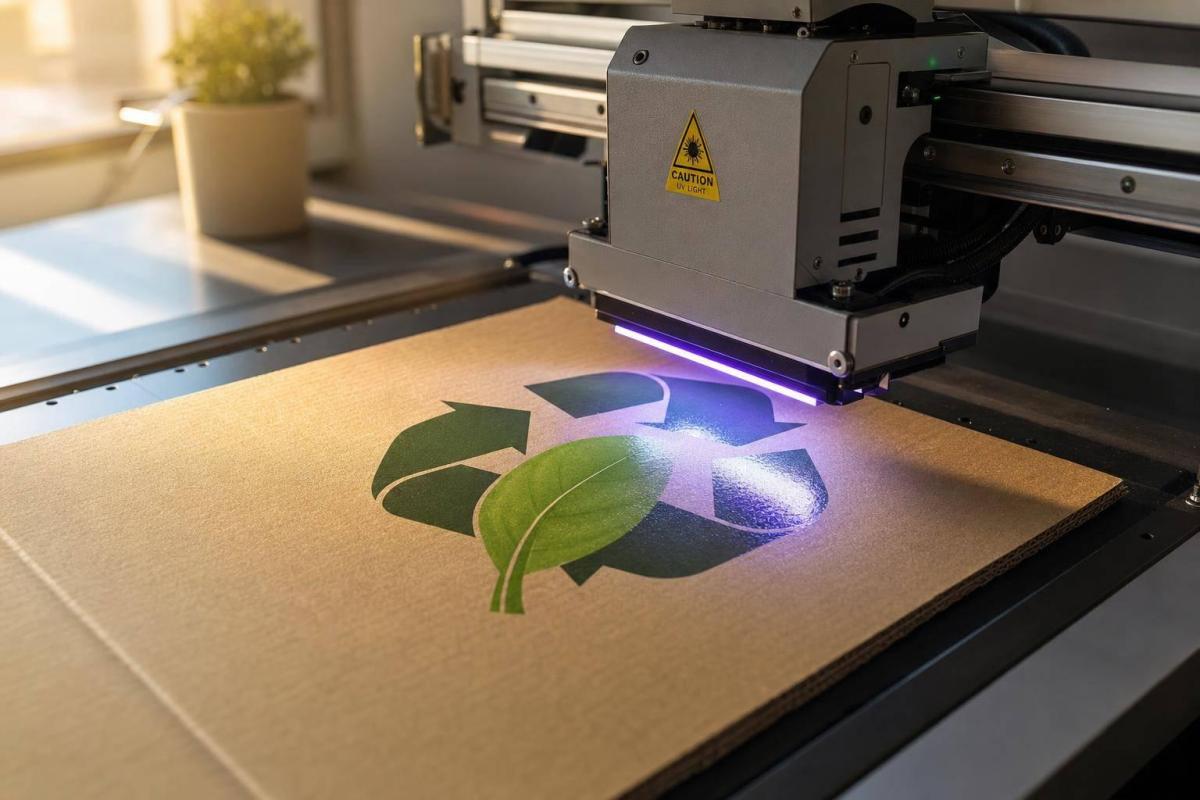
Yes – often. From what I see in the article, UV-curable inks are usually the better pick when you want lower VOC emissions, less print waste, and fast curing that cuts damaged runs.
Here’s the short version:
- Air emissions: UV-curable inks can bring press VOCs down to below 0.1 g/m², versus 8–20 g/m² for solvent-based inks.
- Power use: UV-LED curing can use 30% to 70% less energy than mercury UV, and hot-air/IR drying can use 5 to 9 times more energy than UV curing.
- Waste: Some shops have reported 70% to 75% less make-ready spoilage, and one study found 22% less ink waste in UV/flexo work.
- Limits: Uncured UV ink can irritate skin and eyes, and cured UV ink can make paper recycling harder, especially with heavy coverage or lamination.
So if you’re asking, “Are UV-curable inks better for the planet?” my answer is: often yes at the press, but not in every end-of-life case. The biggest gains show up in emissions and production waste. The main weak spots are worker handling and recycling.
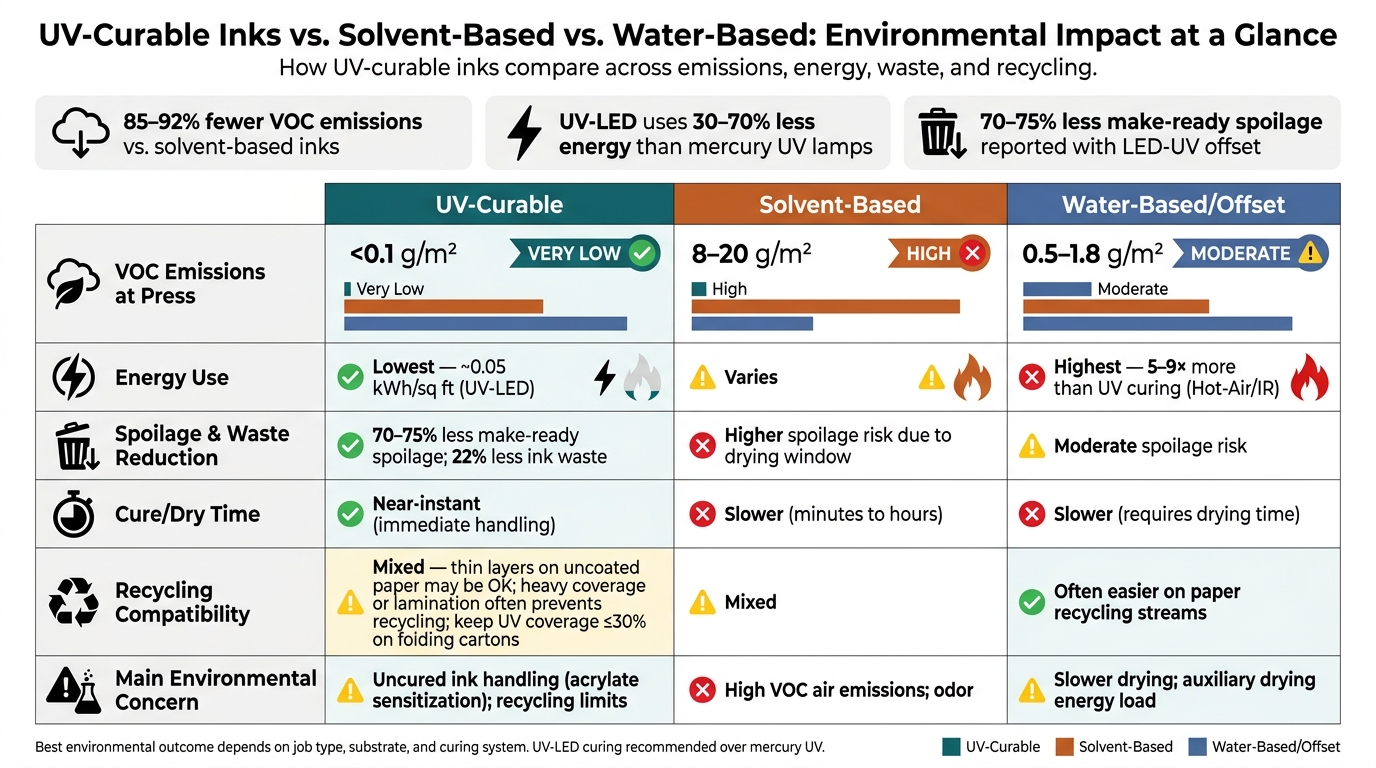
UV-Curable vs. Solvent-Based vs. Water-Based Inks: Environmental Impact Comparison
Quick Comparison
| Factor | UV-Curable | Solvent-Based | Water-Based / Offset |
|---|---|---|---|
| VOCs at press | Very low | High | Low to mid |
| Dry/cure time | Near-instant | Slower | Slower |
| Spoilage risk | Low | Higher | Mid |
| Power use | Low with UV-LED | Varies | Often needs heated/air drying |
| Recycling | Mixed | Mixed | Often easier on paper streams |
| Main concern | Uncured ink handling, recycling limits | Air emissions | Slower drying, added drying load |
If I had to sum it up in one line: UV-curable inks help most when clean air, less spoilage, and long print life matter more than easy recycling.
sbb-itb-ce53437
How UV-Curable Inks Can Cut Emissions and Printing Waste
Lower VOC Emissions and Less Solvent Loss
UV-curable inks can cut press emissions in a big way. The reason is simple: they cure through polymerization, so very little is released during printing.
With UV-LED systems, press-side VOC output can come in at below 0.1 g/m², compared with 8–20 g/m² for solvent-based inks and 0.5–1.8 g/m² for conventional water-based or offset inks. Put plainly, that’s about an 85% to 92% drop compared with solvent-based processes.
For U.S. print shops, that gap can matter beyond the pressroom. Lower emissions can help a facility stay under thresholds that trigger major-source air permits under EPA and state Clean Air Act rules. That can mean less record-keeping and reporting.
There’s also the day-to-day shop-floor side of it. Lower solvent loss usually means less odor and less vapor exposure for workers. In occupied spaces, that can make a noticeable difference. And because UV inks cure so fast, they also cut spoilage during production.
Less Spoilage, Fewer Reprints, and Cleaner Production
Fast cure changes the workflow. Solvent- and water-based prints may smudge or block while they dry, and that wait can last minutes or even hours. UV-cured prints, by contrast, are stable almost at once, so crews can handle and finish them right away.
That leads to fewer damaged runs and less material going in the trash. One LED-UV offset installation reported 70% to 75% less make-ready spoilage, and a 2023 Pira International study found 22% less ink waste in UV/flexo printing. Fewer reprints also mean less paper and vinyl waste.
The table below shows where UV-curable inks have the edge and where the trade-offs still sit.
Comparison Table: UV-Curable vs. Solvent-Based vs. Conventional Water-Based Inks
| Attribute | UV-Curable | Solvent-Based | Conventional Water-Based / Offset |
|---|---|---|---|
| VOC emissions at press | Near-zero (<0.1 g/m²) | High (8–20 g/m²) | Moderate (0.5–1.8 g/m²) |
| Odor during printing | Low | Medium to high | Low to moderate |
| Ink loss to evaporation | Minimal – most ink stays on substrate | Significant – solvents evaporate | Moderate – some water and other volatiles evaporate |
| Spoilage risk during drying | Low – instant cure, immediate handling | Higher – drying time creates a damage window | Moderate – slower drying increases handling risk |
| Key trade-offs | Needs UV curing equipment; uncured ink requires careful handling; recycling compatibility varies. | Higher emissions and odor. | Slower drying; may need auxiliary chemicals. |
Energy Use and the Role of UV-LED Curing
When Instant Curing Can Lower Electricity Use
After emissions and waste, energy use is the next big piece of the puzzle. And here, the curing system matters a lot.
Thermal drying systems – like hot-air ovens and infrared dryers – can use five to nine times more energy than UV curing in similar processes.
That gap gets easier to see on long, continuous jobs. UV-LED systems don’t need warm-up or cool-down time, so they avoid the extra power draw that comes with stopping and starting. On shorter runs, they still cut energy use, but some of that gain can get eaten up by press power and HVAC demand.
Why UV-LED Is Usually the Better Choice for Reducing Impact
Mercury vapor UV lamps can cure well, but they come with baggage. They need warm-up time, they run hot, and they’re often left on through the whole shift. UV-LED systems skip those problems.
Studies show UV-LED uses about 30% to 70% less energy than mercury UV. Part of the reason is simple efficiency. Mercury lamps turn less than 10% of input power into usable UV curing energy. UV-LED systems convert over 30% of input power into UV output.
That also means less wasted heat. And less heat doesn’t just help the curing unit itself. It can also cut HVAC load and reduce heat stress on sensitive substrates.
Lamp life is another big difference. Mercury arc lamps usually last 500–3,000 hours. UV-LED units often reach 20,000 hours or more. Fewer replacements can mean less downtime and less material headed for disposal.
Then there’s mercury itself. Conventional UV lamps contain mercury, so disposal and accidental breakage may call for special waste handling. UV-LED systems contain no mercury and do not generate ozone, which makes waste handling and ventilation simpler.
Comparison Table: UV-LED, Mercury UV, and Hot-Air / IR Drying
The side-by-side view makes the tradeoffs pretty clear.
| Attribute | UV-LED | Mercury UV | Hot-Air / IR Drying |
|---|---|---|---|
| Energy use | Lowest – ~0.05 kWh/sq ft | Moderate to high – ~0.18 kWh/sq ft | Highest – 5–9× more than UV curing |
| Heat output | Very low – most energy goes to UV emission | High – significant infrared waste heat | Very high – heat is the primary drying mechanism |
| Lamp / system life | Often 20,000 hours or more | 500–3,000 hours | No lamps; heating elements vary |
| Mercury content | None | Yes – requires specialized disposal | None |
| Ozone generation | None | Yes – requires extraction ventilation | None |
| Instant on/off | Yes – no warm-up needed | No – requires warm-up; often left running | No – ovens need time to reach temperature |
Where the Benefits Have Limits
UV-curable inks can cut emissions and waste, but there’s no free lunch. The main trade-offs show up in handling, recycling, and disposal.
Handling Uncured Ink and Workplace Safety
The first limit comes before the ink is even cured. Uncured UV inks can irritate the skin and eyes, and they can lead to permanent acrylate sensitization.
That means safety steps matter. Use chemical-resistant gloves, eye protection, protective clothing, ventilation, and UV shielding. UV printing gets rid of the solvent fumes common in other systems, but it brings its own set of chemical and UV exposure risks.
Recycling and End-of-Life Performance Can Vary
The next issue starts after the piece is printed. Once cured, UV inks form a hard film that’s tougher to break apart during repulping and deinking.
INGEDE research found that most conventional UV-curing inks leave too many ink particles in recovered paper to meet good recyclability criteria. In plain terms, the more UV ink on the sheet, the harder the recycling job becomes. That’s a bigger problem on folding cartons and laminated materials.
Design-for-recycling guidance says UV coverage on folding cartons meant for recycling streams should stay at about 30% or less of the surface. And when a UV-printed piece is also film-laminated, recyclability is often only partial. In many cases, those items end up in landfill or go to disposal through energy recovery.
Pros and Cons Table: Gains and Trade-Offs
The table below separates the main gains from the limits that still remain.
| Factor | Benefit | Potential Concern |
|---|---|---|
| Worker exposure | Eliminates solvent fumes common in conventional systems. | Acrylates and photoinitiators can cause sensitization, and UV radiation requires shielding. |
| Recyclability | Thin UV layers on uncoated paper can sometimes perform adequately in repulping. | Heavy coatings, laminates, and plastic substrates often complicate or prevent recycling. |
| Equipment | UV-LED systems have long lamp life and no mercury. | Mercury UV lamps bring disposal and maintenance concerns, and all UV systems need shielding and training. |
What This Means for Print Buyers and Commercial Projects
Projects Where UV-Curable Inks Are a Good Fit
For print buyers, the big question is simple: where does UV durability cut waste over the life of the job?
UV-curable inks make the most sense for high-wear projects where longer life means fewer replacements. That includes outdoor signage, labels, point-of-purchase displays, trade show graphics, and vehicle decals. On rigid materials like corrugated plastic, foam board, and coated metals, UV inks create a tough, scratch-resistant film that stands up to moisture, temperature swings, and heavy handling. That can mean less replacement waste over time.
Another plus: instant curing lets jobs move straight to finishing. In plain English, that can help reduce delays and reprints.
What to Verify Before Ordering
If you want both print performance and a lower-impact job, check two things before you approve it.
- Ask which curing system the print shop uses and whether UV-LED is available, since it often uses less energy and runs cooler.
- Ask whether lamination or heavy coatings could make the chosen substrate harder to recycle.
Conclusion: Are UV-Curable Inks Better for the Planet?
Yes – UV-curable inks are often a better choice for the planet when low VOCs, less spoilage, and longer-lasting prints matter most. That said, the best setup depends on the job, the substrate, and the curing system.
For businesses and organizations in the Hackensack, NJ area, Miro Printing & Graphics Inc. offers large-format printing, digital printing, in-house bindery, and design services for projects with different durability and turnaround needs.
FAQs
Are UV-curable inks always the greenest option?
Not always. UV-curable inks are often a better option than many older ink types because they’re solvent-free, produce no VOCs, and can cut down on ink use.
That said, ink is only one piece of the puzzle. A greener print project also depends on the substrate you choose, such as FSC-certified or recycled paper. Miro Printing & Graphics Inc. looks at the full project this way to support sustainability goals.
Why can UV-printed materials be harder to recycle?
UV-curable inks are often seen as a cleaner option because they cure instantly and contain no volatile organic compounds.
Some printed materials are tougher to recycle, especially when they use multi-layer structures. That said, UV-cured prints are often easier to recycle than many other options. They usually need fewer additives and can move through standard recycling systems more easily.
Is UV-LED curing better than mercury UV?
Yes. UV-LED curing is generally a better option than old-school mercury UV. It uses less energy and avoids volatile organic compounds (VOCs).
It also helps speed up production. Printed materials can be handled right away, while still getting high-quality, durable finishes.
Related Blog Posts
- How Water-Based Inks Improve Printing Sustainability
- UV vs. Eco-Solvent Inks: Which Offers Better Resistance?
- Ultimate Guide to Low-Energy Curing Inks
- Eco-Friendly Printing: Digital vs Flexo vs Offset
https://app.seobotai.com/banner/banner.js?id=6a7281eca5e4d9396b8a07b4

