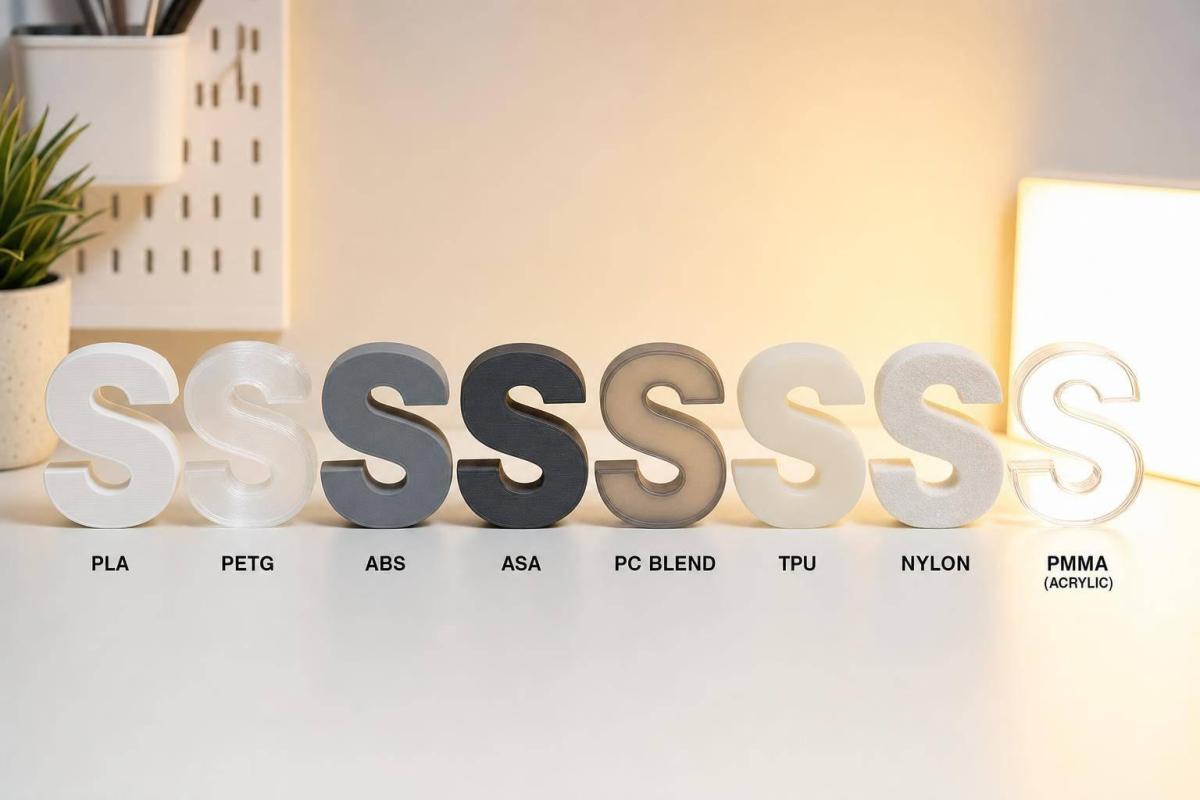
If I had to boil this down to one line, it’s this: pick the material based on sun, heat, light, and stress – not just price or print ease. A sign that looks fine indoors can fail fast outside, especially when surface temperatures hit 120–140°F in summer and UV exposure stays high.
Here’s the short answer:
- PLA works best for indoor, short-term signs
- PETG is a good step up for tougher indoor use and light outdoor exposure
- ABS fits indoor structural parts that may see heat
- ASA is the top choice for permanent outdoor signs
- PC/PETG blends suit lit signs that need more heat resistance and impact strength
- TPU and Nylon are best for support parts, not display faces
- Acrylic/PMMA hybrids are the go-to for premium backlit faces, with about 92% light transmission and outdoor life often around 7–12 years for cast grades
A few numbers tell the story fast:
- PLA softens around 131–149°F
- Clear PETG can transmit about 85–90% of light
- ASA holds up far better in UV than ABS
- TPU can stretch about 200–700% before breaking
- PMMA gives the cleanest lit face in this group
If you’re choosing between materials, the main tradeoffs are simple:
PLA = easiest and lowest cost
PETG = middle ground
ASA = outdoor-first
PMMA = best-looking lit face
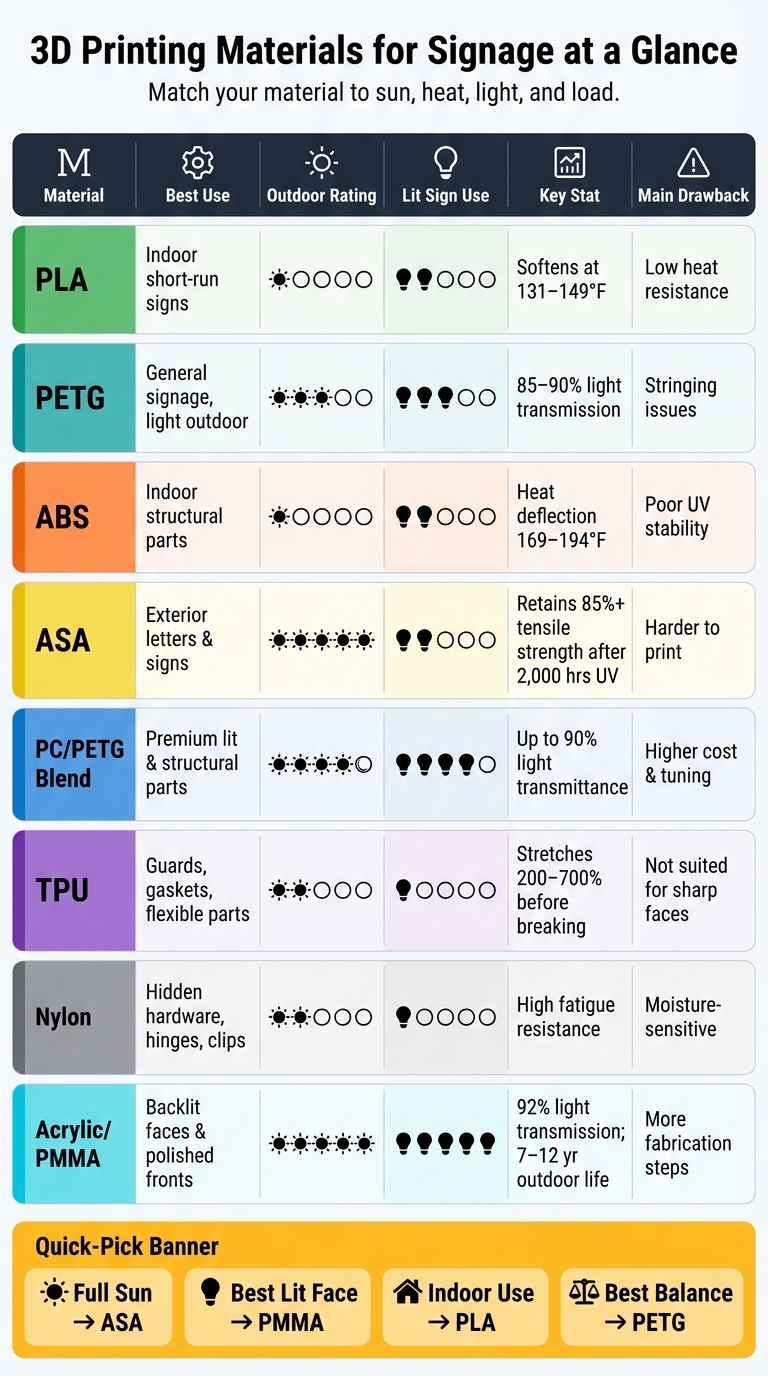
3D Printing Materials for Signage: Side-by-Side Comparison Guide
Quick Comparison
| Material | Best Use | Outdoor Use | Lit Sign Use | Main Drawback |
|---|---|---|---|---|
| PLA | Indoor short-run signs | Poor | Limited | Softens in heat |
| PETG | General signage, light outdoor use | Fair to good | Good | Can string while printing |
| ABS | Indoor structural parts | Poor without coating | Mostly structural only | UV damage outdoors |
| ASA | Exterior letters and signs | Very good | Limited for faces | Harder to print |
| PC/PETG Blend | Premium lit and structural parts | Good with UV care | Good | Higher cost, more tuning |
| TPU | Guards, gaskets, flexible parts | Grade-dependent | Limited | Not suited for sharp faces |
| Nylon | Hidden hardware, hinges, clips | Limited | Poor | Moisture-sensitive |
| Acrylic/PMMA Hybrid | Backlit faces and polished sign fronts | Very good | Best | More fabrication steps |
So if I were making a fast call: use ASA for sun, PETG for general use, PMMA for face quality, and PLA only when the sign stays indoors.
1. PLA
PLA (polylactic acid) is one of the most common filaments in FDM 3D printing. It prints at fairly low nozzle temperatures, usually around 190–210 °C (374–410 °F), with less warping than ABS. In many cases, you can print it with little or no heated bed at all. For short-run indoor signage, that makes PLA a quick, low-hassle choice.
Outdoor Durability
PLA is an indoor-first material. Its glass transition temperature sits around 55–65 °C (131–149 °F), which means it can start to soften if it sits on a sunlit surface during a hot day. Outside, UV exposure can fade the material, and direct sun plus rain can make it brittle within a few months. In plain terms, PLA works well in controlled indoor spaces, but it’s a poor match for signs that have to live in the weather.
Printability
If PLA has a main selling point, it’s how easy it is to print. It works on basic machines, holds small details well, and is easy to sand, prime, and paint. That matters when you want clean lettering, crisp edges, or a polished finish without a lot of fuss. For better durability, use thicker walls and filleted mounting holes to help cut down on cracking.
Optical Performance
PLA comes in a wide range of colors, so it’s a solid pick for opaque, solid-color signs. But it’s usually not the best option for backlit panels or light-diffusing parts. In those cases, optical clarity and heat tolerance matter more, and PLA tends to fall short.
Best-Fit Applications
PLA fits jobs like indoor nameplates, retail shelf labels, point-of-sale signs, trade-show graphics, classroom signage, prototype signage, and temporary promotional displays. It makes the most sense for short-life indoor graphics where fine detail matters more than weather resistance. If you need an indoor sign with more toughness, or something that may face a bit of outdoor exposure, PETG is the next step up.
2. PETG
PETG (polyethylene terephthalate glycol) sits in a nice middle spot for signage. It’s easy to print, takes hits well, and stays clear enough for many lit sign jobs.
Outdoor Durability
PETG handles outdoor use better than PLA, but standard grades still need some help in the sun. Standard PETG has moderate UV resistance, yet long exposure can still lead to yellowing, haze, and embrittlement.
UV-stabilized PETG does much better in accelerated weathering tests. If you’re using standard PETG, it’s smarter to place it in covered areas or add a UV clear coat. That’s why PETG makes sense when you need a material that prints easily but can also deal with some outdoor use.
Printability
PETG usually prints at 230–250 °C with a 70–85 °C bed, and it bonds well while keeping warp low. In plain English: it’s far less fussy than some other outdoor-capable plastics.
The main headache is stringing. You can cut that down with:
- dry filament
- tuned retraction
- a slightly lower print temperature
Bed adhesion is strong, sometimes too strong, so parts can stick harder than you want. Controlled bed prep or a release agent helps avoid that problem.
Optical Performance
Clear PETG offers 85–90% light transmission, which is enough for backlit logos, LED diffusers, and illuminated inserts. That makes it a solid pick when you want light to pass through without jumping to a more brittle material.
Its big selling point is impact toughness. That matters for signs that get handled, shipped, installed, or bumped in high-traffic areas. You can also tweak wall thickness and infill to change how the light spreads and cut down LED hotspots. So PETG can work for both illuminated faces and sign parts that need to take some abuse.
Best-Fit Applications
PETG works well for:
- outdoor dimensional letters
- wayfinding signs
- backlit logo elements
- retail display parts
- mounting brackets
- standoffs
It’s also a good fit for short-run custom signage when toughness and easy printing matter most. For full sun or hotter conditions, ASA is the next material to look at.
3. ABS
ABS sits in the middle ground between PETG and ASA. It’s tougher than PETG, but it doesn’t do well in full sun. ABS (acrylonitrile butadiene styrene) is a step up from PLA when you need indoor sign parts that can take bumps, heat, and day-to-day handling. It’s a tough thermoplastic with a typical tensile strength of 40–50 MPa and strong impact resistance, which makes it a solid fit for indoor sign work that sees wear.
Outdoor Durability
This is where ABS starts to struggle. Standard ABS has poor UV resistance. After a few months in direct sunlight, it can yellow, chalk, and turn brittle. If you need to use it outside, add a UV-resistant paint or clear coat to slow that damage. Even then, ABS works better in shaded or partly protected spots.
Heat, though, is one of its strong points. Its heat deflection temperature usually falls between 76–90 °C (169–194 °F), and its glass transition temperature is around 100–108 °C. In plain English: ABS handles hot summer days and areas near lighting fixtures better than PLA.
Printability
ABS asks more from your printer than PLA or PETG. You’ll usually need:
- A heated bed
- An enclosure
- Low cooling to help cut warping
It also gives off styrene fumes, so ventilation or filtration matters.
Optical Performance
Standard ABS is opaque, so it’s not the right pick for backlit faces or light-diffusing panels. It blocks light well, which is useful for the body or back wall of channel letters when you want to contain LED light and stop light bleed.
For illuminated signs, ABS usually handles the structural side, while a clear or translucent material like acrylic (PMMA) or PETG handles the face. You can also paint the inside of ABS housings white or line them with reflective film to get more from the light output.
That makes ABS a structural material, not a face material, for illuminated signs.
Best-Fit Applications
ABS works best in indoor signage like dimensional lobby logos, trade show displays, retail fixtures, and equipment nameplates. It’s also a strong choice for mounting brackets, back boxes, and internal frames in both indoor and outdoor signs, as long as the material stays out of direct sun.
One reason people keep coming back to ABS in finish-heavy projects is simple: it sands well, solvent welds well, and takes paint well. It also finishes more smoothly than PETG. If the sign face will sit in full sun, ASA is the better move.
4. ASA
When ABS is almost right but direct sun is the dealbreaker, ASA usually makes more sense. You can think of it as ABS’s outdoor cousin: similar in many ways, but built to handle UV exposure and weather much better.
Outdoor Durability
ASA is made to resist yellowing, chalking, embrittlement, and loss of impact strength during long stretches of sun and weather exposure. For exterior signs, that matters a lot. A sign can look good on day one, but if it fades, turns brittle, or starts looking worn after a season outside, that’s a problem.
That’s why ASA works well for exterior signs that need to stay readable and presentable through sun, rain, and seasonal temperature swings.
Printability
ASA prints a lot like ABS. You’ll want a heated bed, higher nozzle temperatures, and an enclosure. Good ventilation still matters, and cooling needs to stay under control.
For large sign panels or long sets of letters, a stable print setup becomes even more important. If the print area temperature bounces around too much, warping and layer issues can show up fast.
Optical Performance
ASA usually has a matte-to-satin finish, which helps cut glare and works well for bold outdoor lettering. That can make signs easier to read in bright light.
If you want a more polished look, sanding, priming, and painting can give ASA a cleaner, more professional finish. And because ASA handles UV exposure well, those finishes tend to last longer outdoors.
Best-Fit Applications
ASA is a strong fit for:
- outdoor nameplates
- storefront letters
- building identification signs
- wayfinding markers
- house numbers
- branded exterior plaques
It also works well for mounting brackets and other sign parts that sit in direct sun. If outdoor life matters more than easy printing, ASA is usually the better pick.
5. PC/PETG Signage Blends
PC/PETG blends sit in the middle ground between easy-print PETG and higher-heat polycarbonate. If standard PETG gets you close but not quite there, this blend gives you more heat resistance and better clarity. You’re getting polycarbonate’s strength and heat handling, mixed with PETG’s toughness, chemical resistance, weather resistance, and transparency. The result is a material that holds up well without being as fussy to print as straight PC.
Outdoor Durability
PC/PETG blends handle heat better than standard PETG. They also offer moisture resistance and chemical stability, which helps limit swelling and surface wear in humid or urban settings. Mechanical testing shows these alloys can reach tensile strength close to pure PC, while also posting better elongation at break and impact resistance. In plain English: they’re less likely to crack when stressed.
For very high-UV areas like the southwestern U.S., it makes sense to use a UV-stabilized grade or keep the sign out of direct sun when possible. Untreated PC-based materials can yellow over time.
That extra performance does come with a catch: print settings need a bit more care.
Printability
PC/PETG blends usually print at nozzle temperatures of about 230–260 °C (446–500 °F), which is hotter than standard PETG. A heated bed in the 70–90 °C (158–194 °F) range helps with adhesion. Drying the filament before printing also helps cut down on surface haze and stringing.
As the PC content goes up, the blend gets harder to extrude. So compared with standard PETG, dialing in settings takes more effort. If you want clean edges and a polished finish, it’s smart to tune retraction and cooling before you jump into a full sign batch.
Optical Performance
Clarity is where these blends stand out for signage. Research on PC/PETG alloys reports light transmittance up to 90%, which makes them a solid choice for illuminated parts. The PC portion helps the material keep its shape near heat sources like LED modules, while PETG helps the surface stay smooth and less prone to microcracking.
That mix works well for:
- Backlit lettering
- Translucent logo panels
- Protective covers over LED arrays
Compared with standard PETG, you get higher clarity along with better heat handling.
Best-Fit Applications
These blends make sense for premium signs that need clear faces, impact resistance, and a longer service life. Good fits include illuminated channel letters, exterior corporate logos, and durable wayfinding signs exposed to both foot traffic and weather.
The main downside is cost. So it’s usually best to save PC/PETG blends for premium, long-life installations.
sbb-itb-ce53437
6. TPU
Unlike the rigid materials above, TPU comes into play when flexibility matters more than stiffness. It’s the outlier in this group: soft instead of rigid, and better suited to protective or functional sign parts than main sign faces. TPU is an elastomeric thermoplastic that can stretch 200–700% before breaking, depending on the grade.
Outdoor Durability
TPU handles abrasion, impact, and repeated flexing well, which makes it a good match for sign parts that get bumped, handled, or exposed to vibration. It also resists oils, greases, and many chemicals. Many grades work reliably in a temperature range of about -40°F to 176°F (-40°C to 80°C).
One catch: UV resistance depends on the formulation. If the part will sit in full sun, check with the filament maker to make sure the grade is UV-stabilized before using it in a long-term outdoor install.
Printability
TPU prints best with a direct-drive extruder, low print speeds, short retractions, and fully dried filament. Since the material is soft, it can buckle or jam in Bowden-style systems. That’s why extruder setup is the biggest print choice here.
Optical Performance
TPU is not the first pick for crisp, glossy sign faces. Its flexible surface usually looks less sharp and less glossy than acrylic or PETG. Still, translucent TPU grades can create a frosted look that works well for flexible LED diffusers, flexible light guides, or protective overlays in backlit signs.
Best-Fit Applications
TPU works well for parts like:
- Vibration-damping mounts
- Edge guards
- Gaskets
- Strain relief
- Clips
- Soft-touch branding accents
It also pairs nicely with rigid PETG or acrylic when the assembly needs extra impact protection. In most sign builds, TPU plays a support role, not the main display surface.
7. Nylon
Nylon plays a support role in sign builds, not a face-material role. It’s an engineering filament that makes the most sense for hidden parts that carry load, flex under stress, rub against other parts, or get handled again and again.
Outdoor Durability
Outdoors, nylon holds up well from a mechanical standpoint. But it has two big weak spots: it absorbs moisture, and UV exposure can warp parts, throw off accuracy, and make unmodified nylon brittle over time. That’s why UV-stabilized PA12 is the safer pick, and even then, it’s better suited to exterior hardware with limited exposure.
For most outdoor sign projects, nylon works best behind the sign face, not on the visible surface. Think brackets, mounts, and support parts that stay out of direct view. Because nylon reacts so much to moisture, drying and enclosure control aren’t optional extras here – they’re part of the deal.
Printability
Nylon can be a pain to print. In most setups, it needs high temperatures, an enclosure, and very dry filament. Leave a spool out in open air, and print quality can start dropping within hours.
Before printing, dry nylon at 158–176°F (70–80°C) for 8–12 hours. Then store it in an airtight container with desiccant between print sessions. If your shop already runs engineering filaments, this is probably just part of the routine. If not, nylon adds extra steps, extra gear, and extra room for error.
Optical Performance
Nylon isn’t the material you pick when looks come first. Most prints come out semi-opaque with a matte or satin finish, which makes nylon a poor fit for translucent sign faces, backlit panels, or anything that depends on bright color, surface clarity, or a glossy finish.
Put simply: nylon is about strength, not looks.
Best-Fit Applications
In hybrid sign builds, nylon belongs behind the display surface. It works well for:
- Clips
- Living hinges
- Snap-fit panels
- Cable guides
- Other parts that need repeated flexing or impact resistance
Use nylon when the part needs to take abuse. Don’t use it for appearance.
8. Acrylic/PMMA Hybrid Constructions
For visible sign faces, the focus shifts. It’s less about how well a material prints and more about how good it looks once it’s on the wall. That’s where acrylic, or PMMA, comes in.
In many signage jobs, the setup is pretty simple: 3D printing handles the structure, and PMMA handles the finish. Acrylic is usually used as a pre-cut face panel or overlay, then bonded to a 3D-printed core. So while the printed part does the heavy lifting, the acrylic face is what people actually see.
Outdoor Durability
UV-stabilized PMMA generally holds up outdoors better than printed plastics. For exterior installs, use sign-grade UV-stabilized acrylic. That extra weather resistance matters when a sign has to sit in the sun day after day.
There’s one catch: acrylic moves with temperature changes. It expands and contracts, and if the panel is locked down too tightly, it can crack over time. That’s why outdoor assemblies should use slotted mounting holes or compliant tapes instead of rigid fasteners.
Printability
PMMA is usually cut, not FDM printed. In most shops, it’s shaped with a laser cutter or CNC router, then attached to the printed structure.
The printed parts – most often PETG or ABS – are built with recesses, standoffs, or slots so the acrylic inlays fit cleanly. From there, the face is bonded with a suitable acrylic adhesive or a high-bond tape, depending on the interface.
That makes the job split pretty clear:
- Acrylic/PMMA is the face material
- The 3D-printed core is the structural support
Optical Performance
Acrylic’s biggest strength is optical clarity. Clear PMMA transmits about 92% of visible light, which is noticeably better than most 3D-printed surfaces.
That difference shows up fast in lit signage. For backlit signs, opal or translucent acrylic helps spread LED hotspots into smooth, even illumination across a logo or letter face. Clear PMMA can also carry edge-lit light from embedded LEDs, which creates the glowing outline effect you see in many retail and architectural signs.
There’s also a finish benefit here. Put an acrylic face over a printed frame, and colors tend to look richer while the whole sign feels more polished.
Best-Fit Applications
Acrylic/PMMA hybrids are common in:
- Illuminated channel letters with printed bodies and acrylic faces
- Storefront identity signs
- Interior wayfinding panels
- ADA-compliant plaques
Use this hybrid approach when face quality, UV stability, and a premium finish matter more than impact resistance. That tradeoff is what the next section weighs material by material.
Performance Tradeoffs: Material by Material
Now that each material is on the table, the next step is simple: match the material to the job.
In practice, the choice usually comes down to four limits: sun, heat, light, and load. That’s where the tradeoffs show up. The big ones are outdoor life, ease of printing, and how the material handles light.
Outdoor Durability
For outdoor use, ASA and PMMA sit at the top. PETG lands in the middle. PLA, ABS, nylon, and TPU can work, but they need more shielding.
The gap between ASA and ABS is hard to ignore. ASA keeps more than 85% of its tensile strength after 2,000 hours of UV exposure, while ABS falls below 60% under the same test conditions. On a storefront sign or a building facade that gets full sun day after day, that difference matters.
Printability
If ease of printing is the main concern, PLA is the easiest starting point. PETG comes next.
After that, things get trickier. ABS, ASA, and PC blends need more control. Nylon can be finicky. TPU usually works best with a direct-drive setup. And PMMA is in a different lane altogether, since it’s usually fabricated outside standard FDM printing.
Optical Performance
For illuminated signage, PMMA is the top pick. It handles light well and is the go-to choice for clean, bright sign faces.
Translucent PETG is a solid second choice for lightly backlit parts where some diffusion is fine. Printed plastics sit lower here. ABS and ASA are mostly opaque, though they take paint well. PC/PETG blends can work as semi-transparent protective diffusers if the print settings are dialed in.
Quick-Selection Reference
Use the table below for fast material selection.
| Material | UV Resistance | Warping Risk | Enclosure Needed | Best-Fit Application |
|---|---|---|---|---|
| PLA | Poor | Very low | No | Indoor logos, short-term event signs |
| PETG | Moderate | Low | Optional | Semi-outdoor panels, functional parts, lightly backlit pieces |
| ABS | Poor | High | Yes | Indoor structural parts, heat-exposed housings (coated) |
| ASA | Excellent | Medium | Yes | Outdoor building signs, permanent exterior lettering |
| PC/PETG Blend | Variable (formulation-dependent) | Medium–High | Yes | Structural brackets, protective covers, thermal-cycling parts |
| TPU | Limited | Low | No | Flexible bumpers, impact guards, gaskets |
| Nylon | Limited | High | Yes | Internal mechanical parts, fastener interfaces |
| Acrylic/PMMA | Excellent | N/A (not FDM) | N/A | Backlit channel letter faces, illuminated cabinet signs |
Pros and Cons of Each Material
Here’s the fast version: each material has one clear upside, one tradeoff, and one job it fits best.
- PLA – The cheapest option and the easiest to print. The downside is heat: it softens around 140°F (60°C) and tends to break down fast outdoors. Best for indoor logos and event signs.
- PETG – A solid middle ground between toughness and print ease. Its main drawback is that it often needs more tuning to control stringing. Best for general indoor use and light outdoor panels.
- ABS – Strong for indoor parts and handles heat well. The catch is weak UV resistance, which can lead to yellowing and cracking outside. Best for indoor structural parts.
- ASA – This is where ABS comes up short. ASA has strong UV and weather resistance, but it asks more from your print setup. Best for permanent exterior lettering.
- PC/PETG Blend – Built for strength, especially in load-bearing or heat-stressed parts. The tradeoff is tougher printing and more work during finishing. Best for brackets and protective housings.
- TPU – Flexible, shock-absorbing, and good where you don’t want scuffs or hard contact. But it’s not a good pick for sharp, clean lettering. Best for edge guards, clips, and non-marring feet.
- Nylon – Strong and fatigue-resistant, which makes it useful for hidden hardware that takes stress over time. The issue is moisture sensitivity and a more technical print process. Best for hinges, wall-mount brackets, and high-load hardware. Both TPU and Nylon are support materials, not display faces.
- Acrylic/PMMA – Offers the highest light transmission at roughly 92–93% and a proven outdoor lifespan of 7–12 years for cast grades. The tradeoff is added fabrication steps and higher cost. Best for backlit channel letters and illuminated cabinet faces.
Use this recap when you need to make a quick material call.
| Material | Key Strengths | Main Limitations | Ideal Use Cases |
|---|---|---|---|
| PLA | Easy to print; low cost; sharp detail | Low heat resistance; weak outdoor durability | Indoor logos, prototypes, event signs |
| PETG | Tough; moderate heat and moisture resistance; good adhesion | Stringing; slightly higher cost | Indoor signage, covered entrances, light outdoor panels |
| ABS | Heat-resistant; smoothable finish | Warps easily; poor UV stability | Indoor structural parts, illuminated cabinet internals |
| ASA | Excellent UV and weather resistance; color-stable | More demanding print setup | Permanent outdoor letters, building signs |
| PC/PETG Blend | High impact strength; strong structural performance | Higher print temperatures; more difficult to finish | Load-bearing brackets, protective housings |
| TPU | Flexible; shock-absorbing; wear-resistant | Not ideal for crisp lettering | Edge guards, flexible clips, non-marring feet |
| Nylon | Strong; fatigue-resistant; durable hardware | Moisture-sensitive; technically demanding | Hinges, wall-mount brackets, high-load hardware |
| Acrylic/PMMA | High light transmission; premium appearance; long outdoor life | More complex fabrication; brittle under heavy impact | Backlit channel letters, illuminated cabinet faces |
Conclusion
No single material works for every sign. The right pick depends on where the sign will live, how it will be lit, how long it needs to last, and what you want to spend.
In most cases, the choice comes down to four things: sun, heat, light, and load.
- PLA – indoor, short-term
- PETG – covered or light outdoor use
- ASA – permanent outdoor use
- PC/PETG – illuminated signs that need strength and clarity
- TPU/Nylon – mounts, clips, and hinges
- PMMA – premium illuminated faces
For mixed-use or illuminated builds, Miro Printing & Graphics Inc. can help with design, printing, and finishing.
Start by matching the material to the sign’s conditions. Then look at cost and how easy it is to print.
FAQs
Which material lasts longest outdoors?
For long-term outdoor signage, cast vinyl and metal are two of the toughest options.
Cast vinyl usually lasts 7 to 10 years outdoors. Some premium grades can last up to 12 years.
Metal substrates, including aluminum, also hold up very well. They offer strong fade resistance and rust-proof durability.
Pair either material with UV-cured or hard solvent inks, and both can perform very well in harsh weather.
What should I use for a backlit sign face?
For a backlit sign face, glossy vinyl is a smart pick because it shows well and works nicely with internal lighting.
Miro Printing & Graphics Inc. can help you choose the best substrate for your project by weighing durability, finish, and site conditions.
When is PETG better than PLA?
PETG is a better pick than PLA when outdoor signage needs to last. PLA works fine for basic printing, but recycled PETG is often the better choice for indoor and outdoor displays because it handles weather much better.
When a sign has to keep performing over time in sun, wind, and rain, PETG offers the kind of durability many standard plastics just don’t have.
Related Blog Posts
- How to Choose Cost-Effective Printing Materials
- Substrate Selection for Digital Printing
- Top 5 Substrates for Multi-Climate Printing
- How to Choose Substrates for Large Format Printing
https://app.seobotai.com/banner/banner.js?id=6a7919e4d642d19a97928326

